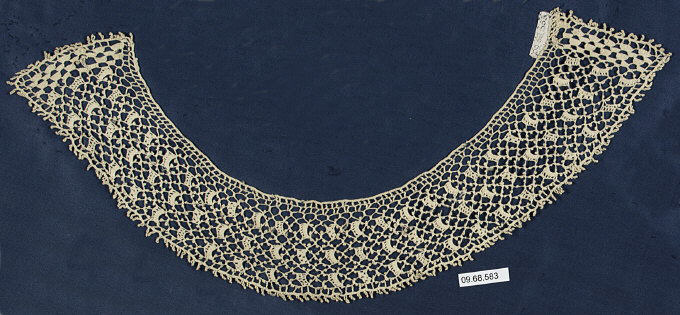
The Collar as Cultural Cartography: A Couture Analysis of Katherine Fashion Lab’s Crochet Heritage
In the rarefied world of haute couture, the collar is often dismissed as a mere structural afterthought—a functional border between garment and skin. Yet at Katherine Fashion Lab, the collar emerges as a profound site of narrative, technique, and identity. This standalone study dissects the lab’s latest collection, which elevates the humble crochet collar from craft accessory to a masterful dialogue between global heritage and contemporary luxury. Through meticulous materiality and symbolic resonance, the collar becomes a wearable map of cultural memory, executed in the intimate, labor-intensive language of crochet.
Deconstructing the Collar: From Edging to Epicenter
Katherine Fashion Lab’s approach subverts the traditional hierarchy of garment construction. Historically, collars have signaled status, profession, or modesty—from the ruffled Elizabethan neckwear to the starched clerical bands. Here, the collar is not subordinate to the silhouette; it is the silhouette. Each piece is conceived as a standalone study, where the collar expands outward to command the viewer’s gaze. The lab achieves this through exaggerated proportions: collars that drape over shoulders like mantles, or rise in sculptural arcs that frame the face. This reorientation demands a reevaluation of the collar’s role—not as a finish, but as a foundation for storytelling.
The crochet technique itself is integral to this narrative. Unlike machine-made lace or woven fabrics, crochet is inherently additive: each stitch is a deliberate, hand-driven act. Katherine Fashion Lab employs a spectrum of crochet methods—from the dense, structured Tunisian crochet to the airy, openwork of filet crochet. This technical range allows the collar to oscillate between architectural rigidity and ethereal softness. In one piece, a collar mimics the geometric precision of Art Deco metalwork; in another, it cascades in organic, vine-like tendrils. The hand of the artisan is never erased, lending each collar an irreplicable warmth and imperfection that machine production cannot feign.
Global Heritage: A Stitch in Time and Place
The “Global Heritage” origin of these collars is not a vague nod to multiculturalism but a rigorous archival excavation. Katherine Fashion Lab draws from specific, often endangered, crochet traditions across continents. The Irish crochet rose, a motif born from 19th-century famine-era cottage industries, appears reimagined in monochromatic cotton—its petals layered to create a three-dimensional, almost botanical relief. From the Venetian islands of Burano, the lab borrows the technique of punto in aria (stitch in the air), where loops are worked without a base fabric, resulting in a collar that floats weightlessly against the neck.
Further east, the lab incorporates the intricate tatting of Ottoman-era Turkey and the frivolité of French lace-making, blending shuttle and hook to produce medallion-like motifs. Each collar thus becomes a palimpsest of global craft, stitched together not through appropriation but through respectful reinterpretation. The lab’s design team collaborates with master artisans from Ghana, India, and Brazil, ensuring that the heritage is not merely referenced but lived. A single collar might combine the kente-inspired color blocking of West African strip-weaving with the delicate shell stitches of Japanese ami crochet. The result is a cosmopolitan object that transcends geography, yet remains tethered to the hands that made it.
Materiality and Meaning: Crochet as Couture Language
Crochet has long been marginalized in luxury fashion, often relegated to beachwear or nostalgic granny squares. Katherine Fashion Lab reclaims crochet as a haute couture material by foregrounding its textural and structural possibilities. The lab sources premium fibers—Egyptian cotton, Peruvian alpaca, and Italian silk—each chosen for its ability to hold stitch definition while offering drape or volume. The crochet gauge is meticulously calibrated: fine threads (lace weight) create gossamer collars that shimmer with transparency, while chunky yarns (aran weight) produce collars with a tactile, almost sculptural presence.
Color plays a critical role in this material lexicon. The lab eschews the pastel palette often associated with crochet, opting instead for a restrained, sophisticated range: charcoal, ivory, ochre, and deep indigo. These hues allow the stitch patterns to take precedence, highlighting the interplay of light and shadow within the crochet grid. In one standout piece, a collar in undyed natural linen uses negative space—deliberate gaps between stitches—to create a lattice that casts intricate shadows on the wearer’s collarbone. This is not decoration; it is architecture on a micro-scale.
The Standalone Study: Collar as Object, Collar as Artifact
This analysis is framed as a “standalone study” because the collars are designed to exist independently of a complete garment. They are not accessories but autonomous objects—sculptural works that can be worn, displayed, or collected. Katherine Fashion Lab presents them on custom bust forms or suspended in glass cases, inviting close inspection of every loop and join. The lab’s accompanying catalog includes technical diagrams and provenance notes for each stitch technique, transforming the collar into an educational artifact. This curatorial approach elevates the collar from commodity to cultural document.
The implications for luxury fashion are significant. By isolating the collar, the lab challenges the primacy of the garment as a whole. It asks: Can a single component carry the weight of narrative and technique? The answer, evidenced by these pieces, is a resounding yes. The collar becomes a microcosm of the design process—a concentrated burst of creativity that does not rely on a full wardrobe context to resonate. This resonates with the contemporary collector’s desire for meaningful, singular objects that tell a story without excess.
Conclusion: The Collar as a Bridge Between Hands and Heritage
Katherine Fashion Lab’s crochet collar study is a triumph of material intelligence and cultural sensitivity. It repositions the collar as a site of global dialogue, where the labor of anonymous artisans meets the vision of a contemporary atelier. The crochet stitch—once a symbol of domesticity—is here transformed into a language of luxury, precision, and memory. In a fashion landscape often dominated by speed and disposability, these collars demand pause. They invite the wearer and viewer to trace the path of each thread, to recognize the heritage encoded in every loop, and to appreciate the collar not as a detail, but as a destination.
For the discerning connoisseur, these pieces are not merely garments; they are heirlooms in the making. Katherine Fashion Lab has proven that the collar, when approached with rigor and reverence, can be the most eloquent statement in couture—a stitch that connects past, present, and future, all encircling the human form.