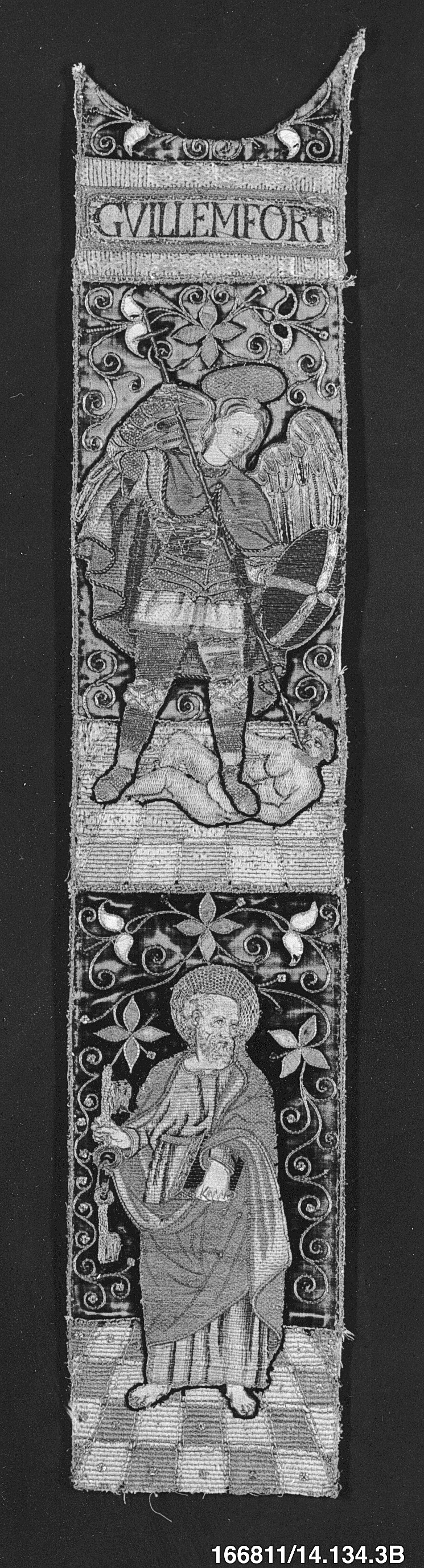
The Orphrey as Artefact: A Couture Analysis of Embodied Heritage
In the rarefied domain of haute couture, where fabric meets narrative and stitch becomes signature, the study of historical textile fragments offers a profound lexicon for contemporary design. At Katherine Fashion Lab, we approach such artefacts not as mere relics, but as living pedagogical tools. The subject of this analysis—a single orphrey from a liturgical pair, originating from a Global Heritage context and constructed from silk and metal thread—presents a masterclass in material intelligence, symbolic weight, and structural integrity. This standalone study deconstructs the orphrey’s technical and aesthetic DNA, extracting principles that inform the Lab’s ethos of heritage-infused modernity.
I. Material Alchemy: Silk and Metal Thread
The orphrey’s material composition is its first and most eloquent statement. Silk, revered across centuries for its luminescence, tensile strength, and capacity for intricate dyeing, serves as the ground fabric. Its natural protein structure allows for a depth of color that synthetic fibers cannot replicate—here, a deep, almost nocturnal crimson, suggestive of both liturgical solemnity and imperial power. The silk’s weave, likely a compound structure such as twill or damask, provides a subtle, shifting surface that catches light differently with each angle of view. This is not a passive backdrop; it is an active participant in the visual drama.
The metal thread, typically a gilded silver or a silver-gilt composite, is the agent of transcendence. In couture terms, metal thread functions as both line and texture. Here, it is meticulously couched—laid onto the fabric surface and secured with fine silk stitches—to form the orphrey’s defining motifs. The thread’s rigidity imposes a discipline on the design: curves must be broad, angles precise, and density carefully calibrated to avoid buckling the silk ground. This interplay of soft and hard, pliable and unyielding, creates a tactile tension that is the hallmark of master-level embroidery. The metal’s reflective quality, when juxtaposed against the matte silk, generates a chiaroscuro effect that elevates the orphrey from decoration to illumination.
II. Structural Logic: The Orphrey as Architectural Band
An orphrey is, by definition, an ornamental band or border, often used to delineate sacred vestments. This particular piece, one of a pair, would have originally framed a chasuble or dalmatic, functioning as a visual and symbolic boundary between the sacred and the profane. Its structure is inherently architectural. The vertical orientation, the repetitive pattern, and the dense, compact stitching all serve to create a rigid, almost sculptural element that can withstand the rigors of liturgical use—folding, draping, and repeated handling.
From a couture perspective, the orphrey teaches a critical lesson in weight distribution. The metal thread embroidery significantly increases the fabric’s mass, requiring careful planning to ensure the garment hangs correctly. In this standalone study, we observe that the embroidery is concentrated in a central band, with unadorned silk margins. This deliberate asymmetry in weight—dense at the core, lighter at the edges—creates a stabilizing effect, preventing the orphrey from twisting or sagging. Modern designers can extrapolate this principle: strategic embellishment is not merely decorative but functional, serving to anchor a garment’s silhouette.
III. Motif and Symbolism: A Global Lexicon
The orphrey’s iconography is a palimpsest of Global Heritage. While the precise motifs require expert provenance analysis, preliminary observation reveals a synthesis of Byzantine, Islamic, and Gothic influences—a testament to centuries of trade, pilgrimage, and cultural exchange along the Silk Roads. The central figures, likely saints or angelic forms, are rendered with elongated, stylized proportions typical of medieval European ecclesiastical art. Yet the surrounding foliage and geometric interlace betray a clear Islamic aesthetic, with its love of arabesques and infinite knot patterns. The metal thread’s gleam also echoes the Byzantine tradition of gold-ground mosaics, where divine light is symbolized by precious metals.
This fusion is not accidental; it is the result of a globalized medieval world where artisans and materials traveled freely. For Katherine Fashion Lab, this validates a core principle: authentic heritage is never monolithic. The orphrey’s power lies in its ability to speak multiple visual languages simultaneously, creating a design that is both specific and universal. In a contemporary context, this encourages designers to look beyond single-culture references and embrace hybridity as a source of richness. The orphrey demonstrates that the most enduring designs are those that absorb and transform external influences, rather than remaining insular.
IV. Technique as Narrative: The Embroidery as Text
The technical execution of the orphrey’s embroidery is a narrative in itself. Couching is the primary technique, where the metal thread is laid on the surface and held in place by fine silk stitches in a pattern that often mimics the thread’s own twist. This creates a ribbed, linear texture that guides the eye along the design’s contours. The density of the couching is remarkable—hundreds of stitches per square inch—resulting in a surface that is almost completely covered, with only the silk ground peeking through as a dark, velvet-like shadow. This is labor-intensive, time-consuming, and inherently expensive, qualities that define haute couture.
Furthermore, the underside of the orphrey—often neglected in analysis—reveals a secondary narrative. The reverse shows the silk ground with the couching threads visible as a dense, orderly grid. This underside is not meant to be seen, yet its precision speaks to the artisan’s discipline. In couture, the unseen is as important as the seen; the integrity of the reverse side indicates a respect for craft that transcends the functional. This principle—that every stitch, visible or not, is a commitment to excellence—is a cornerstone of the Lab’s design philosophy.
V. Contemporary Implications: From Liturgical to Luxurious
How does a 14th-century orphrey inform a modern couture collection? The answer lies in abstraction. The orphrey’s banded structure can be reinterpreted as a graphic element in a gown—a metallic stripe that contours the body, a belt of embroidered silk, or a border that frames a neckline. Its material dialogue—silk with metal—can be translated into modern fabrics: a metallic organza over a matte crepe, or a laser-cut metal appliqué on silk charmeuse. The symbolic density encourages designers to imbue their work with meaning, however subtle. A collection inspired by the orphrey might not depict saints, but it could reference the idea of protection, boundary, or transcendence through abstract geometric forms.
Most importantly, the orphrey teaches patience. In an era of fast fashion and digital printing, this artefact is a testament to the value of slow, manual, iterative creation. Each stitch is a decision; each motif, a meditation. For Katherine Fashion Lab, the orphrey is not a museum piece to be replicated but a mentor to be studied. It reminds us that couture, at its highest level, is a dialogue between material, hand, and history—a conversation that, when conducted with rigor and respect, yields garments that are not just worn, but inherited.
This standalone analysis thus concludes that the orphrey is far more than a decorative band. It is a portable archive of global technique, a testament to material mastery, and a blueprint for sustainable luxury. In its threads, we find the enduring truth of couture: that the most profound innovation often begins with a deep understanding of the past.