From Utility to Art: The Petit Coffre à Bijoux as a Manifesto of 18th-Century Global Craft
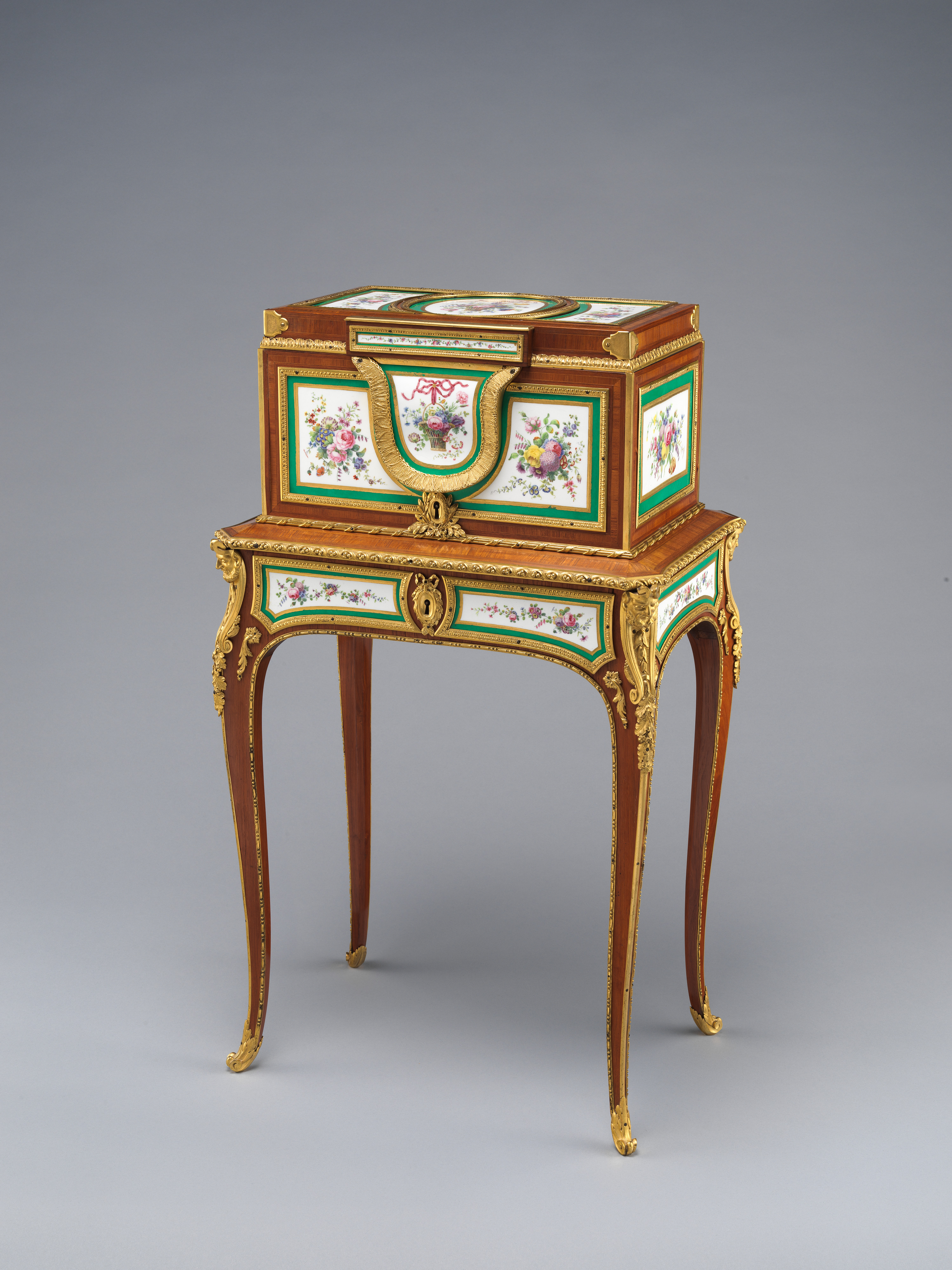
The petit coffre à bijoux—or jewel coffer on stand—stands as a singular testament to the intricate dialogue between material mastery, global trade, and aristocratic identity in the mid-18th century. Katherine Fashion Lab’s analysis of this object, drawn from a study of Global Heritage, reveals a work that transcends mere function. Constructed from oak veneered with tulipwood, sycamore, holly, and ebonized holly, and adorned with thirteen soft-paste porcelain plaques, gilt-bronze mounts, and velvet (the latter a later replacement), this coffer is not a passive container. It is a strategic artifact, a microcosm of the era’s complex supply chains, aesthetic hierarchies, and the performative nature of luxury. This analysis dissects the coffer’s material vocabulary, its structural logic, and its contextual significance as a standalone object of connoisseurship.
The Material Lexicon: Veneer as Narrative
The choice of wood veneers is the first critical layer of meaning. Oak, the foundational carcass, speaks to structural integrity and local availability—a pragmatic nod to European joinery traditions. Yet it is the surface that commands attention. Tulipwood, imported from Brazil via Portuguese trade routes, introduces a warm, salmon-pink hue that was highly prized in Parisian ébénisterie. Its inclusion signals not just aesthetic preference but access to the transatlantic networks that defined the period’s luxury economy. The sycamore, with its pale, almost luminous grain, offers a counterpoint of lightness, while holly and ebonized holly create stark contrasts—the former for delicate floral marquetry, the latter for dramatic geometric framing. This interplay of exotic and domestic woods is a deliberate act of visual storytelling: the coffer becomes a map of global resources, each veneer a node in a web of colonial extraction and artisanal transformation.
The use of ebonized holly is particularly telling. Unlike ebony, which was costly and difficult to source from Africa or Asia, ebonization—a chemical staining process—allowed craftsmen to simulate the prized black surface at a fraction of the expense. This substitution reveals a pragmatic sophistication: the desire for visual opulence without the logistical burden of true scarcity. It is a hallmark of the era’s marchand-mercier culture, where illusion and reality coexisted in service of an elevated aesthetic. The veneers are not merely decorative; they are a coded language of status, trade, and technical virtuosity.
Porcelain Plaques: The Triumph of Soft-Paste Innovation
Perhaps the most arresting feature is the inclusion of thirteen soft-paste porcelain plaques. In an age where hard-paste porcelain from Meissen or China was the gold standard, soft-paste represented a distinctly French achievement. Developed at Vincennes and later Sèvres, soft-paste porcelain was prized for its creamy, translucent body and its receptivity to vibrant enamel colors. Each plaque on this coffer is a miniature canvas, likely depicting pastoral scenes, floral motifs, or allegorical figures—common tropes that elevated the object from furniture to fine art.
The integration of porcelain into furniture was a radical act of cross-medium hybridization. It required close collaboration between the ébéniste (cabinetmaker) and the manufacture de porcelaine, a partnership that embodied the period’s fascination with l’art de vivre. The plaques are not inset randomly; they are positioned to guide the eye across the coffer’s surface, creating a rhythm of color and texture. The gilt-bronze mounts—or bronze doré—serve as the connective tissue, framing each plaque with ornate scrollwork, acanthus leaves, and rocaille motifs. These mounts are not merely functional; they are sculptural elements that amplify the coffer’s three-dimensional presence, casting shadows and catching light in a dance of opulence.
Structural Logic: The Stand as Stage
The coffer’s design as a standalone study object—elevated on a custom stand—is a critical choice. Unlike a chest or cabinet intended for a bedroom or salon, the petit coffre à bijoux was designed for intimate display. Its scale invites close examination, rewarding the viewer with details that would be lost from a distance. The stand itself, likely crafted from the same veneers and mounts, lifts the coffer to eye level, transforming it into a pedestal for precious contents. This verticality is a deliberate departure from the horizontal plane of typical furniture; it commands attention and suggests that the coffer’s primary function is not storage but spectacle.
The velvet interior, though a later replacement, is worth noting. Original velvet would have been a deep crimson or blue, providing a rich backdrop for jewels or miniatures. The replacement material, while historically inaccurate, underscores the object’s continued life as a collector’s piece. It also highlights a tension in conservation: the desire to preserve original intent versus the reality of material decay. For the modern curator, this coffer is both a document of its time and a living artifact, its surfaces altered by centuries of handling, restoration, and reinterpretation.
Contextual Significance: The Global Heritage Lens
Viewing this coffer through the lens of Global Heritage requires us to move beyond Eurocentric narratives. The tulipwood from Brazil, the porcelain techniques influenced by Chinese and Japanese imports, the gilt-bronze mounts cast from French molds—each element tells a story of cultural exchange, often under conditions of colonial exploitation. The coffer is not a pure product of French genius; it is a hybrid, a fusion of materials and ideas that traveled across oceans. This perspective challenges the traditional attribution of such objects to a single “master” or nation. Instead, it positions the coffer as a node in a global network of artisans, merchants, and patrons.
Moreover, the coffer’s role as a jewel coffer imbues it with gendered and social significance. In the 18th century, such objects were often given as wedding gifts or tokens of affection, their contents—rings, necklaces, cameos—serving as both personal adornment and portable wealth. The coffer itself became a symbol of the owner’s taste and social standing, a micro-architecture of intimacy and power. The thirteen porcelain plaques may have mirrored the owner’s collection of miniature portraits or souvenirs, creating a dialogue between the container and the contained.
The Coffer as a Mirror of Modern Luxury
For Katherine Fashion Lab, the petit coffre à bijoux is more than a historical curiosity; it is a case study in the principles that define enduring luxury. The coffer’s success lies in its material integrity—the refusal to compromise on quality, even when that quality is achieved through synthetic means like ebonization. Its narrative depth—the way each veneer, plaque, and mount tells a story of global exchange—elevates it from object to artifact. And its experiential design—the invitation to touch, open, and explore—creates a bond between owner and object that is both tactile and emotional.
In an era of mass production and digital distraction, this coffer reminds us that true luxury is not about abundance but about intentionality. Every material was chosen, every joint cut, every plaque painted with a specific purpose. The velvet may not be original, but the coffer’s soul remains intact: a testament to the power of craft to transcend time, geography, and function. As we study this piece, we are not merely analyzing a piece of furniture; we are decoding a philosophy of beauty that continues to resonate in the modern world of high design.