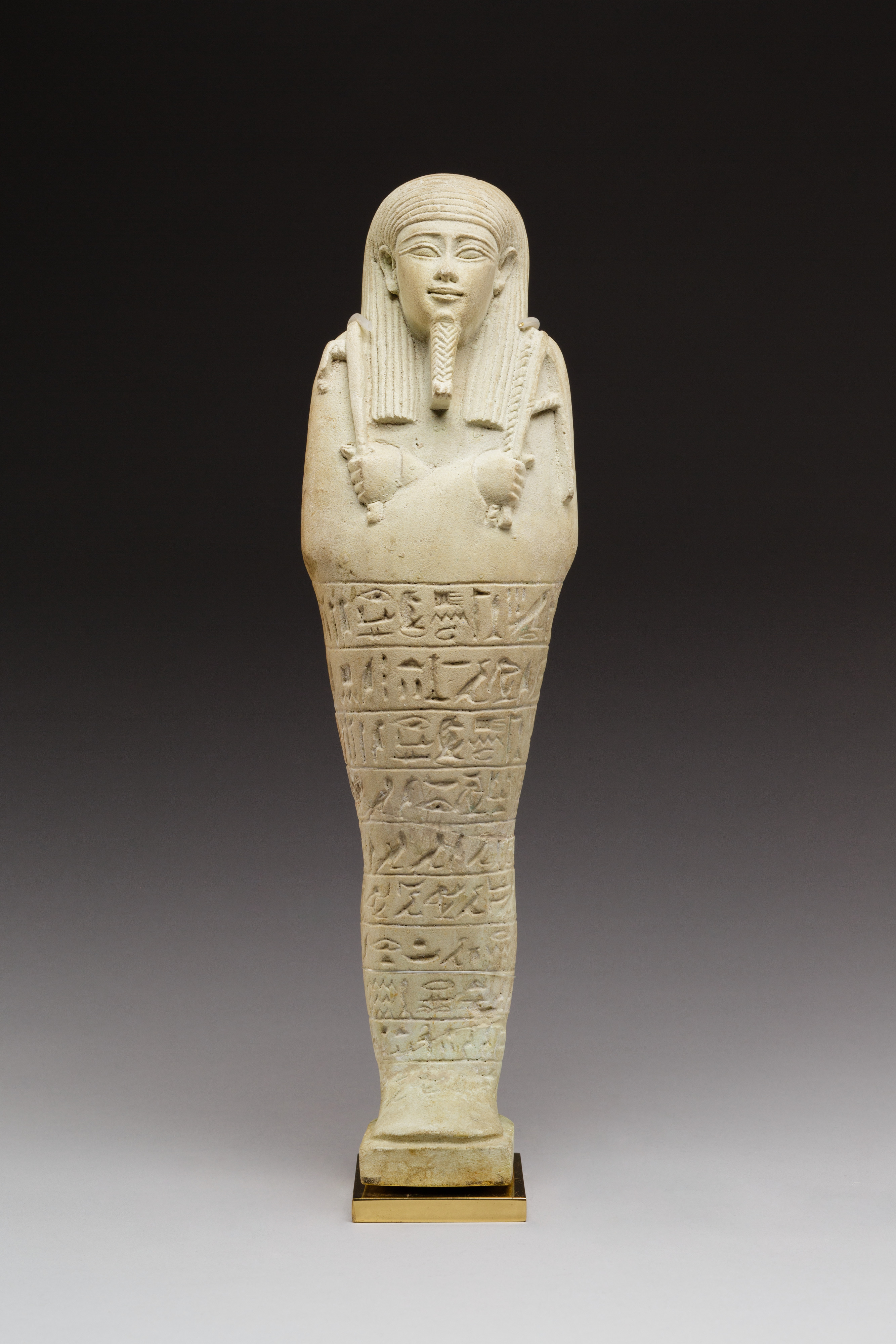
Anachronistic Artifice: Deconstructing the Faience Shabti of Djehutyirdis
In the rarefied echelons of couture, where fabric meets philosophy and adornment becomes archaeology, Katherine Fashion Lab presents a study of radical temporal dislocation. The subject is not a garment, but a funerary object: the Shabti of the High Priest of Thoth, Djehutyirdis, born of Nepthysiti. Crafted from faience—a self-glazing, quartz-based ceramic that predates glassblowing by millennia—this figurine embodies a paradox central to modern luxury: the tension between permanence and ephemerality, between the sacred and the commodified. This analysis, stripped of historical narrative, examines the shabti as a pure object of design, a silent provocateur that challenges the very grammar of contemporary fashion.
The Materiality of Light: Faience as a Proto-Luxury Medium
Faience is not merely a material; it is a technology of illusion. Its vitreous surface, shimmering with a blue-green patina achieved through copper oxide firing, mimics the luster of turquoise and lapis lazuli—stones imbued with solar and regenerative symbolism in ancient contexts. For Katherine Fashion Lab, this is the first lesson in anachronistic design: the object’s value derives not from intrinsic rarity but from the mastery of transformation. The shabti’s faience body is a frozen moment of alchemy, where sand and alkali become a synthetic gem. In couture terms, this mirrors the labor-intensive manipulation of textiles—the pleating of silk, the beading of sequins, the laser-cutting of leather—that elevates raw materials into wearable art.
The shabti’s surface, smooth and unyielding, offers a tactile rebuke to the softness of fabric. Yet its sheen, when captured under gallery light, behaves like a liquid mirror—a quality that designers might translate into liquid metallic finishes or resin-coated organza. The faience finish is a precursor to the high-gloss laminates and patent leathers of contemporary runways, but with a crucial difference: it is fired, not applied. This permanence challenges fashion’s inherent obsolescence, suggesting that couture objects, like this shabti, might aspire to a geological timescale.
Form as Function: The Shabti’s Silhouette and the Architecture of the Body
The shabti of Djehutyirdis is a study in restrained anthropomorphism. Standing approximately 15 centimeters tall, it depicts the High Priest in a mummiform shroud, arms crossed over the chest, hands emerging to hold agricultural implements—a hoe and a basket. This is not a portrait of the individual, but a template for servitude in the afterlife, a standardized body designed for repetitive, ritual labor. The silhouette is a cylinder, a column, a sheath—forms that recur in minimalist couture from Balenciaga to Margiela. Yet here, the geometry is not a stylistic choice but a theological necessity: the shroud effaces individuality, reducing the human form to a vessel for divine duty.
For the fashion analyst, this presents a radical proposition: the shabti’s silhouette is a uniform for eternity. Its lack of articulation—no knees, no elbows, no waist—suggests a body rendered immobile by ritual, a state that high fashion often romanticizes through corsetry, structured tailoring, or exaggerated padding. The shabti’s arms, locked in a perpetual gesture of labor, prefigure the sculptural sleeves of Comme des Garçons or the rigid positioning of a tailored jacket. But unlike Western couture, which often celebrates the body’s movement, this object freezes it. The resulting tension—between the promise of action and the reality of stasis—is a fertile ground for conceptual design.
Symbolic Embellishment: The Inscription as Textile Pattern
Hieroglyphic inscriptions, incised into the faience, wrap around the shabti’s lower torso and back. This is not decoration but a contractual text: a spell from the Book of the Dead, commanding the figurine to perform agricultural work on behalf of the deceased. In couture terms, this is the ultimate brand narrative, a story etched into the object’s very surface. The hieroglyphs function like a monogram, a logo, or a jacquard weave—a repeated motif that carries semantic weight. They transform the shabti from a generic object into a specific, named entity, just as a Chanel tweed jacket’s bouclé texture or a Gucci GG print anchors the garment to a house identity.
Yet the inscriptions also challenge contemporary fashion’s obsession with visibility. The text is legible only to those trained in the script, creating a layer of exclusivity that parallels the coded language of haute couture—the hidden seams, the interior labels, the bespoke tailoring marks. The shabti’s embellishment is both public and private, a narrative that speaks to the initiated while remaining opaque to the casual observer. This duality offers a model for designers seeking to embed meaning without overt decoration: a garment might carry a hidden message, a laser-cut pattern, or a digitally woven phrase that reveals itself only upon close inspection.
The Paradox of Production: Handcraft vs. Seriality
Faience shabtis were produced in vast quantities—sometimes hundreds for a single tomb—using molds. Yet each was individually inscribed, painted, and fired, resulting in subtle variations in color, glaze thickness, and hieroglyphic alignment. This is the original “mass customization,” a proto-industrial process that nonetheless retains the aura of the handmade. For Katherine Fashion Lab, this tension mirrors the contemporary luxury sector’s struggle between artisanal craftsmanship and scalable production. The shabti is neither a unique masterpiece nor a factory reject; it occupies a liminal space, where the mold imposes uniformity and the human hand introduces imperfection.
This duality is critical for understanding the shabti’s value in a couture context. It suggests that luxury need not be defined by singularity alone. The shabti’s beauty lies in its repetition, in the way each iteration is a variation on a theme—much like a seasonal collection or a signature silhouette. The mold is the design code; the individual firing, the client’s personalization. This model offers a blueprint for sustainable luxury: objects that are reproducible yet never identical, that carry the trace of both machine and maker.
Conclusion: The Shabti as a Couture Object of the Future
The Shabti of Djehutyirdis, born of Nepthysiti, is not a relic to be preserved in a vitrine. It is a provocation to rethink the boundaries of fashion: its materials, its forms, its narratives, and its modes of production. In its faience body, we see a prehistory of synthetic luxury; in its mummiform silhouette, a critique of bodily freedom; in its hieroglyphic text, a prototype for branded storytelling; in its mold-made multiplicity, a vision of ethical scalability. Katherine Fashion Lab positions this object not as historical artifact but as a living design brief—a challenge to the industry to create objects that, like this shabti, endure beyond the season, beyond the body, beyond the self.
To wear, to hold, or to contemplate such an object is to engage with a paradox: the desire for permanence in a medium defined by change. The shabti’s true couture is not its form but its function as a vessel for meaning, a silent partner in a dialogue between the mortal and the eternal. In this, it offers the ultimate lesson for fashion: that the most profound garments are not those that cover the body, but those that transcend it.