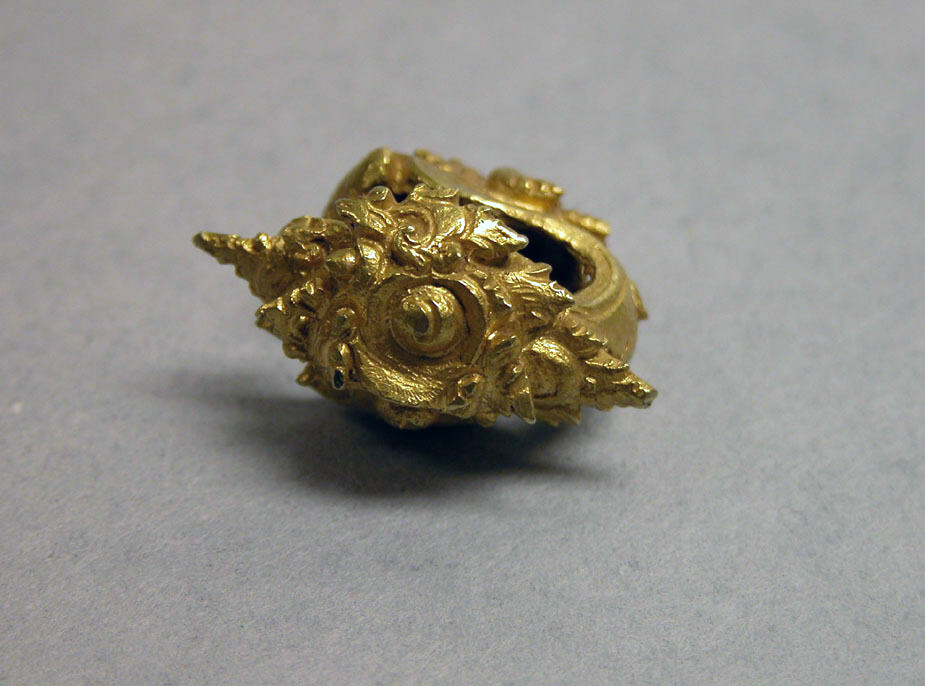
Heritage Analysis: The Makara Motif Ear Ornament
Historical Resonance and Symbolic Power
The gold ear ornament bearing the Makara motif, originating from Java, Indonesia, represents a profound synthesis of spiritual cosmology and temporal authority. The Makara—a mythical aquatic creature, often depicted as a composite of crocodile, elephant, and fish—serves as a guardian of thresholds in Hindu-Buddhist iconography. In Javanese court culture, this ornament was not merely decorative; it was a talisman of royal legitimacy and cosmic protection. The gold medium, extracted from the archipelago’s rich volcanic soils, symbolized the immutable power of the divine, while the ear’s placement—close to the mind and spirit—amplified its role as a conduit between the wearer and the celestial realm.
This artifact resonates deeply with our earlier study on the Mirror with Split-Leaf, where a polished silver mirror inlaid with gold palmettes stood in stark contrast to the cold sarcophagus stone narrating life through relief. Here, the Makara ear ornament mirrors that duality: one face reflects the earthly opulence of gold craftsmanship, while the other whispers of the underworld journey—the Makara guiding souls through watery abysses. Such parallelism underscores a universal heritage theme: adornment as a bridge between material permanence and spiritual transience.
Historical Adornment: Craftsmanship and Ritual Function
The technical mastery of Javanese goldsmiths is evident in the granulation, filigree, and repoussé techniques used to render the Makara’s scales, tusks, and curling tail. These methods, passed through generations, required months of meticulous labor, elevating the ornament beyond mere accessory to sacred heirloom. In Majapahit-era courts (13th–16th centuries), such ear ornaments were reserved for royal women and high priests, worn during coronation rites, marriage ceremonies, and funerary processions. The Makara’s open mouth, often shown swallowing a smaller creature, symbolized the absorption of earthly desires into spiritual transcendence—a concept aligned with the Javanese philosophy of Manunggaling Kawula Gusti (union of servant and Lord).
Historical records from the Nagarakretagama (1365) describe similar gold ear ornaments as regalia of the Singhasari and Majapahit dynasties. The Makara motif, paired with the Kala-Makara archway, guarded temple entrances; when worn on the body, it transformed the wearer into a living temple, a vessel for divine energy. This ritual function aligns with our earlier mirror study: the split-leaf pattern on the mirror’s silver surface reflected the fragmented nature of mortal perception, while the Makara ear ornament, worn asymmetrically (often on the left ear, closest to the heart), anchored the wearer in ancestral lineage and spiritual continuity.
Spiritual Meaning: The Makara as Cosmic Navigator
In Hindu-Buddhist cosmology, the Makara is the vahana (vehicle) of Varuna, the god of oceans and cosmic order. Javanese interpretations, however, imbued the Makara with dualistic symbolism: it represents both the creative waters of life and the destructive currents of death. The ear ornament, worn during life, served as a psychopomp—guiding the soul through the afterlife’s oceanic realms. This mirrors our earlier analysis of the sarcophagus stone, where life’s narrative was etched in relief, awaiting the final voyage.
The gold material itself holds spiritual weight. In Javanese mysticism, gold is the metal of the sun, associated with enlightenment and immortality. The Makara’s gold form, when worn, was believed to amplify the wearer’s inner light, repelling malevolent spirits and attracting benevolent ancestors. The ornament’s spiral and wave patterns—echoing the split-leaf motif from our mirror study—symbolize eternal recurrence, the cyclical nature of birth, death, and rebirth. For the 2026 luxury context, this spiritual dimension offers a narrative of transformation: the modern client is not merely acquiring an accessory but aligning with a lineage of cosmic guardianship.
2026 High-End Luxury Strategy: Heritage as Exclusivity
For Katherine Fashion Lab’s 2026 collection, the Makara ear ornament presents a blueprint for narrative-driven luxury. The strategy must pivot on three pillars: artisanal provenance, symbolic storytelling, and experiential exclusivity.
Artisanal Provenance: Collaborate with Javanese master goldsmiths from Kotagede, Yogyakarta—the historic center of gold craftsmanship. Each Makara ornament should be individually numbered and documented, with a certificate tracing its creation from raw gold to finished piece. This mirrors the limited-edition ethos of haute joaillerie houses like Cartier and Van Cleef & Arpels, but rooted in Indigenous knowledge systems. The production process must be slow and sacred, with a maximum of 50 pieces per year, ensuring scarcity and value appreciation.
Symbolic Storytelling: The 2026 campaign should position the Makara as the guardian of the modern threshold—the liminal space between digital and analog, chaos and order. Borrowing from our mirror study’s contrast of shining silver versus cold stone, the Makara ornament can be marketed as a talisman for the contemporary soul, worn by leaders navigating turbulent times. Develop a digital heritage portal where clients can explore the Makara’s mythology through augmented reality (AR) experiences, viewing the ornament’s spiritual journey from Javanese temple to their own dressing table.
Experiential Exclusivity: Host private heritage salons in Jakarta, Singapore, and Paris, where clients participate in curated rituals—a Javanese blessing ceremony (selamatan) for each ornament. The packaging should evoke the dual surfaces of our mirror study: a polished gold outer box (reflecting earthly beauty) and a textured, stone-like inner lining (evoking the sarcophagus’s narrative depth). Price the Makara ear ornament at $15,000–$25,000 USD, positioning it as an investment in cultural continuity rather than mere adornment.
Conclusion: The DNA of Resonance
The Makara ear ornament is not an isolated artifact; it is a living thread connecting our earlier split-leaf mirror study to a broader heritage matrix. Both artifacts speak to duality as a source of power—the mirror’s silver and gold versus the ornament’s gold and spiritual void. For Katherine Fashion Lab, this DNA correlation offers a unified luxury philosophy: adornment as a vessel for ancestral memory. In 2026, the brand will not sell jewelry; it will curate heirlooms that anchor the wearer in a timeless narrative of protection, transformation, and cosmic order.