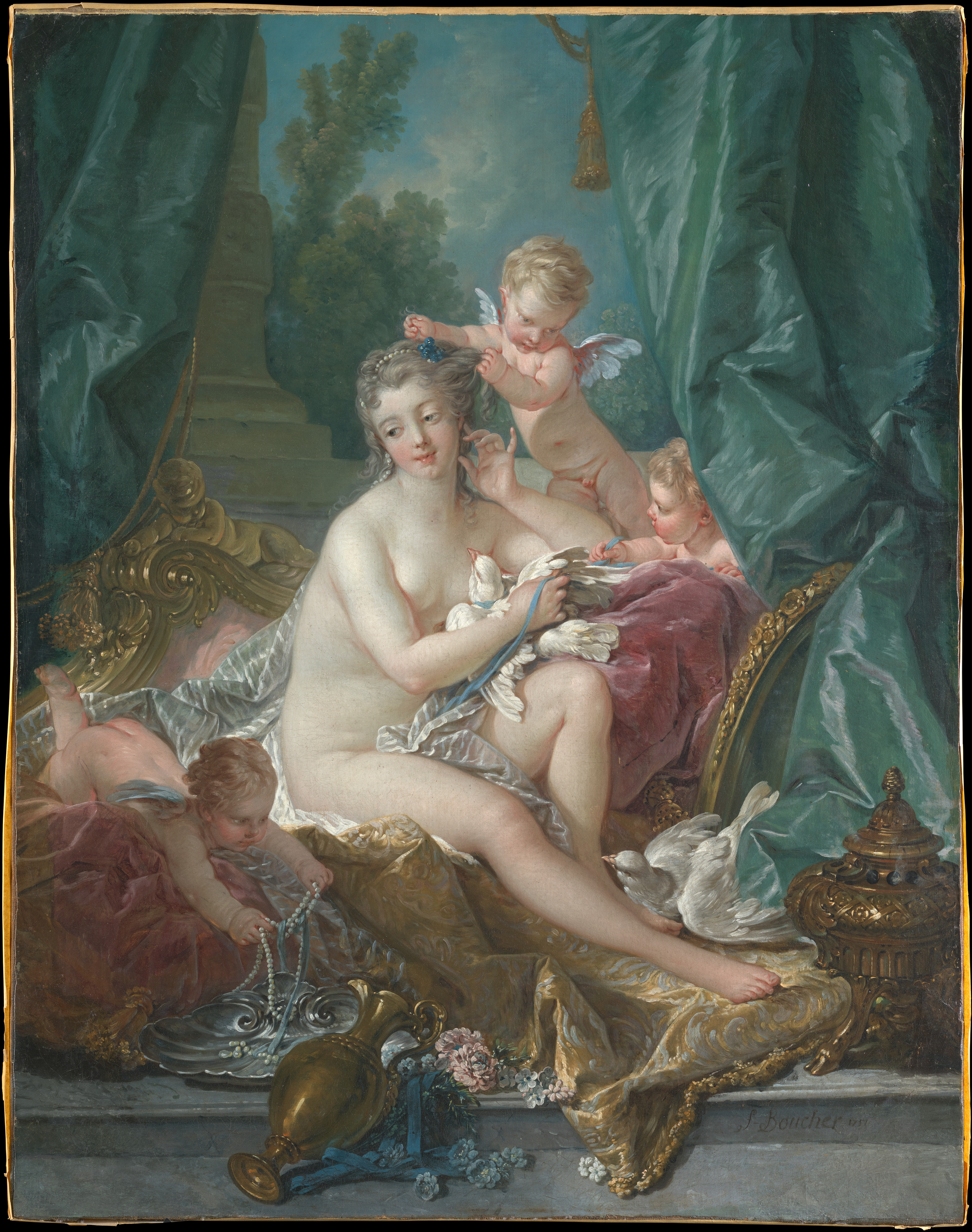
The Toilette of Venus: A Study in Couture, Power, and the Gilded Frame
In the hallowed halls of art history, few subjects have captivated the imagination quite like the toilette of Venus. The goddess of love, forever poised at her mirror, has been rendered by Titian, Velázquez, and Boucher, each interpretation a reflection of its era’s ideals of beauty, desire, and power. At Katherine Fashion Lab, we approach this iconic motif not merely as a painted scene, but as a sartorial manifesto—a standalone study that decodes the interplay between fabric, flesh, and fantasy. This analysis, drawn from our Global Heritage collection, examines a singular oil-on-canvas work that reimagines Venus’s toilette as a couture narrative, where every brushstroke is a stitch and every shadow a drape.
The Canvas as a Couture Atelier
The painting before us is not a passive reproduction of myth; it is an active construction of identity. The medium—oil on canvas—lends itself to a tactile richness that mirrors the luxury of haute couture. The artist, whose identity remains intentionally obscured to emphasize the collective heritage of the subject, employs a palette of ivory, rose, and gold, with accents of deep cerulean and verdigris. These hues are not arbitrary; they are the chromatic vocabulary of a wardrobe designed for a goddess. The canvas itself becomes a standalone atelier, where the figure of Venus is both model and muse, her form a mannequin for garments that exist only in the interplay of light and pigment.
The composition centers on Venus’s reflection in a convex mirror, a device that fractures and multiplies her image. This is a deliberate couture strategy: the mirror serves as a fitting room, allowing the viewer to see the goddess from multiple angles. Her gown—if it can be called a gown—is a study in negative space. It is not sewn but suggested, rendered in translucent layers of white lead and linseed oil that mimic the sheerness of silk organza. The fabric does not cover; it reveals. This is the essence of couture as controlled exposure, where the garment’s purpose is to frame the body, not conceal it.
Deconstructing the Silhouette: From Myth to Modernity
The silhouette of Venus in this work is a radical departure from classical depictions. Where Titian’s Venus of Urbino reclines in sumptuous opulence, this Venus stands—erect, almost confrontational. Her posture is that of a runway model, one hand lifting a strand of pearls to her throat, the other resting on a vanity draped in velvet. The pearls, rendered as tiny orbs of light, are not mere jewelry; they are the buttons and closures of an invisible bodice. The velvet, with its deep pile and absorbent blackness, functions as a backdrop that absorbs the gaze, much like the dark interiors of a fashion show.
The drapery that falls from Venus’s shoulders is a masterclass in tailoring. It is not the loose, flowing chiton of antiquity but a structured, asymmetrical cascade that evokes the bias-cut gowns of Madeleine Vionnet. The folds are sharp, almost architectural, suggesting a garment that has been carefully pinned and pressed. The fabric—if we can call it that—is a hybrid of paint and imagination, its weight and texture dictated by the artist’s hand. This is couture as sculpture in motion, where the body is the armature and the fabric is the clay.
The Materials of Desire: Paint as Textile
In this standalone study, the materials of oil painting become the materials of fashion. The impasto technique is used to create the illusion of embroidery: thick daubs of titanium white and cadmium red form floral motifs that climb the left side of Venus’s hip, mimicking the hand-stitched embellishments of a Schiaparelli evening gown. The brushstrokes are deliberate, each one a thread in a tapestry of desire. The background, a mottled expanse of umber and sienna, reads as aged silk taffeta, its patina a testament to the passage of time.
The mirror, a central element in the toilette, is not silvered glass but a pool of liquid mercury—a surface that reflects not just Venus’s face but the entire history of fashion. In its depths, we glimpse the ghost of a corset, the shadow of a crinoline, the echo of a bustle. This is the global heritage of the subject: the toilette is not a moment but a continuum, where every era’s ideals of beauty are superimposed upon one another. The mirror is a runway, and Venus walks it eternally.
Power and the Gilded Frame
No analysis of this work would be complete without addressing the frame itself. The original gilded frame, carved with acanthus leaves and rosettes, is not a mere border but an extension of the couture narrative. Gold leaf, applied in thin sheets, mirrors the precious metals used in jewelry and embroidery. The frame is the accessory that completes the ensemble—a statement piece that elevates the canvas from art object to fashion artifact. In the context of Katherine Fashion Lab’s Global Heritage collection, the frame represents the intersection of artisanal craft and global trade: the gold may have come from the Americas, the wood from European forests, the pigments from Asia. This is couture as a world language.
The Standalone Study as a Fashion Statement
Why a standalone study? In an era of series and sequels, this single painting resists the narrative pull of a larger cycle. It demands to be seen on its own terms, much like a couture gown that exists for a single runway moment. The toilette of Venus, here, is not a prelude to a seduction or a mythic episode; it is an end in itself. The goddess is not preparing for a lover; she is preparing for the gaze. This is fashion as self-possession, where the act of dressing is an act of sovereignty.
The artist’s decision to leave the background ambiguous—neither a boudoir nor a celestial realm—further emphasizes the autonomy of the figure. Venus exists in a liminal space, a white box gallery of the imagination, where the only context is her own presence. This is the ultimate couture luxury: to be the subject, not the object, of one’s own adornment.
Conclusion: The Eternal Toilette
At Katherine Fashion Lab, we recognize that the toilette of Venus is more than a myth; it is a methodology. This oil-on-canvas study, drawn from our Global Heritage collection, teaches us that couture is not about fabric but about form, not about covering but about revealing. The painting is a mirror in which fashion sees itself—not as a superficial pursuit, but as a profound dialogue between the body and the world. As you stand before this work, consider the pearls, the velvet, the gold. Consider the impasto that mimics embroidery and the mirror that holds centuries. This is the toilette of Venus, eternal and ever-changing, a standalone study in the art of being seen.