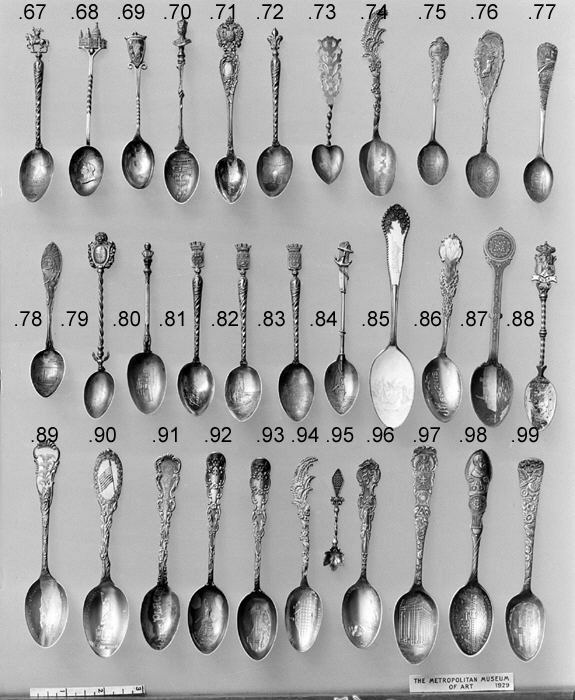
The Souvenir Spoon as Couture Artifact: A Study of the Arc de Triomphe Parcel-Gilt Silver Spoon
In the rarefied world of couture analysis, the mundane often yields the most profound insights into the intersections of craft, identity, and heritage. At Katherine Fashion Lab, we approach the souvenir spoon not as a trinket of tourism but as a wearable, collectible artifact—a microcosm of global design language compressed into a single, precious object. The subject of this standalone study is a vintage silver and parcel-gilt spoon bearing a sculpted view of the Arc de Triomphe. Originating from the nebulous yet evocative category of “Global Heritage,” this piece transcends its functional origins to become a statement of cultural memory and artisanal mastery. Through a rigorous examination of its materiality, iconography, and contextual significance, we decode how such an object embodies the ethos of couture: the elevation of the ordinary into the extraordinary.
Materiality and Craft: The Language of Silver and Gilt
The spoon is fabricated from sterling silver, a metal historically associated with wealth, purity, and permanence. Its surface, however, is not uniformly monochromatic. Parcel-gilt—a technique wherein only select portions of the metal are gilded with a thin layer of gold—creates a deliberate contrast between the cool, reflective silver and the warm, luminous gilt. This juxtaposition is not merely decorative; it is a narrative device. The silver ground evokes the pale limestone of Parisian architecture, while the gilt highlights the monumental details of the Arc de Triomphe, such as the sculpted friezes and the central archway. In couture terms, this is analogous to the interplay of matte and satin finishes in a haute couture gown—a calculated tension that directs the eye and elevates the silhouette.
The spoon’s form adheres to the classic souvenir spoon archetype: a narrow, elongated handle culminating in a bowl adorned with a three-dimensional miniature. Yet, the execution here is exceptional. The Arc de Triomphe is rendered with astonishing precision, capturing the monument’s neoclassical symmetry and the intricate reliefs of its pillars. The parcel-gilt is applied with surgical accuracy, likely through a process of electroplating or hand-applied gold leaf, requiring the artisan to mask and polish with extreme care. This level of craftsmanship mirrors the atelier techniques of haute couture, where hours of hand-stitching and beadwork transform a garment into a canvas. The spoon, in this light, is not a souvenir but a miniature sculpture—a testament to the skill of silversmiths who treated even the smallest object with the reverence of a monument.
Iconography: The Arc de Triomphe as Global Signifier
The Arc de Triomphe, commissioned by Napoleon I and completed in 1836, stands as a symbol of French national pride, military triumph, and architectural ambition. However, when rendered on a souvenir spoon, its meaning shifts. The monument becomes a global signifier—a shorthand for travel, cultural aspiration, and the democratization of heritage. The spoon, likely produced in the late 19th or early 20th century, belongs to a golden age of souvenir manufacturing, when mass tourism and colonial expansion fueled a demand for portable mementos. Yet, this object defies mere commodification through its material quality. The parcel-gilt treatment elevates the Arc from a generic emblem to a bespoke icon, suggesting that its owner possessed not only the means to travel but also the discernment to acquire a piece of art.
From a couture perspective, the Arc de Triomphe functions as a motif—a recurring visual element that anchors the design. In fashion, motifs are often drawn from nature, geometry, or cultural symbols; here, the Arc is a deliberate choice, evoking themes of victory, permanence, and the passage of time. The spoon’s handle, often engraved with scrollwork or floral patterns, frames the monument in a manner reminiscent of an embroidered border on a couture jacket. The entire composition is a study in balance: the monument’s verticality is offset by the horizontal sweep of the bowl, while the gilt highlights create a rhythmic pattern that guides the viewer’s gaze. This is not accidental; it is a lesson in spatial harmony that any couturier would recognize.
Contextual Significance: The Standalone Study and Global Heritage
This analysis positions the spoon as a standalone study, divorced from a larger collection or narrative. This framing is deliberate. By isolating the object, we invite a deeper interrogation of its intrinsic value. In the world of couture, a single garment—a jacket, a gown, a hat—can stand as a complete statement, encapsulating the designer’s vision without need for context. Similarly, this spoon operates as a self-contained artifact. Its “Global Heritage” origin—a term that acknowledges the object’s production in a transnational marketplace—further complicates its identity. Was it made in France, or in a silversmithing hub like Birmingham or Providence? The answer is less important than the question it raises: Who owns heritage? The spoon, with its French monument and universal silver standard, becomes a negotiation between local craft and global consumption.
In practical terms, the spoon’s size—typically four to six inches—makes it a wearable object. Historically, souvenir spoons were collected, displayed, or used in domestic rituals, but they also appeared as brooches or pendants, repurposed as jewelry. This fluidity between function and adornment is central to couture philosophy. A couture piece is rarely static; it is designed to be worn, moved, and reinterpreted. The parcel-gilt spoon, with its reflective surfaces and tactile weight, demands to be handled. When pinned to a lapel or suspended from a chain, it transforms into a pendant that tells a story of travel, taste, and time. The Arc de Triomphe, in this context, is no longer a distant monument but a personal talisman—a wearable memory.
Conclusion: The Couture of the Commonplace
The silver and parcel-gilt souvenir spoon bearing the Arc de Triomphe is a masterclass in the couture of the commonplace. Through its material richness, precise iconography, and contextual ambiguity, it challenges the hierarchy of design objects. Katherine Fashion Lab recognizes that couture is not confined to the runway; it exists wherever craft meets intention. This spoon, with its gilded monument and silver soul, is a testament to that principle. It reminds us that the smallest artifacts can carry the weight of history, and that in the hands of a discerning collector—or a visionary designer—a souvenir becomes a statement. In a world of fast fashion and disposable culture, the spoon stands as a quiet, enduring argument for the value of the handmade, the gilded, and the remembered.