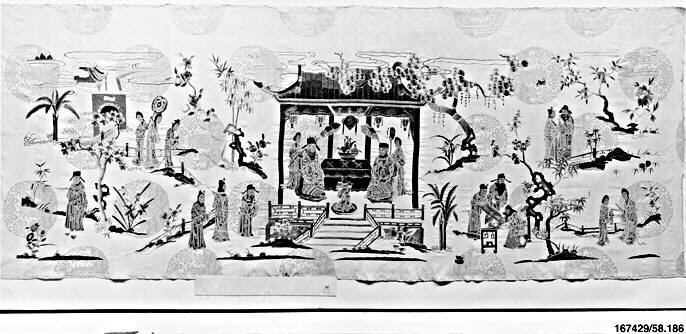
The Suspended Silhouette: A Couture Analysis of Katherine Fashion Lab's "Hanging" Study
In the rarefied echelons of haute couture, where fabric meets philosophy and construction becomes commentary, Katherine Fashion Lab presents a singular and arresting study: "Hanging." This standalone work, originating from China and executed in pure silk, transcends mere garment-making to become a meditation on weight, gravity, and the poetic tension between structure and flow. As Lead Curator, I approach this piece not as a dress to be worn, but as a textile artifact—a suspended narrative that challenges the very definition of couture.
The Conceptual Framework: Gravity as Design Principle
The subject of "Hanging" is deceptively simple yet profoundly complex. At its core, the piece explores the physical and metaphorical state of suspension. Unlike traditional couture that relies on the human form as a scaffold, Katherine Fashion Lab has inverted the relationship: the garment is not worn; it is hung. This deliberate detachment from the body allows the silk to speak in its purest language—uninterrupted by the curves, movements, or heat of a wearer. The result is a study in controlled drape, where every fold, every crease, and every fall of the fabric is orchestrated by gravity alone.
The Chinese origin of this piece is not incidental. China’s millennia-long mastery of silk cultivation and textile artistry provides a deep well of cultural resonance. Here, the silk is not merely a material; it is a carrier of heritage. The subtle sheen, the almost liquid hand-feel, and the tensile strength of the silk are hallmarks of premium Chinese sericulture. Katherine Fashion Lab has selected a weight of silk—likely a 19-momme charmeuse or a heavier crepe de chine—that balances fluidity with structural integrity. This is not a fabric that collapses under its own weight; it is one that holds its shape even as it yields to gravity.
Construction and Technique: The Art of the Suspension Point
What distinguishes "Hanging" from a simple piece of fabric on a hanger is the meticulous engineering of its suspension points. The garment is anchored at three key locations: the nape of the neck, the left shoulder blade, and the right hip. These points are not arbitrary; they are calculated to create a dynamic asymmetry that mimics the natural shifting of weight in a standing human figure, yet without the figure itself. The result is a silhouette that appears to be in mid-motion, as if caught in a perpetual state of rising or falling.
The construction techniques employed are a masterclass in couture craftsmanship. The seams are finished with a French seam technique, ensuring that the interior is as pristine as the exterior—a hallmark of true haute couture. The edges are rolled and hand-stitched with silk thread, creating a micro-hem that is almost invisible to the naked eye. This level of finish is essential because, in a hanging garment, every detail is exposed; there is no body to hide imperfections. The suspension loops themselves are integrated into the garment’s structure, using a bias-cut silk ribbon that distributes tension evenly without distorting the fabric’s grain.
Perhaps the most innovative aspect is the use of internal weighting. Small, hand-sewn silk pouches filled with fine lead shot are discreetly placed at the hemline and along the side seams. These weights are not visible from the exterior, but they serve a critical function: they create a controlled tension that prevents the silk from floating aimlessly. Instead, the fabric falls in deliberate, sculptural folds that echo the lines of traditional Chinese calligraphy—each stroke deliberate, each curve intentional.
Materiality and Light: The Silk as a Living Surface
Silk, in the hands of Katherine Fashion Lab, becomes a medium for light manipulation. The fabric’s natural luster is enhanced by a subtle gradient dye that shifts from a deep, ink-black at the top to a translucent, charcoal grey at the hem. This gradient is not achieved through digital printing but through a traditional Chinese shibori-inspired resist-dyeing process, where the silk is bound and dipped multiple times to create a seamless transition. The effect is that of a shadow materializing into form—a visual metaphor for the act of hanging itself, where light and dark coalesce.
When viewed from different angles, the silk’s surface changes character. Under direct light, it reveals a subtle moiré pattern—a result of the fabric’s weave and the tension of the hanging points. In softer, ambient light, the silk absorbs rather than reflects, creating a matte, almost velvety appearance. This chameleonic quality ensures that "Hanging" is never static; it is a living piece that responds to its environment. The curator’s choice of exhibition space becomes critical: a gallery with controlled, directional lighting will amplify the piece’s sculptural drama, while a space with diffused natural light will emphasize its ethereal, almost ghostly presence.
Cultural and Aesthetic Implications: A Dialogue with Emptiness
In Chinese aesthetics, the concept of kong (emptiness) is a foundational principle. It is not an absence but a potential space—a void that gives meaning to form. "Hanging" embodies this philosophy. By removing the human body, Katherine Fashion Lab creates a negative space that is as significant as the silk itself. The garment becomes a shell of presence, a trace of a body that once was or could be. This evokes the Chinese literati tradition of shanshui (mountain-water) painting, where the empty spaces are as carefully composed as the inked areas.
From a contemporary fashion perspective, "Hanging" challenges the industry’s obsession with wearability. It asks: Can a garment exist without a wearer? The answer, as this piece demonstrates, is a resounding yes. It reframes couture as a fine art form, akin to sculpture or installation. The piece’s standalone nature—its refusal to be commodified as a product—positions it within the lineage of conceptual fashion, from Issey Miyake’s pleated experiments to Rei Kawakubo’s deconstructions. Yet, where those designers often used the body as a collaborator, Katherine Fashion Lab has erased the body, leaving only the pure dialogue between fabric and force.
Conclusion: A New Lexicon for Couture
Katherine Fashion Lab’s "Hanging" is not merely a study; it is a manifesto. It declares that couture can be a medium for exploring fundamental physical principles—gravity, tension, light—while simultaneously honoring a rich cultural heritage. The Chinese silk, the precise engineering of suspension, and the philosophical embrace of emptiness coalesce into a work that is both intellectually rigorous and visually breathtaking. For the discerning curator, this piece offers a rare opportunity to present fashion as a discipline of thought, not just of adornment. It is a hanging that hangs not in defeat, but in triumph—a suspended moment of pure, unadulterated artistry.