The Empress Eugénie: A Couture Analysis of Power, Prestige, and Global Heritage
Introduction: The Sartorial Sovereignty of an Empress
In the annals of fashion history, few figures embody the confluence of political power, aesthetic influence, and cultural diplomacy as profoundly as Empress Eugénie de Montijo, the last Empress of the French. Her legacy, immortalized in oil on canvas, transcends mere portraiture; it serves as a masterclass in the strategic deployment of dress as a tool of statecraft. At Katherine Fashion Lab, we approach this standalone study not as a historical artifact, but as a living case study in couture architecture—a textile testament to how fabric, silhouette, and ornamentation can articulate sovereignty, femininity, and global heritage. The Empress Eugénie, born a Spanish aristocrat (Condesa de Teba) and crowned the arbiter of Second Empire elegance, offers a profound lesson in the symbiosis between personal style and imperial ambition.
The Canvas as Couture: Deconstructing the Oil on Canvas Medium
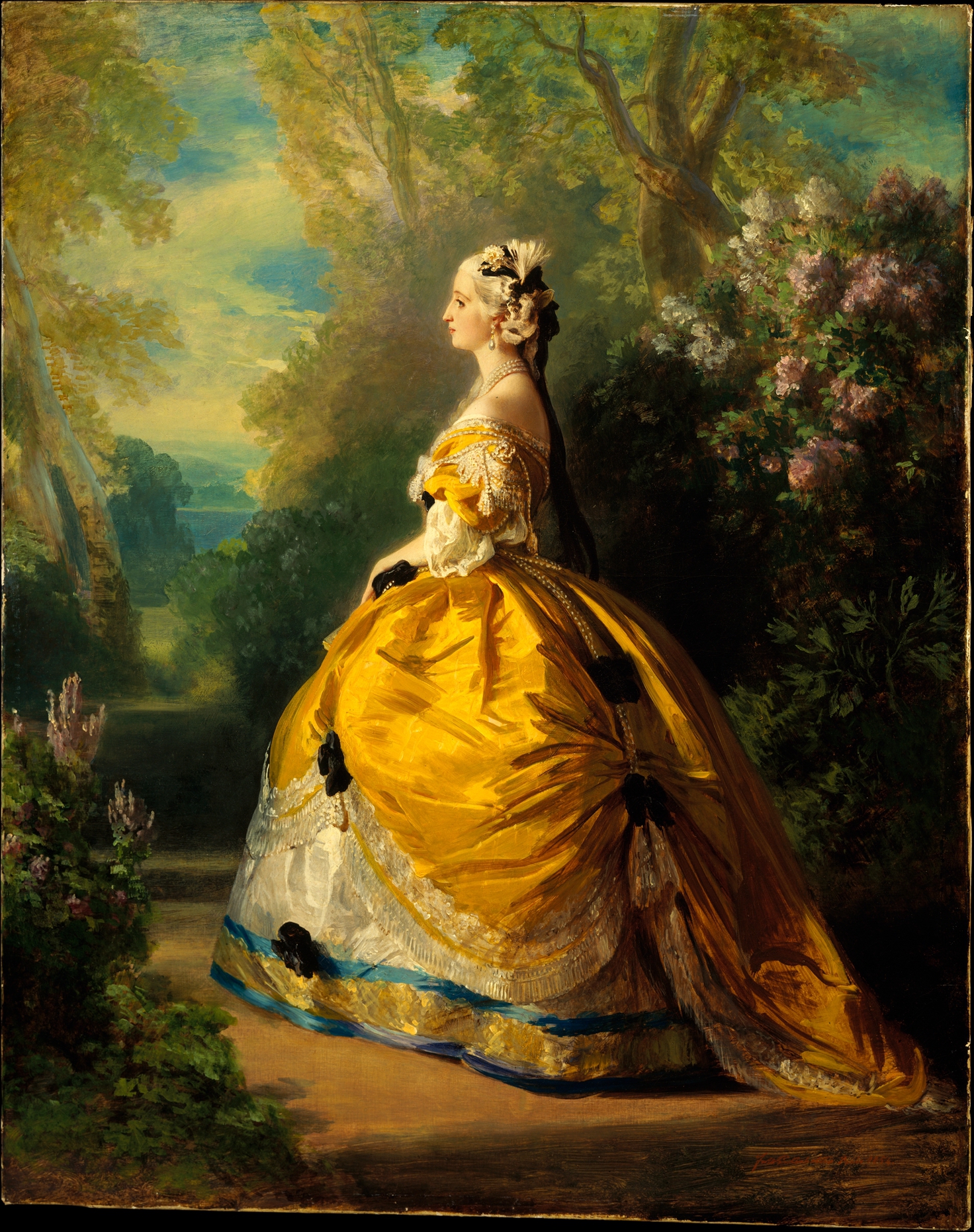
The choice of oil on canvas as the medium for this study is itself a deliberate couture statement. Unlike the fleeting nature of sketch or photograph, oil paint confers permanence, depth, and a tactile richness that mirrors the luxurious fabrics of the era. The canvas becomes a surrogate for the empress’s own skin—a surface upon which the designer (in this case, the painter) layers texture, light, and shadow to create an illusion of three-dimensional opulence. For the couture analyst, this medium demands a forensic reading: each brushstroke is a stitch, each highlight a sequin, each shadow a drape. The empress’s gown, rendered in oil, is not merely depicted; it is constructed, with the artist acting as both tailor and architect.
Global Heritage: The Spanish-French Synthesis in Empress Eugénie’s Wardrobe
Empress Eugénie’s style cannot be divorced from her global heritage. Born in Granada, Spain, to a Scottish-descended father and a Spanish mother of noble lineage, she brought a distinctly Iberian sensibility to the French court. This cultural fusion is evident in her preference for bold, architectural silhouettes that diverged from the softer, more romantic styles of the earlier 19th century. Her gowns often featured rigid corsetry that elongated the torso, a nod to the Spanish guardainfante—a wide, bell-shaped skirt frame—while simultaneously embracing the French crinoline for volume. The result was a silhouette that commanded space, asserting a visual dominance that was both regal and distinctly modern.
This synthesis extended to color theory. The empress famously championed vibrant hues—deep carmine, emerald green, and sapphire blue—colors rooted in Spanish Moorish traditions but refined through Parisian ateliers. In the oil painting, these colors are not merely decorative; they are psychological. The deep reds evoke passion and power, while the greens suggest fertility and connection to nature—a subtle nod to her role as a mother to the Prince Imperial. The palette is a coded language of imperial legitimacy, bridging her Spanish ancestry with her French destiny.
The Architecture of the Gown: Silhouette as Political Statement
The empress’s gowns were engineered to project an image of unassailable authority. The bell-shaped crinoline, at its peak during her reign, was not a frivolous fashion; it was a cage of status. The sheer volume of fabric—often silk taffeta, velvet, or brocade—required immense material resources, signaling the wealth of the Second Empire. Yet, Empress Eugénie refined this silhouette with a narrower waist and a more pronounced back bustle, a style that would later evolve into the tournure of the 1870s. This architectural precision drew attention to her posture, forcing an erect, almost militaristic carriage that mirrored the disciplined elegance of the French court.
In the canvas study, the folds of the gown are not random; they are meticulously arranged to create a cascading rhythm that draws the eye upward to the face—the seat of intellect and authority. The artist’s use of chiaroscuro—the dramatic contrast between light and dark—accentuates the volume of the skirt, making it appear almost sculptural. For the modern couturier, this serves as a reminder that silhouette is never neutral; it is a spatial negotiation of power, with the empress’s body as the epicenter of a carefully orchestrated visual field.
Ornamentation as Diplomacy: Lace, Jewelry, and the Language of Accessories
No couture analysis of Empress Eugénie is complete without examining her ornamental lexicon. In the painting, lace appears as a delicate yet strategic element—often at the collar, cuffs, or as a mantilla draped over her shoulders. The lace is not merely decorative; it is a diplomatic gesture. The empress famously revived the Alençon lace industry in France, positioning herself as a patron of artisanal craftsmanship. By wearing Spanish-style mantillas, she simultaneously honored her heritage and legitimized French artisanship, creating a cultural bridge that reinforced her dual identity.
Jewelry, too, is deployed with precision. The empress’s preference for pearls and diamonds—often arranged in parures (matching sets)—was a calculated display of imperial wealth. In the canvas, the reflection of light off these gems creates a halo effect around her face, suggesting divine right. Yet, there is restraint: the jewelry never overwhelms the gown. This balance is a lesson in strategic minimalism—a concept that Katherine Fashion Lab champions. The empress understood that true power lies not in excess, but in the calculated placement of opulence.
The Hair and Headwear: A Crown of Cultural Identity
Empress Eugénie’s hairstyles were as iconic as her gowns. She popularized the bandeau style, with hair swept back and adorned with a tiara or floral wreaths. In the oil study, her hair is often depicted with a central part and soft waves framing the face—a style that referenced classical Roman matrons, thereby linking her reign to the grandeur of antiquity. This was a deliberate historical allusion, positioning the Second Empire as the heir to Rome’s imperial legacy.
Headwear, when present, was equally symbolic. The Spanish mantilla—a lace veil worn over a high comb—appears in many portraits, serving as a visual signature of her heritage. This accessory was not merely nostalgic; it was a political statement of cultural pride, subtly reminding viewers that her authority was rooted in a lineage that predated the French throne. For the contemporary designer, this teaches the power of signature accessories as anchors of personal brand identity.
Conclusion: The Enduring Legacy of a Couture Empress
Empress Eugénie de Montijo’s portrait in oil is far more than a historical record; it is a strategic manual for couture as statecraft. Her ability to weave her Spanish heritage into the fabric of French imperial identity offers a timeless lesson in the use of dress as a tool for cultural diplomacy. At Katherine Fashion Lab, we extract from this study the imperative that every garment is a narrative—a thread connecting past, present, and future. The empress’s silhouette, color choices, and ornamentation were not merely aesthetic preferences; they were calculated decisions that projected power, fostered national pride, and asserted her place in history. For the modern couturier, her legacy is a call to design with intention, to see fabric as a medium for storytelling, and to recognize that true elegance is never apolitical. The canvas may be static, but the couture it captures remains a dynamic blueprint for the art of imperial influence.