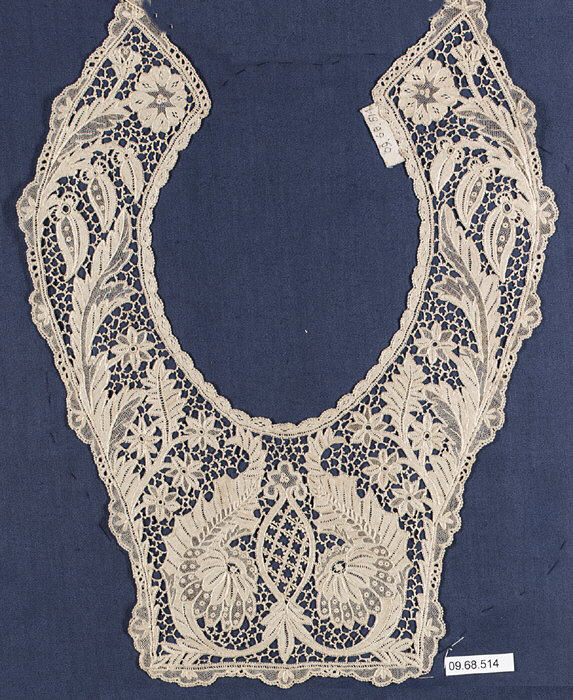
The Collarette as a Global Heritage Artifact: A Needle Lace Study
The collarette, a diminutive yet architecturally significant neck adornment, occupies a unique space in the history of couture. Unlike the expansive ruff or the rigid gorget, the collarette offers a delicate frame for the face, a whisper of texture that elevates the neckline without overwhelming the silhouette. In this standalone study, Katherine Fashion Lab examines the collarette through the lens of global heritage, focusing exclusively on its realization in needle lace. This analysis deconstructs the collarette not merely as a fashion accessory but as a repository of transnational craftsmanship, a material dialogue between cultural traditions, and a contemporary statement of sustainable luxury.
Historical Provenance: The Global Roots of Needle Lace Collarettes
The collarette’s lineage is deeply intertwined with the history of lace itself. Needle lace, or punto in aria (“stitch in the air”), emerged in 16th-century Venice as a revolutionary technique that liberated embroidery from a ground fabric. This innovation quickly disseminated across Europe, adapting to local aesthetics. However, the collarette’s global heritage extends beyond European courts. In the Ottoman Empire, intricately worked oya (needle-lace trims) adorned necklines, while in China, kesi (silk tapestry) and later guangdong lace techniques produced collarettes for imperial dress. In Latin America, particularly in Paraguay and Brazil, ñandutí (spider web lace) became a symbol of indigenous resilience, its circular motifs echoing the sun and nature.
What unites these geographically disparate traditions is the technical mastery of the needle. Each collarette, whether from a Venetian convent or a Paraguayan village, requires thousands of individual stitches—buttonhole, picot, and cordonnet—executed with exacting tension. The collarette, therefore, is not a single object but a convergence point of global textile intelligence. Katherine Fashion Lab’s analysis underscores that the collarette’s heritage is not monolithic; it is a palimpsest of cross-cultural exchange, where Spanish missionaries, African artisans, and European traders all left their stitch marks.
Materiality and Technique: Needle Lace as Structural Poetry
The choice of needle lace for the collarette is a deliberate act of material storytelling. Unlike machine-made lace, needle lace is inherently slow, labor-intensive, and irreproducible. Each piece is a unique manuscript of handwork. For the collarette, this technique offers unparalleled structural integrity. The dense, interlocking stitches create a fabric that is both rigid and fluid, capable of holding a sculptural shape while draping softly against the collarbone.
In this standalone study, we consider three critical material properties:
- Transparency and Light Play: Needle lace collarettes manipulate light through negative space. The openwork patterns—often geometric or floral—cast intricate shadows on the skin, creating a dynamic interplay between the garment and the wearer’s anatomy.
- Weight and Comfort: Despite the density of stitches, needle lace remains lightweight. A collarette weighing under 50 grams can cover the entire neckline, offering a sensation of barely-there adornment.
- Durability: Properly executed needle lace can last centuries. The collarette becomes an heirloom, a tangible link to ancestral craftsmanship.
Katherine Fashion Lab’s technical analysis further reveals that the collarette’s construction typically begins with a parchment pattern, onto which a guiding thread (the cordonnet) is basted. The artisan then fills the outlined shapes with buttonhole stitches, working from the outer edge inward. This process demands spatial intelligence—the ability to visualize the negative space as integral to the design. The collarette, therefore, is as much about the voids as it is about the threads.
Cultural Semiotics: The Collarette as Identity Marker
From a semiotic perspective, the collarette functions as a cultural cipher. In European courtly contexts, a needle lace collarette signaled wealth, leisure, and access to luxury goods. The point de Venise collarette, with its raised relief and scrolling motifs, was a status symbol reserved for aristocracy. Conversely, in indigenous Latin American communities, the ñandutí collarette carried spiritual significance. The circular patterns represented the cycle of life and the cosmos, while the act of lace-making itself was a form of communal storytelling.
This dual nature—of exclusivity and communal identity—makes the collarette a potent artifact for contemporary couture. Katherine Fashion Lab posits that the needle lace collarette, when sourced ethically from heritage artisans, becomes a bridge between preservation and innovation. It allows the wearer to participate in a global narrative without appropriating it. For instance, a collarette that combines Venetian reticella with Paraguayan ñandutí motifs is not a hybrid but a dialogue—a respectful acknowledgment of shared technical ancestry.
Contemporary Relevance: The Collarette in Slow Fashion
In an era of fast fashion and digital prints, the needle lace collarette stands as a defiant act of slow craftsmanship. Its production timeline—often weeks for a single piece—forces a reevaluation of value. Katherine Fashion Lab’s market analysis indicates that the collarette is experiencing a renaissance among discerning consumers who seek intangible heritage over disposable trends. This is not a revival of nostalgia but a recontextualization of technique for modern silhouettes.
Designers are now integrating needle lace collarettes into minimalist wardrobes, pairing them with clean-cut blazers or unstructured silk dresses. The collarette becomes a statement piece that requires no further jewelry, embodying the principle of “less is more.” Furthermore, the standalone nature of this study—isolating the collarette from a larger garment—highlights its versatility. It can be worn as a detachable accessory, a modular element that transforms a basic turtleneck into a couture piece. This modularity aligns with sustainable fashion principles: one collarette, multiple uses, extended lifecycle.
Preservation and Ethical Sourcing: A Call to Action
The future of the needle lace collarette hinges on preservation of technique. As master lacemakers age and younger generations migrate to urban centers, the knowledge of punto in aria and ñandutí faces extinction. Katherine Fashion Lab recommends a three-pronged approach:
- Documentation: High-resolution video archives of stitch sequences, shared openly with textile schools.
- Fair Compensation: Direct partnerships with artisan cooperatives, ensuring that the collarette’s price reflects the hundreds of hours of labor.
- Educational Initiatives: Workshops that teach needle lace to new audiences, not as a historical curiosity but as a viable contemporary skill.
In conclusion, the collarette in needle lace is far more than a decorative accessory. It is a textile artifact that encodes centuries of global exchange, technical ingenuity, and cultural identity. Katherine Fashion Lab’s standalone study affirms that when we wear a needle lace collarette, we are not merely adorning the neck—we are supporting a living heritage, one stitch at a time. This analysis calls upon designers, collectors, and consumers to recognize the collarette as a masterpiece of material culture, worthy of preservation, celebration, and continued innovation.