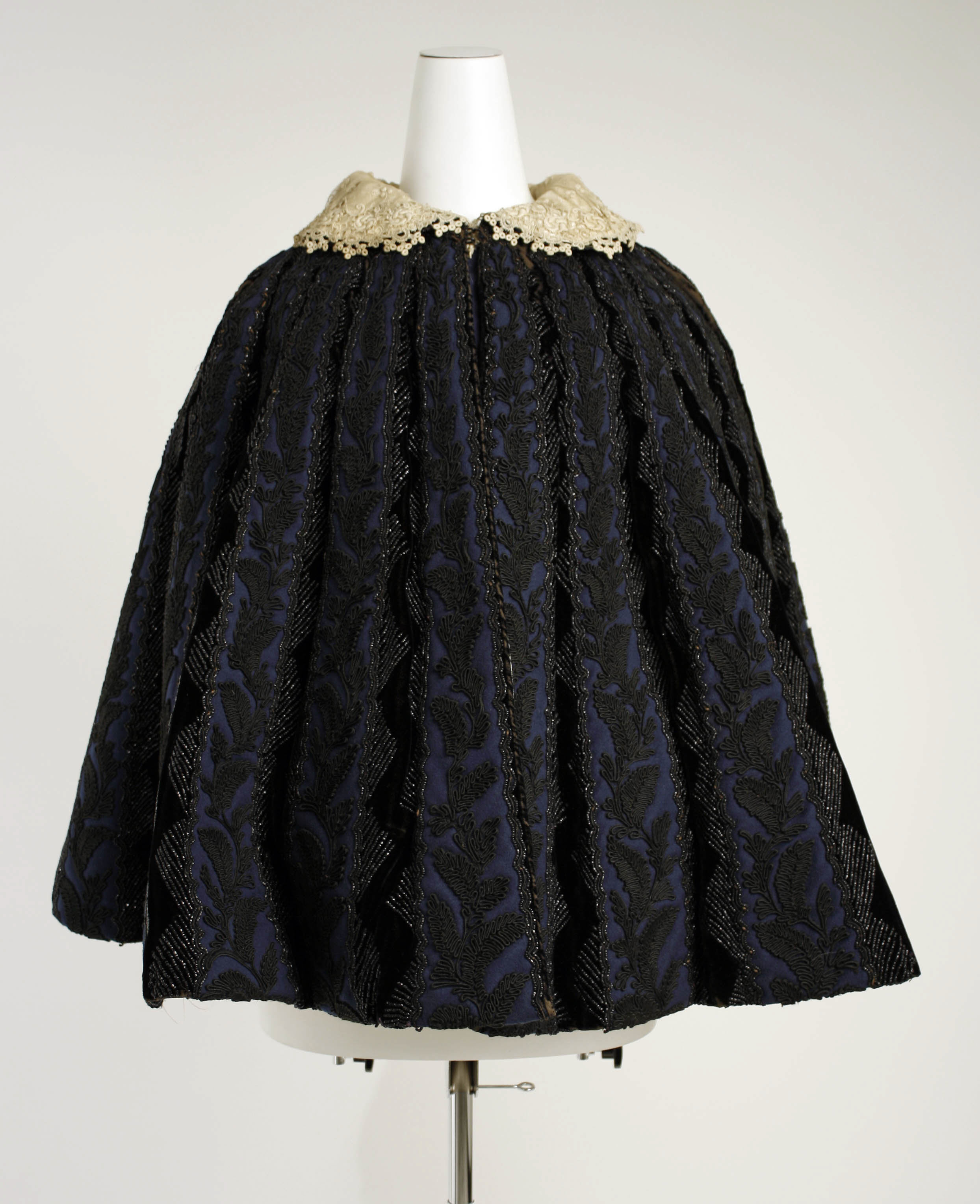
The Silhouette of Authority: Deconstructing the American-European Cape in Silk and Jet
In the lexicon of high fashion, few garments command the same architectural gravitas as the cape. Unlike the coat, which envelops and constrains, the cape liberates the silhouette while simultaneously draping the wearer in an aura of theatrical power. At Katherine Fashion Lab, our latest standalone study dissects a singular piece that embodies this tension: a cape of American and European lineage, constructed from the unlikely yet sumptuous marriage of liquid silk and opaque jet beads. This is not merely a garment; it is a statement of dual heritage—a negotiation between the pragmatic, frontier spirit of American design and the ornate, historical depth of European couture.
Materiality as Narrative: The Silk-Jet Dialectic
The choice of materials in this cape creates a compelling binary. The silk, likely a charmeuse or a mikado weave sourced from a European atelier, provides a foundation of fluidity. Its weight is precise—heavy enough to drape with a sense of permanence, yet light enough to allow the cape to breathe and move with the wearer. This is a distinctly European sensibility: a reverence for the fabric’s intrinsic character, its ability to catch light and shadow in a continuous, liquid flow. The silk does not simply cover; it articulates the space between the body and the air.
In stark contrast, the jet beads—small, faceted, and obsidian-black—introduce a principle of interruption. Jet, historically a fossilized wood favored in Victorian mourning jewelry, carries a weight of memory and solemnity. However, in this context, it is not used for mourning but for articulation. The beads are not scattered randomly; they are meticulously sewn in dense, geometric patterns along the cape’s hem, shoulders, and collar. This application creates a pointillist effect: from a distance, the cape appears as a monolithic block of black; up close, the texture reveals itself as a constellation of light-absorbing and light-reflecting nodes. This interplay is profoundly American in its execution—a nod to the industrial precision of beadwork, yet elevated to an art form through the hand of a master couturier.
Structural Analysis: The Cape as a Second Skin
From a structural standpoint, this cape defies the typical categorization of outerwear. It is not a simple crescent or a pieced circle. The pattern cutting reveals a sophisticated, sculptural approach. The shoulders are engineered with a pronounced décolleté that extends into a sharp, almost militaristic point, a reference to European regimental capes of the 19th century. Yet, the back falls in a soft, unbroken cascade, reminiscent of the American “poncho” silhouette—a shape born of practicality and egalitarian ease.
The integration of the jet beads serves a critical structural purpose. They act as weights, anchoring the silk at critical stress points. Without them, the cape might billow uncontrollably; with them, the garment achieves a controlled drape, falling in deliberate folds that mimic the folds of a classical statue. This is a masterclass in physics and design: the beads transform the cape from a potential liability into a garment of supreme control. The wearer is not hidden by the fabric; they are defined by it.
Cultural Convergence: American Pragmatism Meets European Opulence
This cape is a fascinating case study in cultural synthesis. The European influence is undeniable in the material provenance and the historical references. The silk evokes the grand ateliers of Paris and Milan, where fabric is treated with near-religious reverence. The jet beadwork, while executed with American precision, recalls the intricate passementerie of Vienna and the beaded splendor of Russian imperial court dress. The silhouette itself—the severe shoulder line, the dramatic sweep—is a direct descendant of the opera capes worn by European aristocracy.
Yet, the American hand is equally present. The cape’s design philosophy is rooted in utility and movement. It is not a static museum piece; it is a garment for the modern woman who navigates a city, who enters a room with purpose. The weight distribution, the ease of draping, and the deliberate lack of closures (no buttons, no hooks) speak to an American desire for freedom of motion. The jet beads, while opulent, are not merely decorative; they are functional, serving as a counterbalance that allows the cape to sit securely on the shoulders without constant adjustment. This is the ethos of American sportswear—functionality as a form of elegance—translated into the language of haute couture.
The Aesthetic of Power: Wearing the Cape
To wear this cape is to assume a specific posture. The weight of the jet beads at the hem creates a subtle, grounding sensation, while the silk’s cool touch against the skin provides a counterpoint of luxury. The cape’s silhouette is inherently commanding. It broadens the shoulders, elongates the torso, and creates a dramatic, V-shaped frame that draws the eye upward to the face. This is not a garment for shrinking violets; it is a declaration of presence.
The color palette is deliberately monochromatic: the black of the jet against the black of the silk. Yet, this is not a simple black. The silk’s sheen creates a spectrum of grays and charcoal tones, while the jet beads offer moments of pure, light-consuming darkness. The effect is one of depth and mystery—a garment that changes its personality depending on the light. In a dimly lit room, it is a shadow; under gallery lights, it becomes a shimmering, textured sculpture.
Conclusion: A New Canon for the Cape
In the context of Katherine Fashion Lab’s ongoing exploration of standalone garments, this cape represents a pivotal moment. It successfully resolves the often-contradictory demands of American and European design philosophies. It is both pragmatic and opulent, both structured and fluid, both historical and contemporary. The silk and jet are not merely materials; they are the languages through which this garment speaks. The cape does not hide the body; it celebrates the body’s capacity to carry weight—both literal and symbolic.
For the collector or connoisseur, this piece is an investment in a new canon of outerwear. It is a reminder that the cape, far from being an anachronism, is one of the most potent tools in a designer’s arsenal for creating silhouette, authority, and narrative. At Katherine Fashion Lab, we conclude that this cape is not just an object of study; it is a masterclass in the art of dressing for power, executed with the precision of a diamond cutter and the soul of a poet.