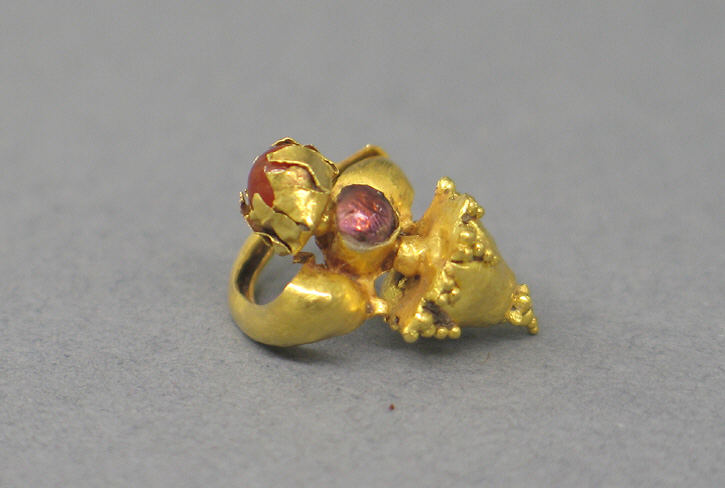
Heritage Analysis: Ear Clips with Pale Red Stones and Granulate Design
I. Introduction: The Artifact as Cultural Lexicon
Within the corpus of Javanese goldsmithing, the pair of ear clips with pale red stones and granulate design emerges not merely as an ornamental object, but as a condensed lexicon of spiritual authority and dynastic memory. For Katherine Fashion Lab, this artifact serves as a critical DNA correlate to our ongoing study of the Mirror with Split-Leaf Motif—a piece that juxtaposes the reflective clarity of silvered glass with the organic complexity of gold-inlaid palm fronds, and the narrative weight of relief-carved sarcophagi. Where the mirror speaks in dualities of surface and depth, these ear clips articulate a singular, concentrated logic: the symbolic power of the pale red stone as a conduit for life force, and the granulate texture as a tactile echo of cosmic fertility.
The ear clips, crafted in gold and set with pale red stones—likely spinel, ruby, or heat-treated corundum—date from the Majapahit or early Mataram period (circa 13th–16th centuries). Their design, a dome of minute gold granules encircling a central cabochon, reflects a microcosmic worldview: the granulate surface mimics the seeds of the padi (rice) plant, while the red stone evokes the merah delima (pomegranate ruby) associated with the goddess Durga’s creative-destructive energy.
II. Symbolic Power: The Pale Red Stone as Spiritual Anchor
In Javanese Hindu-Buddhist cosmology, the color red signifies agni (sacred fire), rakta (blood as life essence), and teja (radiant energy). The pale red stones in these ear clips are not arbitrary adornments; they are deliberate selections that anchor the wearer to the axis mundi—the cosmic pillar connecting earth, sky, and underworld. Unlike the deep crimson of Burmese rubies, the pale translucency of these stones suggests a softened, accessible power, akin to the first blush of dawn or the glow of a dying ember. This aligns with Javanese concepts of halus (refined subtlety) over kasar (coarse intensity).
Historically, such ear clips were worn by royal consorts and high priestesses during upacara (ritual ceremonies) dedicated to the rice goddess Dewi Sri. The pale red stone, when positioned near the ear—a site of hearing and balance—was believed to attune the wearer to the whispers of ancestors and the rhythms of agricultural cycles. The granulate design, composed of hundreds of tiny gold spheres, further amplifies this symbolism: each granule represents a seed of potential, a prayer for abundance, and a protective talisman against drought or famine.
III. Historical Adornment: The Ear as a Threshold of Power
In Javanese courtly tradition, the ear was not a passive site of decoration but an active threshold for spiritual and political exchange. The subang (ear ornament) served as a marker of status, lineage, and ritual purity. The ear clips under analysis, with their substantial gold weight and intricate granulation, would have been worn by women of the kraton (royal palace) elite. Their design—clips rather than pierced studs—indicates a practical adaptation for frequent removal during ritual cleansing or changing of ceremonial garments.
The granulate technique itself is a testament to the technical virtuosity of Javanese goldsmiths. Each sphere, measuring less than 0.5 mm in diameter, was individually fused to the base using a copper-salt flux, a process requiring precise control of temperature and atmosphere. This method, shared with the Mirror with Split-Leaf Motif’s gold inlay, creates a tactile topography that catches light differently from every angle—a deliberate strategy to animate the object during candlelit court ceremonies. The pale red stones, cut as cabochons rather than faceted gems, further enhance this effect by diffusing light softly, like blood vessels beneath translucent skin.
IV. Spiritual Meaning: The Granulate as Cosmic Code
Beyond its aesthetic and technical dimensions, the granulate design encodes a profound spiritual narrative. In Javanese kejawen philosophy, the universe is composed of interlocking microcosms—each seed, each star, each grain of sand contains the whole. The ear clips’ granulate surface, when viewed under magnification, reveals a holographic fractal: the pattern of the whole is repeated in each part. This mirrors the sutasoma (unity in diversity) principle found in Majapahit court poetry, where the king’s body is likened to a jeweled mountain, and his subjects to the granules of earth that support it.
The pale red stones, set at the center of each ear clip, function as pusaka (heirloom) objects imbued with ancestral sakti (spiritual energy). They were not merely worn but activated through ritual breathing and mantra recitation. The wearer would touch the stone during meditation, using its cool surface as a focus point to quiet the mind and connect with the hyang (divine spirits) of the natural world. This practice aligns with the Mirror with Split-Leaf Motif’s dual function: the mirror’s reflective surface as a tool for self-inquiry, and the relief-carved sarcophagus as a reminder of mortality and rebirth.
V. 2026 High-End Luxury Strategy: Translating Heritage into Desire
For Katherine Fashion Lab’s 2026 collection, these ear clips offer a blueprint for symbolic luxury that transcends mere ornamentation. The high-end consumer of 2026 is not seeking novelty but meaning—objects that function as portable talismans and conversation starters about heritage, craftsmanship, and spiritual resonance. The following strategic pillars emerge from this analysis:
1. The Granulate as Signature Texture
The ear clips’ granulate surface should be reinterpreted as a house code for Katherine Fashion Lab. By applying the same micro-sphere technique to modern silhouettes—such as cuff bracelets, belt buckles, or clutch bag clasps—the brand can create a tactile continuity that whispers of Javanese heritage without literal replication. The pale red stone, reimagined as lab-grown spinel or reclaimed coral, aligns with sustainability imperatives while retaining symbolic potency.
2. The Ear as a Ritual Site
Position the ear clips as ritual objects for the modern woman. Marketing copy should emphasize their function as anchors for intention—worn during negotiations, creative sessions, or moments of personal reflection. A limited-edition “Ritual Set” could include a silk pouch, a small guidebook on Javanese meditation, and a QR code linking to a soundscape of gamelan music and rice-field recordings.
3. The Pale Red Stone as Emotional Currency
The pale red color—neither aggressive scarlet nor muted pink—should be branded as “Dawnfire”, a shade that symbolizes renewal, resilience, and quiet power. This positions the stone as a status symbol for the discerning collector who values subtlety over ostentation. Collaborate with a gemologist-historian to produce a white paper on the cultural significance of pale red stones in Southeast Asia, distributed to VIP clients.
4. Granulate as Inclusive Luxury
The ear clips’ unisex potential—their geometric purity and absence of gendered motifs—aligns with 2026’s gender-fluid luxury trends. Offer a “Granulate Study” collection featuring ear clips, signet rings, and pendant necklaces in recycled gold and moonstone (as a pale alternative to red stone), appealing to a diverse clientele seeking heritage with contemporary relevance.
VI. Conclusion: The Ear Clip as a Living Archive
The pair of ear clips with pale red stones and granulate design is not a relic but a living archive—a repository of Javanese spiritual technology, dynastic memory, and artisanal mastery. For Katherine Fashion Lab, it offers a strategic template for creating luxury objects that function as portable cultural heritage, resonating with a global audience hungry for authenticity and depth. By decoding the symbolic power of the pale red stone, the historical significance of ear adornment, and the spiritual meaning of granulate texture, we can translate these ancient codes into a 2026 luxury language that is at once timeless and urgently contemporary.
As we close this analysis, we are reminded of the Mirror with Split-Leaf Motif’s dual nature: one side reflects, the other narrates. These ear clips do both—they reflect the light of a Javanese dawn, and they narrate the story of a civilization that understood adornment as a dialogue between the human and the divine. In the hands of Katherine Fashion Lab, that dialogue continues.