The Threads of Mourning: A Couture Analysis of the Turkish Funeral Woodcut
Introduction: The Frieze as Sartorial Archive
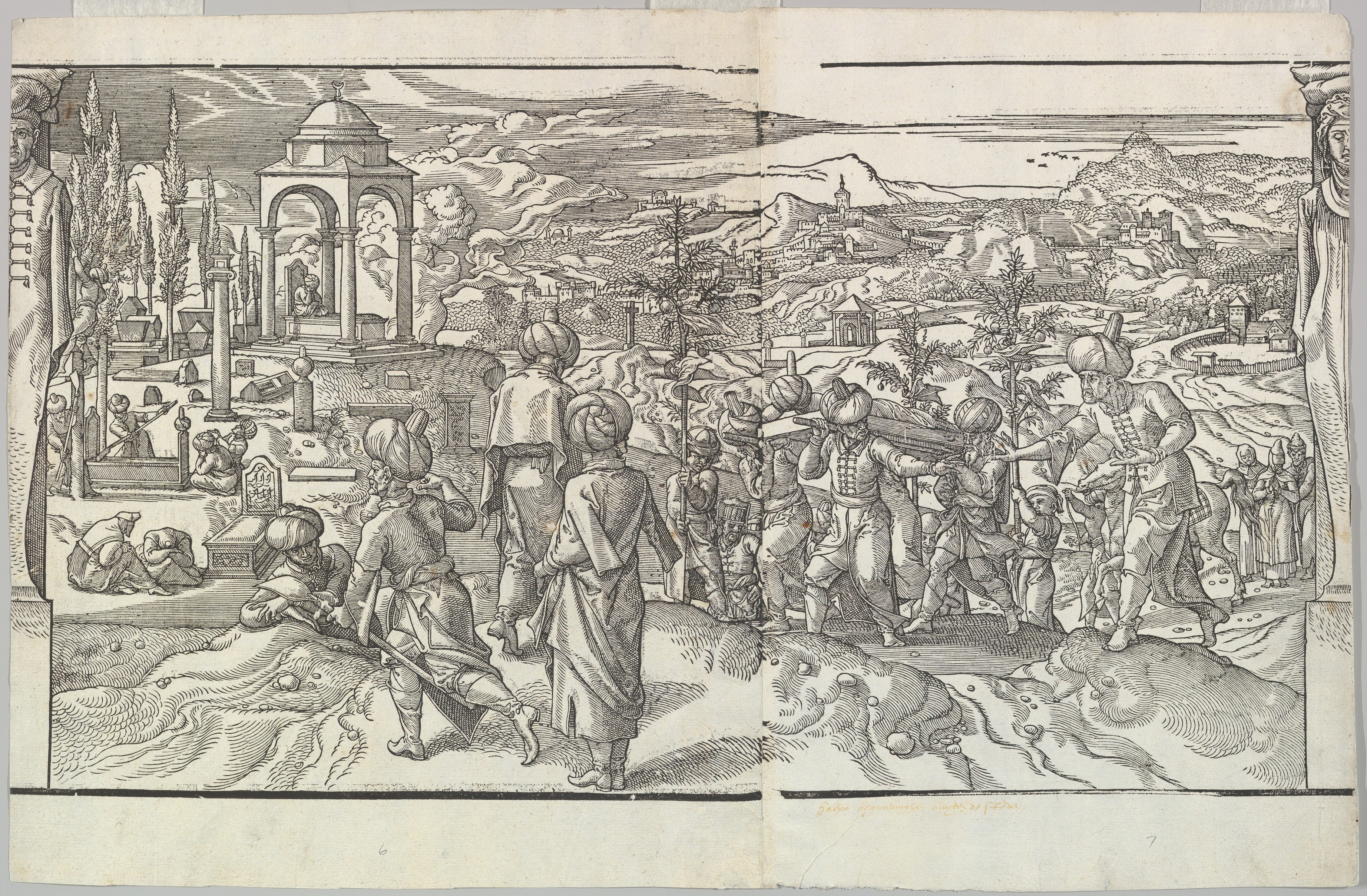
The woodcut titled Ces Moeurs et fachons de faire de Turcz, specifically the segment depicting a Turkish funeral, offers an extraordinary lens through which to examine the intersection of ritual, social hierarchy, and textile expression. Executed in the 16th century—a period when the Ottoman Empire exerted profound influence over the Eastern Mediterranean and beyond—this frieze is not merely an ethnographic curiosity but a sophisticated visual document of material culture. For Katherine Fashion Lab, this artifact serves as a foundational study in the semiotics of mourning attire, revealing how garments function as both personal armor and communal narrative. The woodcut’s stark lines and deliberate compositions allow us to decode a sartorial language that speaks of grief, status, and the immutable cycles of life and death.
Theatre of Grief: Composition and Silhouette
At first glance, the funeral procession depicted in the woodcut is a study in controlled chaos. The figures move in a linear, processional order, their bodies draped in heavy, voluminous fabrics that obscure individual form, creating a unified silhouette of collective mourning. The garments—long, flowing robes, layered cloaks, and turbans wrapped with precision—are not merely functional; they are architectural. The woodcut’s medium, with its reliance on black ink and paper, emphasizes the interplay of light and shadow, transforming these fabrics into sculptural elements. The folds of the robes are carved with deliberate vertical lines, suggesting the weight of wool or heavy silk, materials that would have signified both piety and prosperity.
For the couture analyst, this is a masterclass in how volume and draping can convey emotional gravity. The absence of bright color—a limitation of the woodcut but also a choice—mirrors the somber palette of actual Ottoman mourning attire, where deep blues, blacks, and muted earth tones dominated. The silhouettes are elongated, with sleeves falling well past the hands, a detail that speaks to a deliberate erasure of the individual’s physical boundaries, merging the mourner with the collective. This is not fashion for the living; it is fashion for the ritual passage.
Textile Hierarchies: Wool, Silk, and the Language of Rank
The woodcut’s figures are not anonymous; they are meticulously differentiated by their attire, revealing a strict hierarchy of textile. The central figure, likely a religious leader or high-ranking official, wears a robe with a distinctively broader collar and more intricate folds, suggesting a heavier, more expensive fabric—perhaps a brocaded silk or fine wool from the looms of Bursa. In contrast, the attendants and lesser mourners are depicted in simpler, more uniform garments, with fewer folds and a tighter fit, indicating coarser weaves or lesser-quality materials. This differentiation is not accidental; it encodes social standing within the very fibers of the clothing.
Key textile markers include the turban, a potent signifier of status. The woodcut shows variations in turbans’ size, wrapping technique, and the presence of aigrettes or feathers. A larger, more elaborately wound turban suggests a higher rank, while simpler wraps denote lower status. The fabric itself—whether a fine muslin or a heavier cotton—would have been instantly readable to a contemporary audience. For Katherine Fashion Lab, this underscores the importance of textile provenance and the narrative power of raw materials. A modern interpretation might use a heavy, matte silk to replicate the solemnity of the original, or a textured wool to recall the humility of the lower mourners.
Symbolic Embellishments: The Absence of Ornament as Statement
Strikingly, the woodcut’s funeral attire is almost entirely devoid of overt embellishment. No embroidery, no metallic threads, no visible jewelry except perhaps a simple ring or belt buckle. This deliberate austerity is a profound sartorial choice. In a culture that prized intricate embroidery and lavish ornamentation for ceremonial occasions, the absence of such details in a funeral setting speaks volumes. The garments become a form of negative space, where the lack of decoration is itself a symbol—of humility before God, of the transience of worldly wealth, of the leveling power of death.
However, the woodcut does hint at subtle embellishments in the form of draped fabric and the way light catches the folds. The hems of the robes are slightly thicker, suggesting a border or a facing, perhaps in a contrasting color or a more durable material. These minute details are the couture equivalent of a whisper—a reminder that even in grief, the human impulse to adorn remains, albeit subdued. For the modern designer, this teaches the power of restraint. A collection inspired by this frieze might feature clean lines, minimal hardware, and a focus on the quality of the fabric’s drape and weight, allowing the material to speak for itself.
Cultural Context: The Ottoman Mourning Codex
To fully appreciate this woodcut, one must understand the Ottoman mourning traditions it depicts. The Janissaries and other state officials often wore specific colors and cuts during funerary rites, with deep indigo and charcoal signifying official mourning. The woodcut captures this with precision: the figures’ robes are uniformly dark, with only the turbans offering a contrast in white or pale tones. This color symbolism is not arbitrary; it is a codified language that communicated the social gravity of the event. The funeral of a sultan or a high-ranking vizier would have been a state affair, with hundreds of mourners dressed in prescribed attire, creating a visual spectacle of grief that was both personal and political.
The woodcut also reveals the role of textile as a marker of time. The folds and drapes of the robes suggest a heavy, slow-moving fabric, which would have been appropriate for a somber occasion. In contrast, Ottoman daily wear often featured lighter, more fluid materials like cotton and linen. This shift in fabric weight and texture is a subtle but powerful signal of the event’s gravity. For Katherine Fashion Lab, this insight is invaluable: it demonstrates how fabric weight and handling can alter the emotional register of a garment, turning a simple robe into a statement of reverence.
Contemporary Resonance: Translating the Woodcut into Modern Couture
The Turkish funeral woodcut is not a relic; it is a living document of sartorial anthropology. For Katherine Fashion Lab, this analysis informs a potential collection that explores the intersection of ritual, grief, and luxury. Key design elements would include asymmetric draping to mimic the folds of the woodcut, the use of matte, heavy fabrics like virgin wool and crushed silk, and a color palette restricted to charcoal, ink black, and bone white. The turbans could be reinterpreted as sculptural headpieces or hoods, while the processional nature of the frieze inspires a collection that emphasizes layering and flow—garments that move with the body but also create a sense of contained power.
Moreover, the woodcut’s emphasis on collective identity over individual expression offers a counterpoint to contemporary fashion’s obsession with personal branding. A couture line inspired by this work would celebrate uniformity and ritual, using identical cuts and fabrics for multiple pieces to evoke the unity of the mourners. This is not a trend; it is a philosophical statement about the role of clothing in shared human experience. The challenge for the modern designer is to honor the historical context while creating pieces that feel relevant and wearable—a delicate balance between reverence and innovation.
Conclusion: The Eternal Thread of Mourning
In the woodcut of the Turkish funeral, we see more than a historical record; we see a blueprint for couture that speaks to the universal human need to express grief through fabric. The garments are not just clothes; they are vessels of memory, markers of status, and instruments of ritual. For Katherine Fashion Lab, this analysis underscores the importance of looking to global heritage for inspiration, not as a form of appropriation but as a dialogue across time and culture. The woodcut’s stark beauty, its careful attention to textile hierarchy, and its profound restraint offer lessons that are as relevant today as they were in the 16th century. In the hands of a skilled designer, the threads of that Ottoman funeral can be rewoven into a contemporary narrative of loss, dignity, and the enduring power of what we wear.