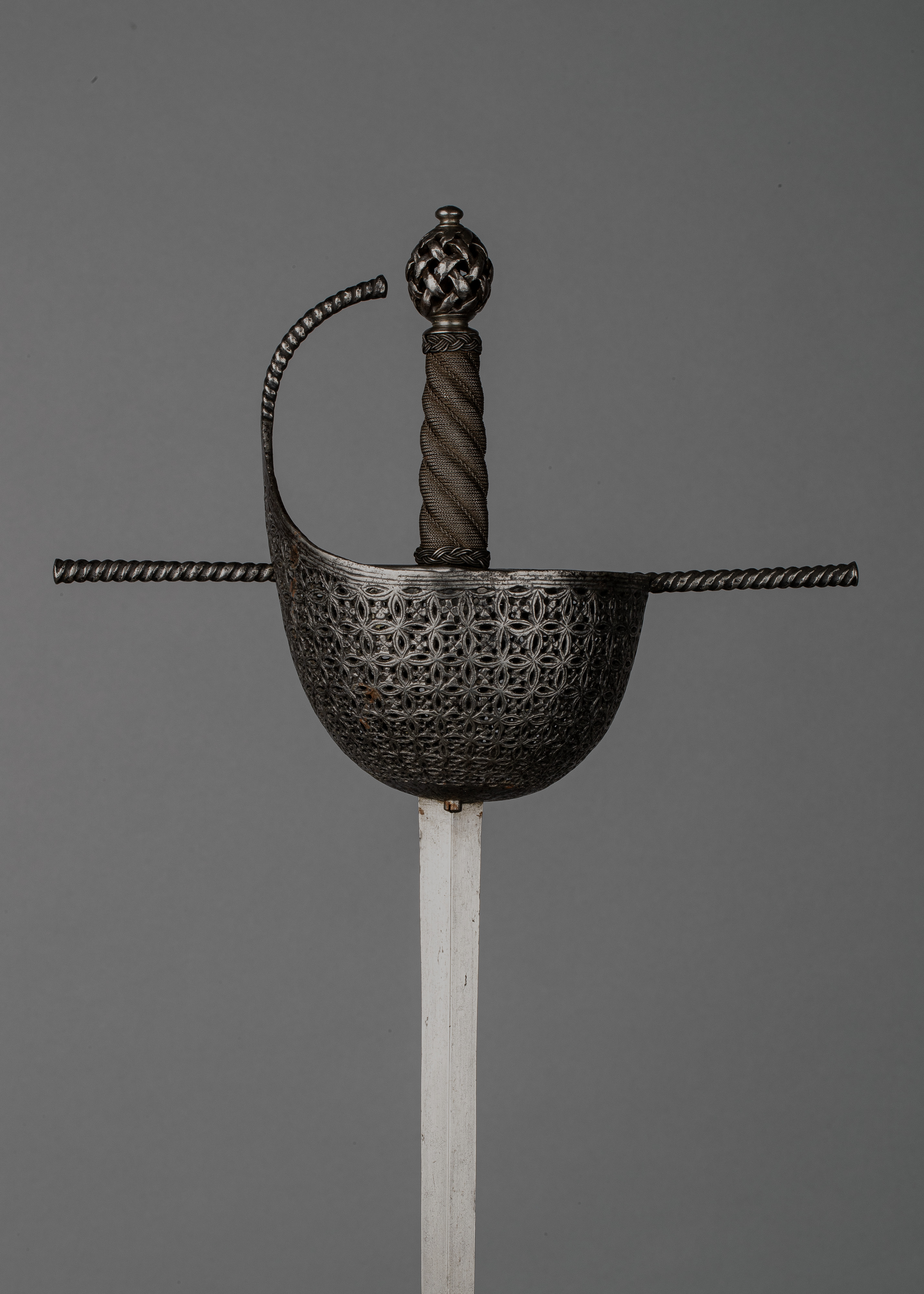
The Cup-Hilted Rapier: A Study in Steel and Status
In the annals of arms and armor, few objects capture the intersection of artistry, lethality, and social symbolism as profoundly as the Italian cup-hilted rapier. For this standalone study, Katherine Fashion Lab turns its analytical lens to a masterwork from Milan—a city that, during the late 16th and early 17th centuries, was not only a crucible of metallurgical innovation but also a theater of elite self-fashioning. This rapier, forged in high-carbon steel, is more than a weapon; it is a sartorial statement, a technological marvel, and a testament to the Renaissance cult of the individual. As we dissect its form, function, and cultural resonance, we reveal how a blade designed for the duel became an enduring archetype of power, precision, and personal identity.
Historical Provenance: The Milanese Forge
Milan, during the late Renaissance, was a powerhouse of arms production, rivaled only by Toledo and Solingen. The city’s guilds of armorers and swordmakers were renowned for their ability to balance aesthetic refinement with functional rigor. The cup-hilted rapier emerged in this milieu as a response to the evolving codes of honor and violence that defined aristocratic life. Unlike the broadswords of earlier centuries, which were brute instruments of war, the rapier was a civilian weapon—worn as a mark of gentility, yet always ready to defend one’s reputation in the street or the piazza. The Milanese cup-hilt, with its deep, hemispherical guard, offered superior hand protection while allowing for the nimble, thrust-oriented techniques championed by fencing masters like Ridolfo Capo Ferro. This rapier, then, is not merely a tool; it is a document of a society where style and survival were inextricably linked.
Materiality and Craft: The Alchemy of Steel
The choice of high-carbon steel is central to this object’s significance. For Katherine Fashion Lab, the material is not merely a substrate but a narrative medium. The blade, forged through a process of heating, hammering, and quenching, achieves a balance between hardness and flexibility—essential for a weapon designed to pierce mail or leather while resisting breakage under stress. The steel’s surface, when polished to a mirror finish, reveals subtle patterns of lamination, a hallmark of Milanese craftsmanship. The cup-hilt itself is a marvel of repoussé and chiseling: its surface is adorned with intricate scrollwork, perhaps once gilded or blued to contrast with the blade’s silver gleam. This decoration is not superfluous; it signals the owner’s wealth and taste, transforming a utilitarian object into a piece of wearable art. In the context of high fashion, steel becomes a fabric—cold, luminous, and unforgiving—yet shaped by human hands into a silhouette of controlled elegance.
Form and Function: The Anatomy of the Cup-Hilt
The cup-hilt rapier is a study in ergonomics and aesthetics. The hilt, comprising the pommel, grip, and cup guard, is designed for precision handling. The cup, typically 10 to 12 centimeters in diameter, is deep enough to envelop the hand, with a rolled edge that deflects an opponent’s blade. Inside, the guard is often lined with leather or velvet, a detail that speaks to the wearer’s comfort as much as to protection. The grip, wrapped in wire or cord, provides a tactile interface between steel and skin, allowing for subtle adjustments in angle and pressure. The blade, typically 90 to 110 centimeters in length, is slender and tapering, with a diamond or hexagonal cross-section that maximizes rigidity for the thrust. Every curve and contour is calculated: the quillons (cross-guards) are swept forward to trap an adversary’s blade, while the pommel acts as a counterweight, ensuring perfect balance. This is not a weapon of brute force; it is an extension of the fencer’s will, a tool of surgical precision.
Cultural Resonance: The Rapier as Fashion Icon
To understand the cup-hilted rapier as fashion, we must consider its role in the theater of courtly life. In Renaissance Italy, the sword was an essential accessory for any man of status, worn at the hip as a sign of rank and readiness. The cup-hilt, with its dramatic silhouette, was particularly suited to the elaborate doublets and ruffs of the period. It was a conversation piece, a symbol of the wearer’s education in the martial arts, and a marker of his adherence to the codes of chivalry and dueling. The rapier’s presence in portraits—from the works of Caravaggio to the court painters of the Medici—underscores its function as a prop of identity. In this sense, the rapier is the precursor to the modern luxury accessory: a crafted object that communicates power, lineage, and personal refinement. For Katherine Fashion Lab, this rapier embodies the principle that fashion is not merely about adornment but about the projection of self through material culture.
Technical Mastery: The Art of the Duel
The cup-hilt rapier’s design is inextricable from the evolution of fencing as a discipline. By the early 17th century, the rapier had become the preferred weapon for the duel, a ritualized form of combat that was both a legal and social mechanism for resolving disputes. The cup-hilt’s protective geometry allowed fencers to adopt a more aggressive, forward-leaning stance, exposing the hand only minimally. This shift in technique—from slashing to thrusting—required a new vocabulary of movement, codified in treatises like Capo Ferro’s Gran Simulacro dell’Arte e dell’Uso della Scherma (1610). The rapier’s balance, weight, and flexibility were calibrated to these principles, making it an instrument of both offense and defense. In the hands of a master, the rapier was a tool for controlling distance, timing, and tempo—a dance of death with its own grammar and grace.
Conservation and Legacy: The Rapier in the Modern Eye
As a standalone study, this rapier invites us to consider its life beyond the battlefield. Today, it resides in private collections and museum vitrines, its steel patinated by centuries of exposure. Conservation efforts focus on stabilizing the metal without removing the historical evidence of use—scratches from parries, nicks from thrusts, and the subtle wear of handling. For the fashion analyst, these marks are akin to the patina on a vintage handbag or the fraying on a bespoke suit; they tell a story of engagement with the world. The rapier’s legacy endures in contemporary design, from the clean lines of modern fencing foils to the ornamental daggers of haute couture runways. Its influence can be seen in the structured shoulders of a Balenciaga blazer or the metallic accents of a Givenchy gown—a reminder that the language of power and precision is timeless.
Conclusion: Steel as Second Skin
In concluding this analysis, Katherine Fashion Lab affirms that the cup-hilted rapier is far more than a historical artifact. It is a masterclass in the synthesis of form and function, a testament to Milanese metallurgy, and a mirror of Renaissance social codes. Its steel body, cold and unyielding, is paradoxically intimate—shaped to the hand, worn on the hip, and carried into the most charged moments of human interaction. As we study its lines, its weight, and its history, we recognize that fashion, at its most profound, is always about the armor we choose to wear. The rapier, in its silent elegance, reminds us that the most powerful statements are often made not with words, but with the objects we carry into the world.