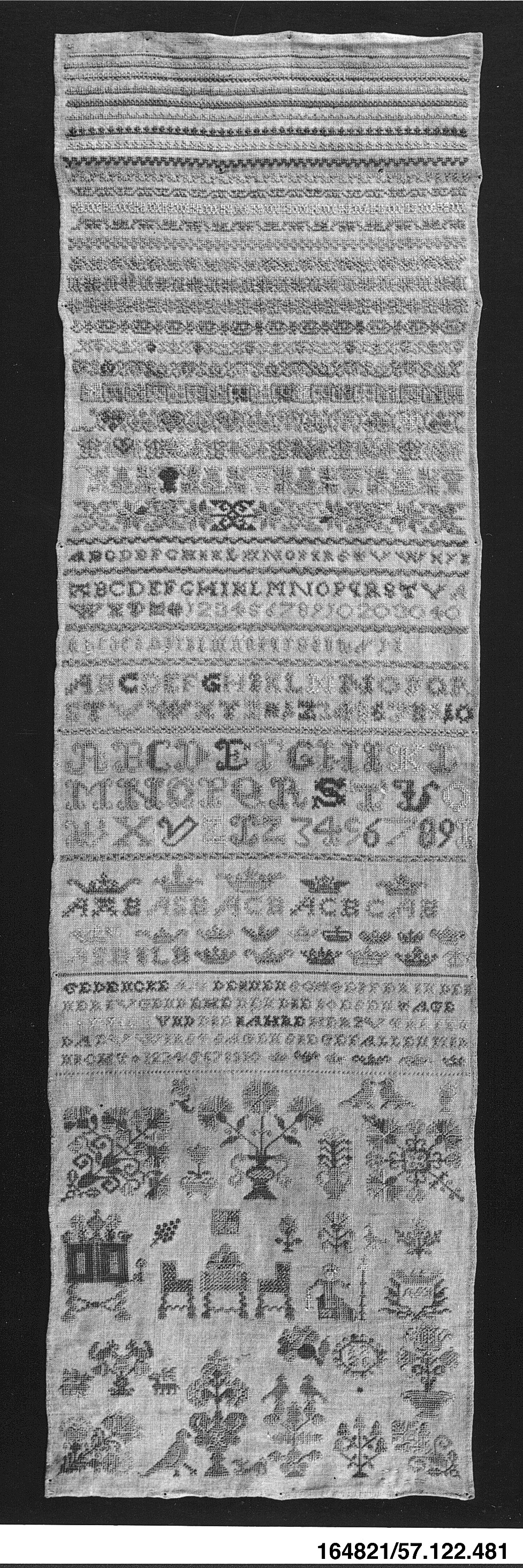
The Sampler as Couture: A Study in Global Heritage and Textural Opulence
In the rarefied echelons of haute couture, the narrative often gravitates toward the spectacular—the sculptural silhouette, the avant-garde construction, the ephemeral drama of the runway. Yet, at Katherine Fashion Lab, we recognize that true mastery often resides in the quiet, deliberate articulation of technique and heritage. The subject of our current analysis—a standalone study titled “Sampler”—represents a profound departure from conventional fashion discourse. It is not a garment in the traditional sense, but a textile artifact of immense conceptual and material weight. Crafted from silk on linen, this piece draws from a Global Heritage of needlework traditions, repositioning the humble sampler from a pedagogical tool into a statement of couture-level artistry.
Deconstructing the Sampler: From Domestic Pedagogy to Artistic Sovereignty
Historically, the sampler served as a practical record of stitching techniques, a rite of passage for young women across cultures—from the intricate cross-stitch alphabets of 17th-century Europe to the geometric precision of Japanese sashiko and the vibrant narrative panels of Central Asian suzani. Katherine Fashion Lab’s Sampler subverts this utilitarian origin. By isolating the sampler as a standalone study, the Lab elevates it from a preparatory exercise to a finished, autonomous work. The piece becomes a meditation on the act of making itself, a celebration of the hand’s intelligence in an age of mechanized production.
The choice of materials is critical to this reinterpretation. Silk on linen is a dialogue between opulence and austerity. Linen, a fiber with roots in ancient civilizations—from Egyptian mummy wrappings to Irish damask—provides a grounded, tactile foundation. Its natural irregularities and subtle slubs speak to a global history of agrarian labor and domestic craft. Upon this earthy canvas, the silk thread performs a counterpoint of luxury. Silk, historically traded along the Silk Road and prized by empires from China to Byzantium, introduces a luminous, almost liquid quality. The interplay is not merely visual but haptic: the cool, matte texture of linen against the warm, glossy sheen of silk creates a tension that is both sensuous and intellectually stimulating.
Technique as Narrative: The Language of Stitch
In the Sampler, stitch becomes syntax. The piece likely employs a repertoire of techniques that span continents and centuries. Chain stitch, a technique found in ancient Peruvian textiles and later refined in European embroidery, creates a continuous, flowing line—suggesting connectivity and unbroken tradition. Satin stitch, with its dense, smooth coverage, offers areas of pure color and light, reminiscent of the luminous halos in Byzantine icons or the polished surfaces of Mughal courtly garments. Seed stitch, a scattering of small, discrete knots, introduces texture and rhythm, echoing the granular patterns of African kente cloth or the stippled effects of French petit point.
Katherine Fashion Lab’s execution likely transcends mere technical proficiency. The arrangement of these stitches is not random but choreographed. A diagonal line of herringbone stitch might bisect a field of stem stitch, creating a visual counterpoint that mirrors the global exchange of ideas. The density of thread is manipulated to produce gradients of opacity and transparency, areas where the linen ground shows through, creating a sense of depth and breath. This is not embroidery as decoration, but embroidery as structural language—a lexicon where each stitch is a word, each row a sentence, and the entire composition a narrative of cultural convergence.
Global Heritage: A Cartography of Influence
The Global Heritage of the Sampler is not a passive reference but an active, curated dialogue. Consider the geometric motifs that may appear: a diamond pattern echoes the gol (medallion) designs of Turkmen carpets, while a stepped zigzag recalls the meander of ancient Greek pottery. A floral spray might reference the tree of life motifs common to Persian and Indian textiles, while a border of repeating crosses could nod to the blackwork embroidery of Tudor England. Each motif is a node in a vast network of human creativity, a testament to how techniques and symbols migrate, adapt, and hybridize across borders.
This is not cultural appropriation but cultural cartography. The Lab acknowledges the specific origins and meanings of these motifs—the spiritual significance of the suzani sunburst, the protective symbolism of the evil eye in Mediterranean embroidery—while allowing them to coexist in a new, harmonious syntax. The sampler becomes a map of the world, stitched not with borders but with bridges. It asks the viewer to consider how a stitch made in a 17th-century English parlor might share a formal kinship with a stitch made in a 19th-century Uzbek workshop, and what that kinship reveals about our shared human desire to order, beautify, and communicate.
Standalone Study: The Sampler as Finished Object
The designation of this piece as a standalone study is a deliberate curatorial and conceptual choice. In the hierarchy of fashion, the textile is often subservient to the garment. Here, the textile is the garment, the architecture, the final statement. The Sampler exists without the necessity of a body, a hanger, or a context. It is a pure object of contemplation, akin to a painting or a sculpture. This autonomy challenges the viewer to engage with the work on its own terms—to read the stitches as one reads a poem, to feel the texture as one feels a landscape.
From a design perspective, the Sampler also functions as a speculative prototype. It suggests possibilities for future collections: a dress constructed entirely of embroidered panels, a jacket where the sampler serves as a back piece, or a series of accessories that isolate individual motifs. Yet, in its current state, it resists commodification. It is a study in the purest sense—a laboratory of ideas, a repository of technique, a testament to the time and labor that defines true couture.
Conclusion: The Couture of Patience
In an industry increasingly driven by speed, digital rendering, and mass production, Katherine Fashion Lab’s Sampler stands as a quiet manifesto. It declares that couture is not merely about the final product but about the process—the hundreds of hours of hand-stitching, the global knowledge encoded in each thread, the intimate relationship between maker and material. The piece is a meditation on patience, precision, and the enduring power of the hand. It reminds us that the most profound statements in fashion are not always the loudest, but those that whisper of heritage, craft, and the infinite complexity of a single, perfect stitch.