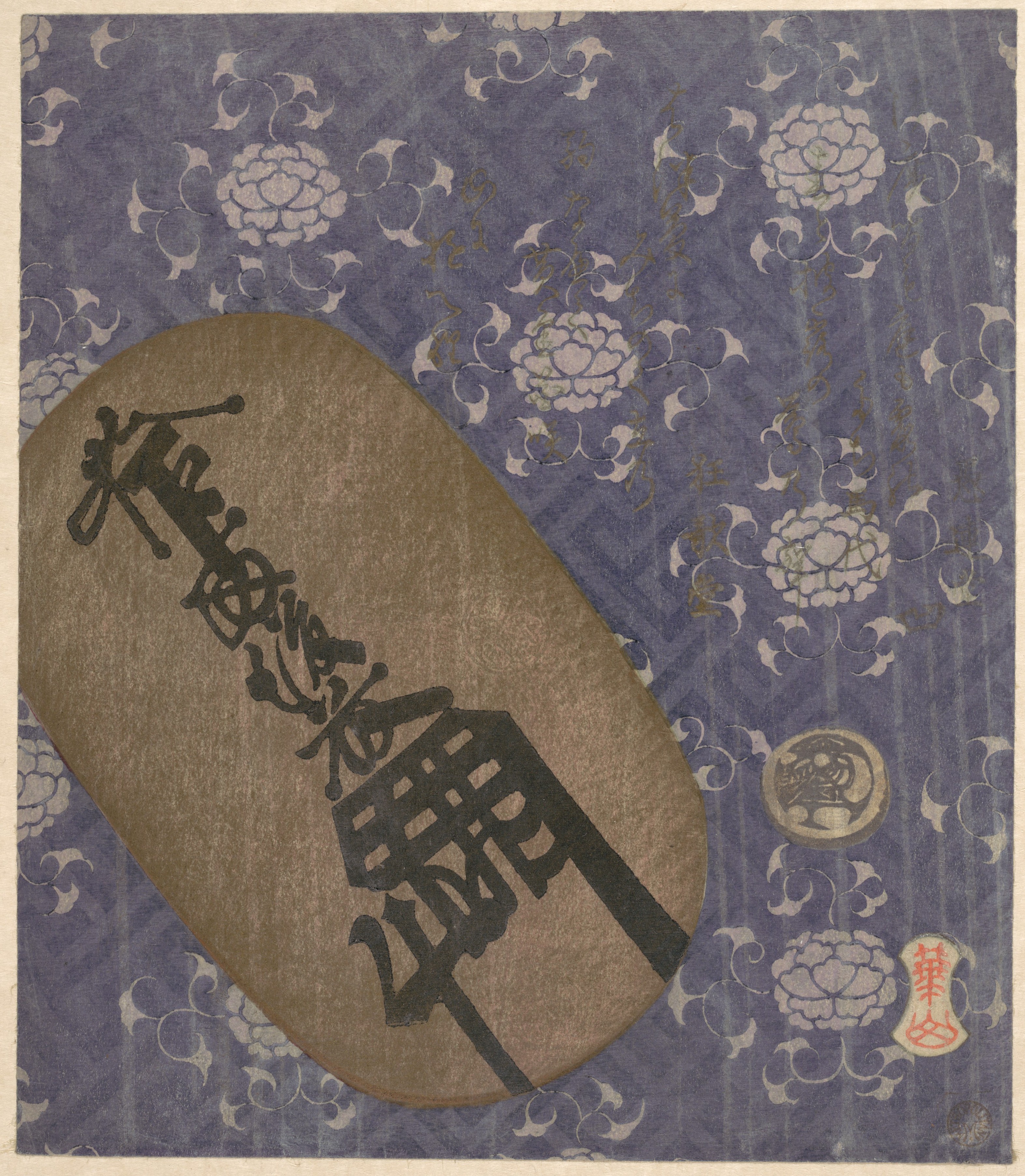
The Currency of Beauty: A Couture Analysis of Ōban Gold and Mameita-Gin Silver Coinage Against Peony-Decorated Paper
In the rarefied world of haute couture, the dialogue between materiality and symbolism is paramount. At Katherine Fashion Lab, we dissect not merely garments but the very artifacts that inspire the textile narratives of tomorrow. The subject of this analysis is a singular work: a Japanese woodblock print (surimono) executed in ink and color on paper, depicting an Ōban gold coin and a mameita-gin silver “bean coin” resting upon a peony-motif decorated paper. This standalone study, originating from the Edo period, transcends its status as a decorative print to become a profound commentary on value, nature, and aesthetic hierarchy. For the couturier, it offers a masterclass in contrast, texture, and the fusion of opulence with organic grace.
The Anatomy of Wealth: Ōban and Mameita-Gin as Textile Motifs
The Ōban, a large oval gold coin of the Tokugawa shogunate, represents the apex of monetary authority. Its sheer scale and lustrous, unadorned gold surface speak to a power that is absolute and self-evident. In couture, the Ōban translates to a statement of bold, unapologetic luxury. The fabric equivalent would be a heavy, metallic gold brocade—perhaps a lampas weave of pure silk and gold thread (kinran)—cut in clean, architectural lines. The coin’s smooth, reflective quality suggests a fabric with a high sheen, such as satin charmeuse or a liquid metallic lame, that catches light with every movement. The absence of intricate detailing on the coin itself is a deliberate design choice: it is a canvas of pure, uncompromising value, demanding attention through its very restraint.
In stark contrast, the mameita-gin—a small, irregularly shaped silver “bean coin”—embodies a different form of wealth: one that is tactile, granular, and organic. Its name, “bean coin,” evokes a sense of growth and natural form. The silver surface, often textured from the casting process, suggests a matte or brushed metallic finish in fabric. Think of a silver organza pleated to create a pebbled texture, or a hand-embroidered surface using small, irregular silver sequins to mimic the coin’s lumpy contour. The mameita-gin is the whisper of wealth, the quiet accumulation of value. In a couture context, it represents the power of detail—the subtle, almost hidden luxury found in a complex weave or a meticulously placed embellishment. The interaction between the Ōban’s grand statement and the mameita-gin’s intimate scale creates a dynamic tension that is central to the print’s visual rhythm.
The Peony as Symbolic Ground: Nature’s Counterpoint to Currency
Beneath these metallic forms lies the peony-motif decorated paper, a surface that transforms the composition from a simple still life into a layered narrative. The peony, known as the “king of flowers” in Japanese culture, symbolizes wealth, honor, and prosperity—a direct parallel to the coins themselves. However, the peony is also a symbol of ephemeral beauty, of the fleeting nature of spring. This duality is crucial. The paper, likely a karakami (Chinese-style paper) with a woodblock-printed pattern, provides a soft, matte, and organic counterpoint to the hard, reflective metals above it.
For the designer, the peony pattern offers a rich vocabulary of motifs. The layered petals, the vibrant shades of pink, red, and white, and the curvilinear stems can be translated into a variety of textile techniques. Consider a jacquard weave where the peony is rendered in a subtle tone-on-tone effect, or a digital print that captures the watercolor-like bleeding of the original woodblock ink. The paper’s texture—slightly absorbent, with a natural tooth—suggests a fabric like raw silk, linen, or a fine cotton voile. The peony pattern is not merely a background; it is the philosophical soil from which the coins emerge, grounding abstract value in the tangible reality of nature. The contrast between the metallic sheen of the coins and the matte, floral paper creates a visual and tactile dialogue that is the essence of sophisticated design.
Material Alchemy: Translating Woodblock Print to Fabric
The technical execution of the surimono is itself a lesson in material alchemy. The woodblock print process—carving, inking, and pressing—creates a surface that is both graphic and textural. The ink sits slightly raised on the paper, and the colors (such as the deep indigo, vermilion, and gold) are applied in distinct, layered blocks. For the couture collection, this translates to a multi-layered approach to fabric construction.
One could envision a three-dimensional textile that mimics the print’s depth. The Ōban’s gold might be rendered in a metallic leather or a gold foil-embossed silk, its surface smooth and reflective. The mameita-gin could be represented by hand-stitched silver bugle beads or tiny, irregularly shaped sequins sewn onto a base of matte silver silk charmeuse, creating a tactile, uneven surface that catches light differently from every angle. The peony paper would be the foundation: a hand-painted or digitally printed silk organza in layered shades of coral, blush, and sage green, with the floral pattern echoing the curves of the coins above.
The genius of this translation lies in the interplay of finishes: matte vs. gloss, smooth vs. textured, organic vs. geometric. The print’s composition—the large oval coin, the scattered silver beans, and the floral ground—suggests a garment with structured, sculptural elements (a fitted bodice or a sharp-shouldered jacket in gold) offset by softer, draping components (a flared skirt or a flowing cape in the peony print). The mameita-gin coins could be scattered across the garment as strategic embellishments, like constellations of silver on a floral night sky.
From Study to Silhouette: A Couture Proposition
This print is not merely a pattern to be copied; it is a design philosophy. The Ōban and mameita-gin represent two poles of luxury: the monumental and the intimate. The peony paper represents the natural world that both contains and transcends human constructs of value. For Katherine Fashion Lab, the resulting collection would explore these themes through silhouette, texture, and color.
Imagine a gown where the bodice is a sculptural armor of gold lamé, echoing the Ōban’s authority. The skirt, in contrast, is a cascade of peony-printed silk tulle, layered to create a sense of depth and movement, with silver mameita-gin beads scattered along the hem like fallen coins. The sleeves could be a sheer organza, printed with a delicate peony pattern, allowing the skin to show through—a nod to the paper’s transparency. The color palette would be restrained: the deep gold of the Ōban, the cool silver of the mameita-gin, and the rich, earthy tones of the peonies: crimson, blush, ivory, and forest green.
Accessories would further this narrative. A structured handbag in gold leather, shaped like an elongated Ōban, with a clasp of silver “bean” studs. Jewelry in mixed metals: a large, smooth gold pendant paired with a necklace of irregular, matte silver beads. The design language is one of controlled opulence—where every element, from the largest panel to the smallest bead, is imbued with meaning.
Conclusion: The Enduring Value of Contrast
This surimono is a testament to the Japanese aesthetic principle of wabi-sabi—the beauty found in imperfection, impermanence, and contrast. The polished gold coin and the rough silver bean are not rivals; they are complementary forces. The peony, blooming and fading, reminds us that all value is contextual. For the couture house, this analysis yields a collection that is intellectually rigorous and visually stunning. It challenges the wearer to consider what constitutes true luxury: the bold statement or the quiet detail, the eternal metal or the fleeting flower. At Katherine Fashion Lab, we conclude that true elegance lies in the masterful orchestration of all these elements, creating a garment that is not just worn, but experienced—a wearable artifact of beauty and meaning. The currency of this design is not gold or silver, but the enduring power of artistic contrast.