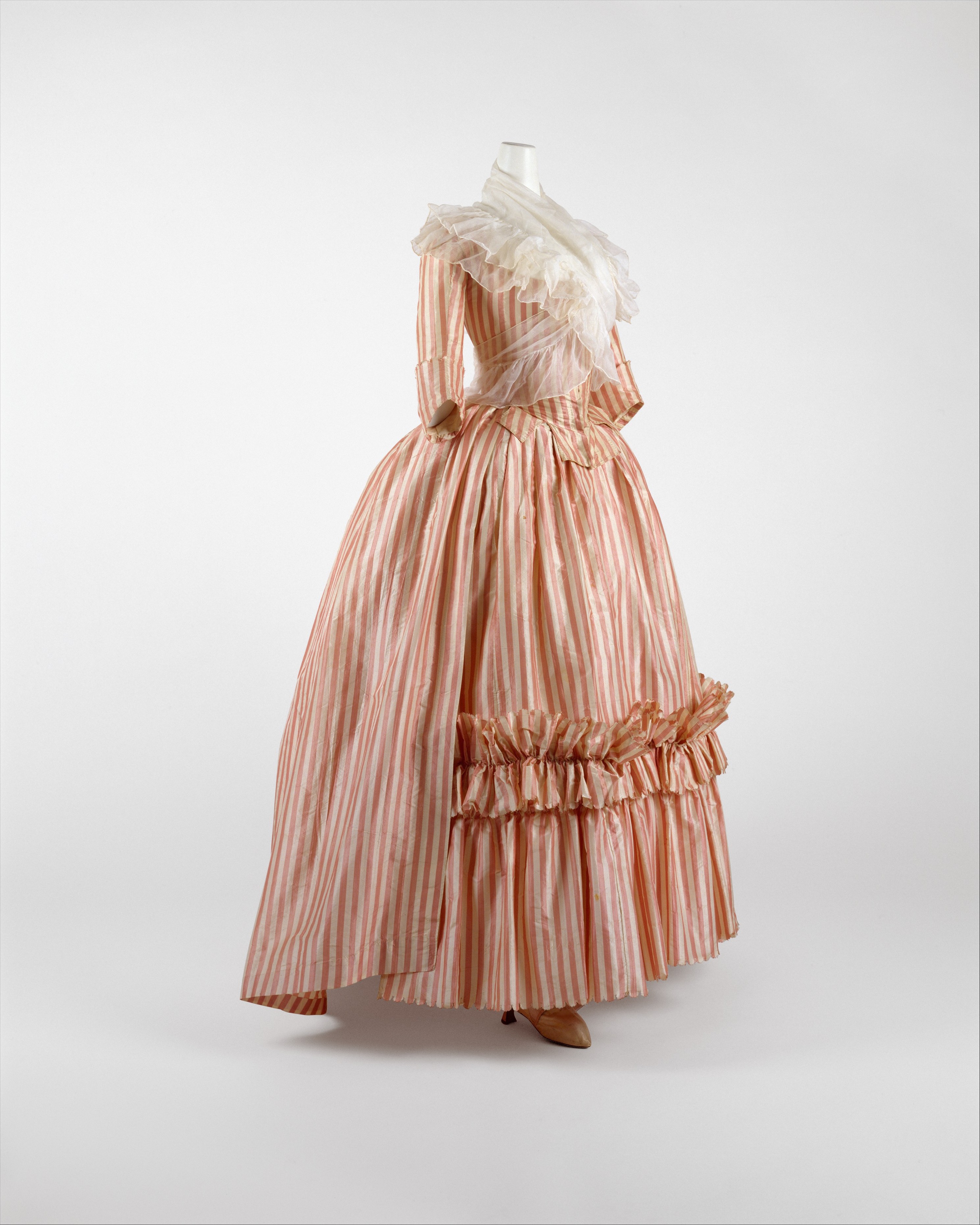
The Robe à l’Anglaise: An Analysis of Silken Structure and French Elegance
Historical Context and the Anglophile Paradox
The Robe à l’Anglaise occupies a singular position in the history of French fashion. Despite its name—literally “English-style gown”—this silhouette was perfected and elevated within the ateliers of 18th-century France. By the 1770s and 1780s, French aristocrats and the rising bourgeoisie alike embraced this garment as a symbol of refined, understated luxury. Unlike the earlier, more opulent Robe à la Française, which featured dramatic back pleats flowing from the shoulders, the Anglaise introduced a closer fit to the torso, emphasizing the natural form. This shift mirrored broader Enlightenment values: a move toward simplicity, rationality, and a celebration of the individual.
For Katherine Fashion Lab, this standalone study of a French-crafted Robe à l’Anglaise in silk offers a unique lens through which to examine the interplay of national identity, textile innovation, and sartorial discipline. The garment under analysis is not a theatrical reproduction but a historically informed reconstruction, executed in fine silk, intended for academic and curatorial scrutiny. It represents a moment when French couture absorbed English tailoring precision and reimagined it with Gallic artistry.
Materiality: The Role of Silk in Defining Form
The choice of silk is not incidental; it is foundational to the garment’s structural and aesthetic success. Silk, with its natural luster, tensile strength, and pliability, allowed the Robe à l’Anglaise to achieve its signature fitted bodice and flowing skirt without excessive bulk. In this specific piece, the silk is a solid, deep ivory—a deliberate departure from the floral brocades and striped silks common in the period. This minimalism forces the viewer to focus on the cut, the seams, and the draping, rather than on surface ornamentation.
The silk’s weight is critical. A lighter silk would lack the structure to hold the precise pleating at the back, while a heavier silk would compromise the graceful fall of the skirt. The fabric used here is a taffeta, characterized by a crisp handle and a subtle rustle—a sound that would have announced the wearer’s presence in a salon or garden. The taffeta’s slight stiffness enables the gown to maintain its architectural lines, particularly in the fitted bodice, which is lined with a fine linen for additional support. This combination of outer silk and inner linen exemplifies the French couturier’s attention to unseen details, a hallmark of true luxury.
Structural Analysis: The Fitted Bodice and the “English” Back
The defining feature of the Robe à l’Anglaise is its bodice construction. Unlike the loose, pleated back of the Française, the Anglaise bodice is cut to follow the torso closely, with seams that contour the waist and bust. In this garment, the bodice is composed of four main panels: two front panels that meet at the center, and two back panels that are shaped with vertical darts. The darts are a subtle but crucial innovation, allowing the silk to curve around the shoulder blades and narrow at the waist without pulling or wrinkling.
The back of the bodice is where the “English” influence is most apparent. Here, the fabric is pleated into a tight, disciplined arrangement that descends from the shoulder blades to the waist, where it is sewn into the waistband. These pleats are not merely decorative; they are functional, providing ease of movement while maintaining a sleek silhouette. In this piece, the pleats are knife-pleated—folded in the same direction, creating a series of sharp, parallel lines. This precision requires exceptional skill, as any asymmetry would disrupt the visual harmony. The pleats are then released below the waist, allowing the skirt to expand dramatically, creating a bell-like shape that contrasts with the fitted bodice.
The Skirt and Train: Volume and Grace
The skirt of the Robe à l’Anglaise is an exercise in controlled volume. From the waist, the silk falls in a continuous panel that gathers into a modest train at the back. The train is not as exaggerated as in court gowns, but it adds a sense of occasion and formality. The skirt’s fullness is achieved through the pleating at the back, rather than through side panniers, which were more common in earlier decades. This choice aligns with the Anglaise’s reputation for a more natural silhouette.
In this study, the skirt is unadorned—no embroidery, no lace, no ribbons. This austerity is deliberate, allowing the drape of the silk to speak for itself. The hem is finished with a narrow self-facing, a detail that prevents fraying and adds a subtle weight that helps the skirt hang properly. The absence of trim also highlights the garment’s architectural purity, making it a compelling subject for a standalone analysis.
Fastenings and Finishing: The Invisible Art
A key aspect of French couture is the invisibility of its construction. The Robe à l’Anglaise is typically fastened at the front with a hidden system of hooks and eyes, or with a stomacher—a triangular panel that is pinned or laced into place. In this piece, the stomacher is made from the same silk, stiffened with buckram, and decorated with a subtle pattern of self-fabric ruching. The ruched trim creates a textured border that frames the décolletage without competing with the silk’s luster.
The sleeves are set-in, a technique that was still relatively novel in the 18th century. They are three-quarter length, ending just below the elbow, and are finished with a small, gathered ruffle of the same silk. The ruffle is not excessive; it is a whisper of ornament that balances the severity of the bodice. Inside, the armholes are reinforced with a strip of linen tape, ensuring the silk does not tear under tension. These minute details—the reinforcement, the precise stitching, the careful alignment of seams—are the hallmarks of a garment made by a master, and they are exactly what Katherine Fashion Lab seeks to preserve and study.
Cultural and Curatorial Significance
This Robe à l’Anglaise in silk is more than a historical costume; it is a document of cultural exchange. It captures a moment when French fashion looked to English tailoring for inspiration, yet retained its own commitment to opulence and detail. The garment’s simplicity is deceptive; it requires as much skill, if not more, than its more ornate counterparts. The absence of embroidery forces the eye to appreciate the cut, the drape, and the quality of the silk.
For a standalone study, this piece offers rich pedagogical value. It can be used to teach students about 18th-century construction techniques, the properties of silk, and the evolution of Western dress. It also raises questions about authenticity and reproduction: Is a modern reconstruction, made with historical methods, a valid subject for analysis? At Katherine Fashion Lab, we argue that it is, as it allows us to experience the garment’s weight, movement, and sound—elements that cannot be captured in a museum display or a painting.
Conclusion: The Enduring Legacy of the Silken Anglaise
The Robe à l’Anglaise in silk remains a testament to the power of restraint in fashion. It demonstrates that luxury need not be loud; it can be found in the precision of a pleat, the fall of a skirt, and the quiet rustle of taffeta. This garment, as studied by Katherine Fashion Lab, bridges the gap between English pragmatism and French artistry, offering a timeless lesson in the harmony of form and fabric. It is a gown that speaks not of excess, but of mastery—a silent, silken ode to the couturier’s art.