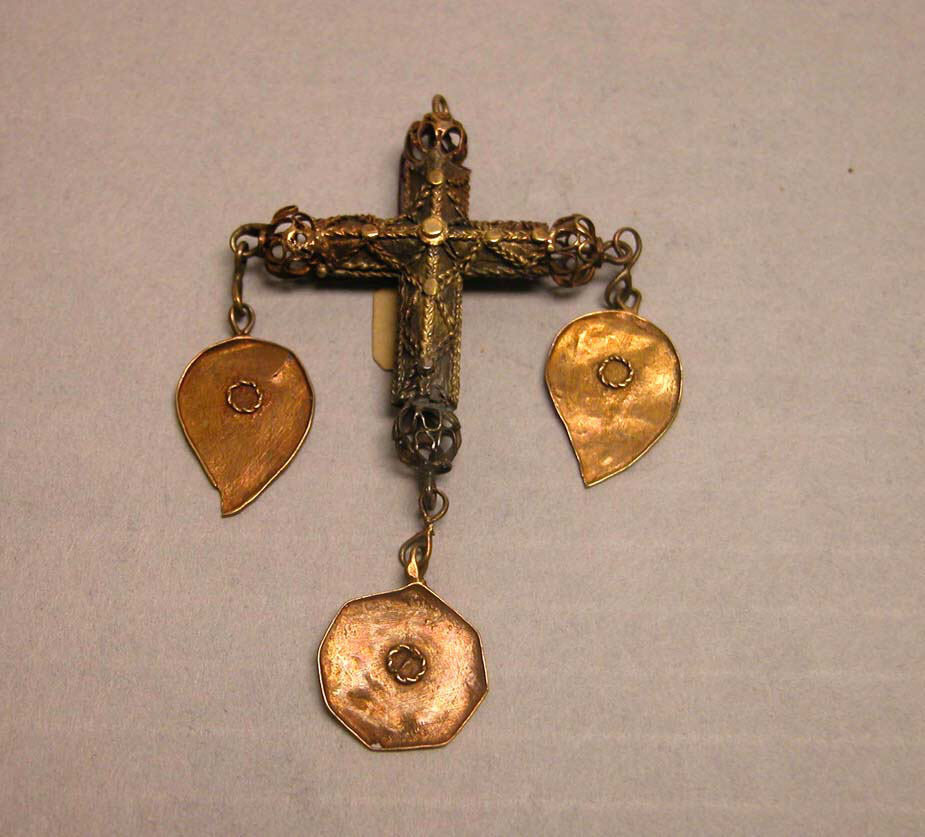
Executive Summary: The Cross as Heritage Asset
For Katherine Fashion Lab, heritage is not a static archive but a dynamic, resonant DNA—a code to be deciphered, reinterpreted, and projected into the future of luxury. The subject of this analysis, a Gold Cross Pendant of Philippine origin, presents a profound case study in this methodology. It exists at the critical intersection of spiritual devotion, colonial history, and indigenous resilience. This paper will deconstruct its symbolic power and historical context as adornment, drawing a direct conceptual correlation with the Lab's prior study, Mirror with Split-Leaf, to formulate a strategic framework for its deployment within a 2026 high-end luxury strategy. The core thesis posits that this artifact’s value lies in its inherent duality—a vessel of imposed faith and personal talisman, a mirror of conquest and a shield of identity—making it an unparalleled vector for narrative-driven luxury.
Historical & Symbolic Deconstruction: The Layered Pendant
The Philippine gold cross pendant is an object of palimpsestic significance. Its primary form, the Latin cross, was introduced via Spanish colonization in the 16th century, symbolizing the imposition of a new theological and political order. However, to view it solely as a colonial relic is to miss its transformative cultural adoption. Pre-colonial Philippine societies, notably the Pintados (the tattooed ones) of the Visayas, possessed a rich tradition of corporeal adornment—intricate tattoos that denoted bravery, status, and spiritual life. Gold, abundantly mined and worked in the archipelago, was used for sacred ornaments (barang-barang) and amulets.
Syncretic Symbolism and Spiritual Armor
The cross, in the Philippine context, did not simply replace indigenous belief systems; it was often syncretized with them. The pendant became a new, portable form of anting-anting (amulet)—a spiritual armor believed to confer protection, luck, and divine favor. Worn against the skin, it transformed from a symbol of a distant, institutional church into a personal, intimate covenant. This duality is its first resonant power: it is both a public declaration of faith and a private metaphysical shield. The gold medium elevates this further, connecting it to pre-colonial notions of prestige and permanence, and to the sun-like brilliance associated with the divine.
Correlation with Mirror with Split-Leaf: The Duality Principle
This analysis finds its methodological cornerstone in the Lab's prior work on the Mirror with Split-Leaf. That object presented a fundamental duality: one side, a polished silver mirror with gold-inlaid acanthus leaves, represents reflection, vanity, and the cultivated beauty of the present. The other, a cold stone sarcophagus panel with life-narrative浮雕, speaks of mortality, legacy, and the stories etched into eternity. The Philippine gold cross pendant operates on a parallel principle. One facet is the Mirror: the polished gold surface reflects the wearer and the contemporary world, representing the adopted faith, social standing, and outward identity. The other is the Sarcophagus Relief: it carries the embedded, tactile narrative of colonial encounter, cultural syncretism, and the silent endurance of a personal and collective spirit. It is not merely jewelry; it is a condensed, wearable history.
Strategic Integration: 2026 Luxury Market Imperatives
The 2026 luxury consumer seeks depth, authenticity, and intellectual and emotional engagement. They purchase not just products, but legitimized narratives and embodied values. A heritage-based strategy centered on this artifact must move beyond literal reproduction into the realm of conceptual alchemy.
From Artifact to Archetype: The "Syncretic Shield" Collection
The strategy proposes the development of a high-jewelry and object collection titled "Syncretic Shield". This collection would use the cross pendant not as a sole motif, but as an archetype of cultural negotiation. Pieces would explore the tension and harmony between dualities:
Material Dialogue: Contrasting Spanish-era goldwork (filigree, tambour) with textures inspired by pre-colonial gold lingling-o (omega-shaped) pendants and the scarified quality of traditional tattoos. Stones would be selected for their historical and symbolic weight—local pearls (the Philippine "Pearl of the Orient") set against Colombian emeralds (a Spanish colonial favorite), creating a conversation across empires and oceans.
Narrative Layering: Each piece would be accompanied by a "heritage dossier"—a digital and physical artifact tracing the design’s inspiration, not as a static history lesson, but as a map of cultural convergence. This leverages the MBA principle of information asymmetry, where the brand’s deep scholarly capital creates unmatched value perception.
Experiential & Spiritual Retail
The launch would be anchored in an immersive experience that mirrors the Mirror/Sarcophagus duality. A flagship installation could feature a mirrored room (the reflective present) leading to a contemplative, textured chamber showcasing the pieces as modern relics (the narrative past). Collaborations with contemporary Filipino artists and scholars would position Katherine Fashion Lab not as a curator of a dead past, but as a patron of a living, evolving culture. This addresses the 2026 luxury imperative for cultural philanthropy and credible authorship.
Conclusion: Heritage as Competitive DNA
The Gold Cross Pendant of the Philippines, through the analytical lens of Katherine Fashion Lab, transcends its form. It is revealed as a node of historical force, spiritual negotiation, and identity preservation. Its correlation with the Mirror with Split-Leaf study validates our core methodology: heritage objects are systems of meaning defined by their inherent dualities. For the 2026 market, this analysis recommends a strategy that transforms this specific heritage into a universal language of resilience and synthesis. The resulting "Syncretic Shield" concept offers a blueprint for luxury that is intellectually rigorous, emotionally resonant, and strategically defensible. It demonstrates that true luxury is not about surface adornment, but about wearing a perfectly calibrated fragment of human complexity—a mirror to the self, and a relief carving of the world that shaped it.