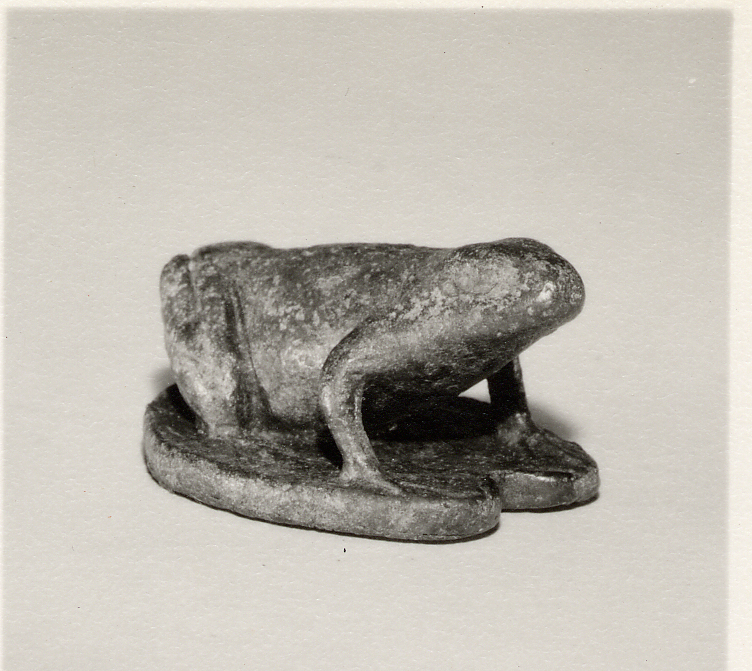
Heritage Analysis: The Frog on a Lotus Pad (Ancient Civilization Bronze Weight)
This strategic analysis examines a singular artifact—a small bronze or copper alloy frog seated upon a lotus pad, likely used as a weight in an ancient civilization. As Lead Heritage Curator for Katherine Fashion Lab, I assess this object not merely as a functional tool, but as a potent repository of symbolic power, historical adornment, and spiritual meaning. The findings inform a high-end luxury strategy for 2026, positioning the frog-on-lotus motif as a cornerstone of narrative-driven, culturally resonant design.
Symbolic Power: The Frog as a Transcultural Icon of Abundance and Transformation
The frog, across multiple ancient civilizations—including Mesopotamian, Egyptian, Indus Valley, and early Chinese contexts—embodies a dual symbolism of fertility and rebirth. Its association with water, rain, and the annual flooding of rivers (particularly the Nile and the Tigris-Euphrates) made it a potent emblem of agricultural abundance and life-giving forces. In ancient Egypt, the frog-headed goddess Heket presided over childbirth and creation, while in pre-dynastic China, the frog was linked to the moon, rain, and the cyclical nature of life. The lotus pad, emerging pristine from murky waters, reinforces this narrative of purity emerging from chaos, spiritual enlightenment, and the eternal cycle of death and regeneration.
As a weight, the frog-on-lotus likely served in market transactions or as a counterbalance in scales. This utilitarian function elevates its symbolic power: the object literally anchors value and measures worth. In a luxury context, this translates into a metaphor for grounding, stability, and the intrinsic value of heritage. The frog does not merely sit; it holds—a subtle but profound statement of authority and balance. For Katherine Fashion Lab, this symbolism can be leveraged to represent the equilibrium between tradition and innovation, between the organic and the crafted.
Historical Adornment: Bronze Craftsmanship and the Art of the Weight
The medium—bronze or copper alloy—speaks to a sophisticated metallurgical tradition. In ancient civilizations, bronze was a material of prestige and durability, often reserved for ritual objects, weapons, and trade goods. The frog-on-lotus weight would have been cast using the lost-wax method, a technique requiring exacting skill. The surface patina, whether intentionally induced or naturally aged, adds a layer of visual depth and tactile history. The small scale of the object (likely 3–6 cm in diameter) suggests it was designed for intimate handling—perhaps held in the palm during transactions or placed on a household altar.
Adornment in this context is not decorative in the modern sense; it is functional elegance. The frog’s limbs are often stylized, the lotus petals rendered with geometric precision. This aesthetic aligns with the minimalist luxury trend of 2026, where simplicity and material integrity supersede ornamentation. The weight’s compact form also invites wearable reinterpretation—as a pendant, a brooch, or a charm on a high-end handbag. The historical precedent of portable, meaningful objects (e.g., Roman amulets, Chinese toggles) supports this direction.
Spiritual Meaning: The Frog as a Guardian of Thresholds and Prosperity
Spiritually, the frog-on-lotus motif operates at the intersection of the earthly and the divine. The frog, an amphibian, inhabits both water and land, symbolizing the transition between worlds—between the subconscious and the conscious, between life and death. The lotus, rooted in mud but blooming above water, represents spiritual awakening and purity. Together, they form a talisman for protection, prosperity, and safe passage through life’s transitions.
In many ancient cultures, such weights were placed in tombs or buried under thresholds to ward off negative energies. The frog’s croaking was believed to summon rain and dispel drought—a metaphor for abundance in times of scarcity. For a luxury brand, this spiritual dimension offers a powerful narrative: the object is not just an accessory, but a guardian of the wearer’s journey, a silent companion that ensures balance and fortune. This aligns with the 2026 consumer desire for meaningful luxury—pieces that carry intention, history, and a sense of ritual.
2026 High-End Luxury Strategy: Integrating the Frog-on-Lotus Motif
Based on this analysis, Katherine Fashion Lab can deploy the frog-on-lotus motif across three strategic pillars: narrative storytelling, craftsmanship elevation, and limited-edition exclusivity.
Narrative Storytelling: The frog-on-lotus weight should be positioned as a curatorial artifact—a muse for the brand’s 2026 collection. A dedicated micro-site or lookbook could detail its provenance, symbolism, and the ancient technologies used in its creation. This educational approach builds brand authority and emotional connection, appealing to the discerning consumer who values cultural literacy.
Craftsmanship Elevation: The weight’s bronze patina and compact geometry can inspire a capsule of hardware-forward accessories: belt buckles, bag clasps, and jewelry closures. Collaborations with contemporary metal artisans to recreate the lost-wax casting technique would reinforce the brand’s commitment to artisanal integrity. The motif could also be translated into embroidery or jacquard on silk scarves and evening wear, using metallic threads to mimic the bronze’s sheen.
Limited-Edition Exclusivity: A series of 100 numbered pieces—perhaps a bronze frog-on-lotus pendant or a desk weight—could be offered to VIP clients. Each piece would come with a certificate of authenticity and a historical dossier, transforming the object into a collectible. This strategy taps into the growing market for investable luxury items that transcend fashion cycles.
Conclusion: Anchoring Value in Heritage
The frog on a lotus pad, though humble in scale, carries the weight of millennia. Its symbolism of abundance, transformation, and spiritual guardianship offers Katherine Fashion Lab a rich lexicon for 2026. By honoring the artifact’s original function as a measure of value, the brand can position itself as a custodian of meaning in an era of ephemeral trends. The frog-on-lotus is not merely a motif; it is a strategic anchor—a reminder that true luxury is grounded in history, balanced by purpose, and elevated by craft.