Deconstructing the Sacred: A Couture Analysis of “The Holy Family with the Infant Saint John the Baptist”
In the rarefied world of haute couture, where fabric becomes narrative and silhouette speaks to history, the analysis of a masterpiece often transcends the canvas. At Katherine Fashion Lab, we approach the “The Holy Family with the Infant Saint John the Baptist”—a stunning oil-on-wood artifact from the Global Heritage collection—not merely as a religious icon but as a profound study in textile theology, drapery as power, and the architecture of familial intimacy. This standalone study, executed with the luminous precision of oil on wood, offers a lexicon of design principles that resonate deeply with the modern couturier. It is a masterclass in the interplay of sacred geometry and organic fluidity, a dialogue between the eternal and the ephemeral that defines the highest echelons of fashion.
The Palette of Devotion: Chromatic Hierarchy in Oil
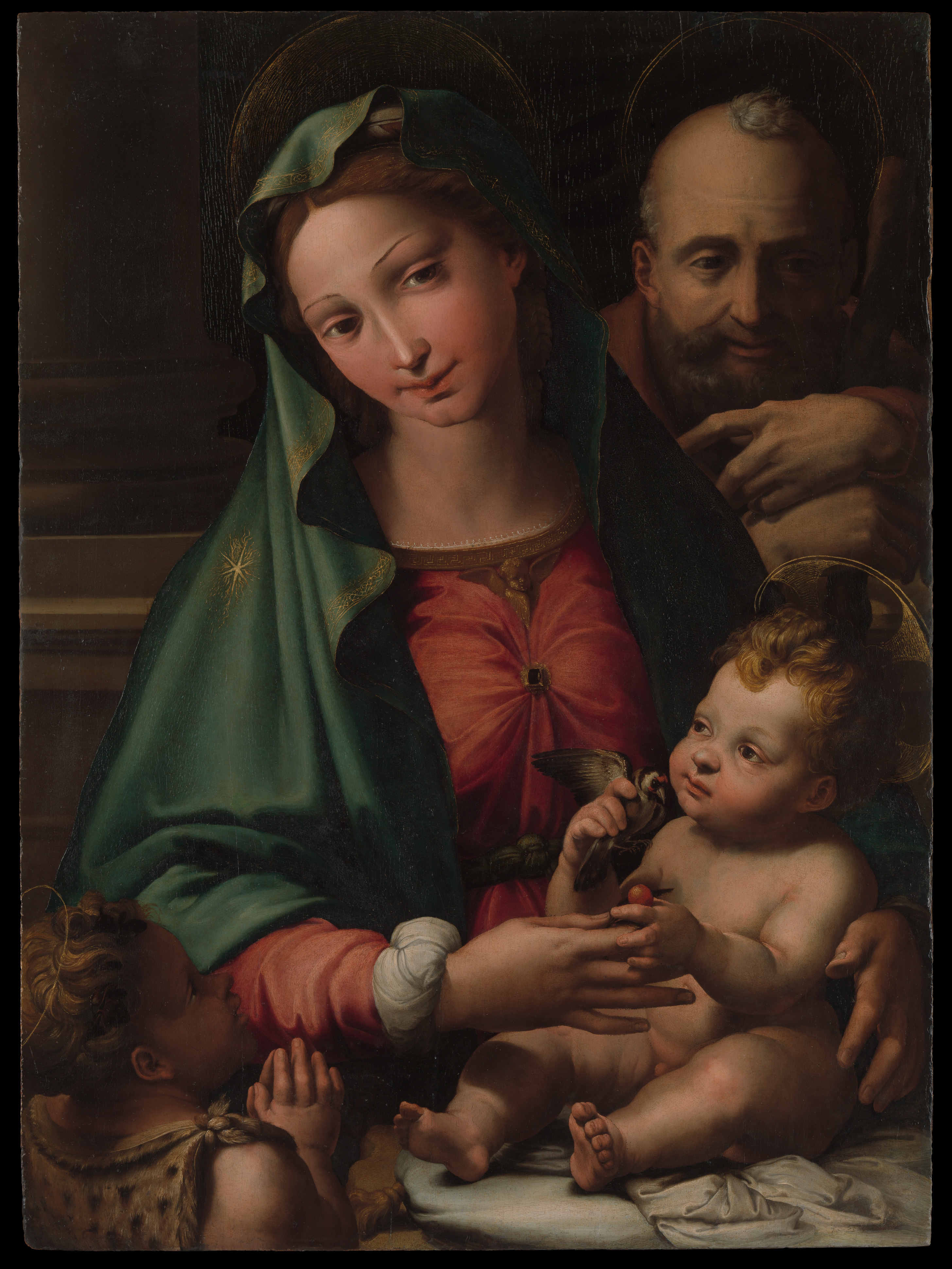
The work’s chromatic structure is a deliberate, hierarchical system that mirrors a luxury maison’s seasonal color story. The artist employs a restrained yet potent palette: the deep, resonant ultramarine of the Virgin’s robe, the earthy, sun-baked umber of Saint Joseph’s tunic, and the soft, pearlescent flesh tones of the infant Christ and Saint John. This is not random coloration; it is a chromatic narrative of status and symbolism. The ultramarine, historically more precious than gold, was derived from lapis lazuli—a pigment of immense cost and spiritual weight. In couture terms, this is the equivalent of a bespoke fabric woven from vicuña wool and silk, a material that announces its own rarity.
The interplay of light and shadow—the chiaroscuro—creates a textural depth that is the painterly equivalent of a haute couture garment’s three-dimensional construction. The highlights on the Virgin’s cheek and the folds of her mantle are not painted; they are sculpted with light, much like a master tailor uses darts and tucks to create volume on a mannequin. The shadow that falls across Saint Joseph’s face, partially obscuring his features, is a deliberate design choice—a veil of humility that renders him a supporting structure rather than a focal point. This is the couturier’s art of subordination: knowing when the fabric should speak and when it should recede.
Drapery as Architecture: The Silhouette of the Sacred Family
The treatment of drapery in this oil-on-wood study is nothing short of architectural. The Virgin Mary’s mantle does not merely cover her form; it defines a space. The folds cascade in a series of rhythmic, vertical pleats that anchor her figure to the earthly plane, while simultaneously lifting the eye toward the infant Christ. This is a structural drape, reminiscent of the grand, sculptural gowns of a Givenchy or a Balenciaga. The fabric is heavy, yet it flows with a controlled grace—a paradox that only the finest artisans can achieve.
Saint Joseph’s tunic, in contrast, is a study in textural restraint. The folds are shallower, the lines more horizontal, grounding him as the earthly protector. The fabric here is not a statement of divinity but of functional dignity. It is the equivalent of a tailored, double-breasted coat in a heavy wool—practical, yet imbued with gravitas. The infant Saint John the Baptist, clad in a simple animal skin, introduces a raw, organic texture that disrupts the polished harmony of the central group. This tactile contrast is a deliberate couture device: the introduction of a coarse, natural fiber against a sea of refined silk and wool creates a visual tension that holds the viewer’s gaze. It is the fashion equivalent of pairing a raw-edged denim jacket with a silk gown.
Silhouette and Geometry: The Sacred Triangle
At the core of this composition lies a geometric master plan: the sacred triangle. The heads of the Virgin, Saint Joseph, and the infant Christ form an almost perfect isosceles triangle, with the infant Saint John as a dynamic counterpoint at the base. This is not accidental; it is a foundational structure that dictates every other design element. In couture, the silhouette is the first and final law. Here, the triangle is a symbol of stability, divinity, and familial unity—a shape that the modern designer might interpret as a sharp, architectural shoulder line or a flared, A-line skirt.
The infant Christ, positioned at the apex of this triangle, is the focal point of the garment’s narrative. His nudity, contrasted with the layered drapery of the adults, creates a negative space that draws the eye. This is the couturier’s equivalent of a bare shoulder or a keyhole cutout: a moment of vulnerability that amplifies the surrounding structure. Saint John’s pose—leaning in, almost embracing the Christ child—adds a dynamic diagonal that disrupts the static triangle, injecting movement and intimacy. This diagonal line is the seam of the narrative, the hidden dart that gives the garment its shape.
Texture and Materiality: The Oil-on-Wood as Fabric
The medium itself—oil on wood—is a material manifesto. The smooth, polished surface of the wood panel provides a rigid foundation, much like the corseted structure of a couture gown. The oil paint, applied in layers of glazes, creates a luminous, almost translucent quality that mimics the sheen of silk or the subtle iridescence of a pearl-embroidered bodice. The brushstrokes are both visible and invisible—a paradox that defines the highest level of craftsmanship. In some areas, the paint is thick, creating a tactile impasto that resembles the weight of brocade or the pile of velvet. In others, it is thin, allowing the wood grain to peek through, a subtle reminder of the underlying structure—the “bones” of the garment.
The artist’s attention to material specificity is remarkable. The fur of Saint John’s garment is rendered with short, staccato strokes that convey its coarse, animal nature. The Virgin’s veil is painted with long, sweeping strokes that suggest a fine, almost transparent linen. This is the couturier’s skill: the ability to translate material into mark-making, to make the viewer feel the weight of silk, the scratch of wool, the coolness of linen, without ever touching the fabric. The oil-on-wood becomes a textile laboratory, where every stroke is a stitch and every glaze is a dye.
Context and Contradiction: The Standalone Study as a Fashion Statement
As a standalone study, this work exists outside the narrative of a larger altarpiece or series. It is a singular, self-contained object—a fashion statement in its own right. This context liberates the artist from the constraints of a larger program, allowing for a more intimate, focused exploration of form and emotion. In the same way, a couture piece from a capsule collection is a declaration of independence, a garment that must speak for itself without the support of a full runway narrative. The intimacy of the scene—the close proximity of the figures, the gentle touch of hands—creates a private viewing experience, akin to the close inspection of a hand-stitched hem or a perfectly set sleeve.
The Global Heritage origin of this piece adds another layer of complexity. It is a work that transcends its European roots, drawing on a universal language of familial love and sacred geometry. In the context of Katherine Fashion Lab, this piece becomes a cultural artifact that informs our design philosophy: the idea that luxury is not about excess but about meaningful construction. The oil-on-wood technique, with its layering and luminosity, mirrors our own commitment to slow fashion—the belief that a garment, like a painting, should be built with intention, patience, and a reverence for material.
Conclusion: The Couture of the Eternal
In analyzing “The Holy Family with the Infant Saint John the Baptist,” we are not merely observing a painting; we are reading a garment. The drapery is the cut, the palette is the collection, the geometry is the silhouette, and the materiality is the fabric. This oil-on-wood study, with its sacred subject and earthly execution, offers a masterclass in design thinking. It reminds us that couture is not about covering the body but about revealing the soul through structure, texture, and light. At Katherine Fashion Lab, we take this lesson to heart: every seam is a prayer, every fold a devotion, and every garment a standalone study in the art of the eternal.