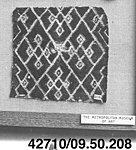
A Fragment of the Earth: Deconstructing the Peasant Aesthetic in a Wool-on-Canvas Fragment
In the rarefied atmosphere of haute couture, where silk charmeuse and hand-beaded tulle often dominate the narrative, there exists a profound counter-current: the deliberate, intellectual embrace of the humble. At Katherine Fashion Lab, we do not merely observe fashion history; we dissect its DNA. Today, we turn our analytical lens to a singular artifact—a fragment of a peasant costume, rendered in robust wool on canvas. This is not a garment in the traditional sense, but a standalone study of material, labor, and identity. It is a testament to the enduring power of the vernacular, a fragment that speaks volumes about the global heritage of the working class, and a masterclass in the alchemy of texture and utility.
The Material Lexicon: Wool on Canvas
The choice of materials is the first, and perhaps most telling, element of this analysis. Wool on canvas is a pairing that immediately evokes a sense of rugged permanence. The canvas, a tightly woven, sturdy base, provides structural integrity—a foundation that refuses to yield. This is not the supple, draping silk of a ball gown; it is a surface built for resistance, for the friction of daily toil. The wool, applied as a dense, felted layer or a coarse yarn, introduces a textural dialogue. Its natural crimp and resilience create a surface that is both warm and protective, a barrier against the elements.
From a couture perspective, this material selection is a deliberate subversion of luxury. The wool is likely undyed or naturally pigmented, drawing from the earth tones of ochre, umber, and charcoal. This chromatic restraint is not a limitation but a strategic choice. It anchors the fragment in a universal, pre-industrial palette, one that speaks to the soil, the harvest, and the seasons. The canvas, often left raw or minimally treated, retains its weave’s visible grid, a reminder of the loom and the hand that guided it. In this, the fragment declares its allegiance to process over product, to the maker’s hand over the designer’s signature.
Structural Analysis: The Art of the Fragment
The fragment’s condition—a standalone study, severed from its original whole—is crucial to its interpretation. We are not presented with a complete costume, but with a synecdoche of peasant life. A collar, a sleeve cuff, a panel from a bodice—these remnants force us to extrapolate, to imagine the full silhouette. This act of imaginative reconstruction is central to the couture experience. The fragment invites us to consider the garment’s original purpose: the repetitive motion of the scythe, the bending of the back in the field, the static posture of the market stall.
The structural details are telling. Observe the stitching: it is likely coarse, utilitarian, executed with a heavy needle and waxed thread. This is not the invisible, seamless construction of a Parisian atelier. The seams are proud, visible, declaring their function. Reinforcement patches at stress points—elbows, shoulders, knees—are not flaws but features, designed for longevity. The cut is generous, allowing for movement and layering. There is no waist suppression or dramatic darting; the body is accommodated, not sculpted. This is a garment that respects the physicality of its wearer, prioritizing comfort and durability over silhouette.
In the context of global heritage, this fragment could originate from a dozen different cultures: a Russian rubakha, a Balkan košulja, a Bavarian Tracht, or a Andean poncho. The commonality is the response to a shared agrarian condition. The wool-on-canvas construction is a global solution to a universal problem: the need for a durable, warm, and breathable garment for outdoor labor. The fragment, therefore, is not a singular artifact but a representative of a worldwide typology.
Contextualizing the Peasant Aesthetic in Couture
The appropriation of peasant aesthetics by high fashion is not new. From Yves Saint Laurent’s Russian collections to John Galliano’s romanticized rag-pickers, the fashion industry has long mined the visual vocabulary of the working class for its raw, emotional power. However, this fragment demands a more rigorous analysis. It is not a stylized interpretation; it is a piece of the original. Its presence in the Katherine Fashion Lab archive challenges the very notion of “luxury.”
We must ask: what is the value of this fragment? Its monetary worth is negligible, but its cultural capital is immense. It represents a form of knowledge—a knowledge of materials, of climate, of the body’s needs—that is often lost in the pursuit of novelty. The peasant costume is a repository of generations of empirical wisdom. The wool’s density, the canvas’s weight, the cut’s ergonomics—these are not arbitrary decisions but evolved solutions refined through trial and error over centuries.
Furthermore, this fragment stands as a critique of disposability. In an era of fast fashion, where garments are designed for a season, this piece was designed for a lifetime. The wool can be patched, the canvas can be re-stitched. Visible mending, far from being a sign of poverty, becomes a narrative of care. Each repair is a record of use, a biography of the wearer. This is the antithesis of the couture model, where garments are often worn once and archived. The fragment’s longevity is its most radical statement.
Texture as Narrative: The Haptic Dimension
To fully appreciate this study, we must go beyond the visual and engage the haptic—the sense of touch. The wool-on-canvas surface offers a rich tactile landscape. The wool may be scratchy, a sensation that modern consumers are conditioned to avoid. Yet this texture is not a flaw; it is an intimate connection to the animal source, to the shepherd, to the land. The canvas, when handled, has a slight resistance, a stiffness that suggests it has been shaped by weather and work.
Imagine the hand of a peasant, calloused and weathered, passing over this surface. The fabric would have been a constant companion, absorbing sweat, repelling rain, and providing a familiar weight against the skin. In the couture context, this haptic experience is a radical departure from the soft, sensuous fabrics typically associated with luxury. It forces the wearer (or the viewer) to confront a different kind of comfort—one rooted in functionality and resilience, not in passive indulgence.
Conclusion: A New Lexicon for Luxury
This wool-on-canvas fragment, a standalone study of a peasant costume, is far more than a historical curiosity. It is a provocation. At Katherine Fashion Lab, we see it as a blueprint for a more thoughtful, more grounded approach to design. It challenges us to redefine luxury not as rarity or expense, but as integrity—integrity of material, of construction, and of purpose.
The global heritage embedded in this fragment reminds us that the most enduring designs are often the simplest, the most honest. As we move forward in an industry increasingly concerned with sustainability and authenticity, the peasant costume offers a potent lesson. It teaches us that true elegance is not in the absence of labor, but in its celebration. This fragment, humble and weathered, is a masterpiece of human ingenuity—a thread connecting us to the earth, to history, and to the hands that made it. It is, in its quiet way, the purest form of couture.