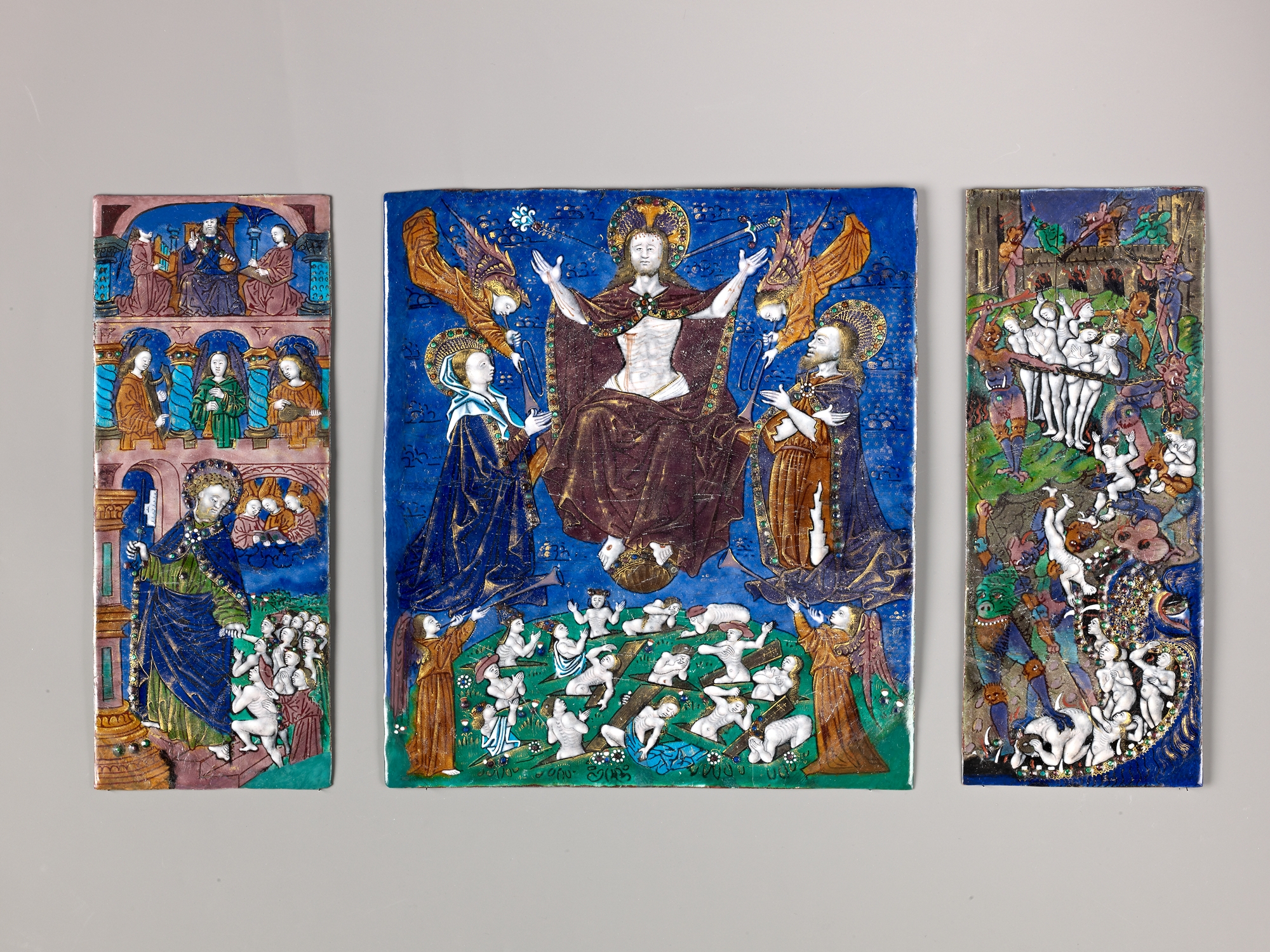
Triptych: The Last Judgment: A Couture Analysis of Divine Dread and Metallic Allure
Within the hallowed archives of fashion history, certain artifacts transcend their material form to become profound studies in narrative, texture, and human psychology. The French Triptych: The Last Judgment, executed in painted enamels on copper with partial gilding, stands as one such artifact. As a standalone study, it presents not merely a religious tableau but a masterclass in the couture principles of composition, material innovation, and the manipulation of visual hierarchy. For Katherine Fashion Lab, this piece is a seminal text, offering a blueprint for constructing garments of immense symbolic weight and technical bravura.
Material Alchemy: The Strategic Deployment of Enamel and Gold
The foundational genius of this triptych lies in its material selection—painted enamels on a copper substrate. This is not mere decoration; it is a strategic design choice with direct couture parallels. Enamel, a vitreous substance fused to metal under extreme heat, creates a surface that is at once luminous, durable, and impermeable. In fashion terms, this translates to the development of innovative textile treatments: lacquered silks, resin-coated jacquards, or heat-molded fabrics that hold a precise, sculptural form. The copper base provides structural integrity, much like a corseted foundation garment or a rigid underskirt, offering a perfect, unyielding canvas for the narrative to unfold.
The selective use of gilding is the quintessential exercise in strategic embellishment and focal point creation. The gilded elements—likely halos, heavenly rays, or the robes of the blessed—act as divine spotlights. In a couture context, this mirrors the meticulous placement of hand-embroidered metallic thread, pailettes, or Swarovski crystals to guide the viewer’s eye. The gilding does not cover the entire piece; it is a precious accent, creating a stark, moral, and visual contrast between the radiant celestial realm and the matte, somber depths of the damned. This teaches us that true luxury lies not in blanket coverage, but in the calculated, meaningful application of preciousness.
Narrative Silhouette: The Architectural Power of the Triptych Form
As a triptych, the work employs a tripartite structure—central panel flanked by two hinged wings—that is inherently architectural and dramaturgical. This format is analogous to the deconstructive potential of a transformative garment. Imagine an evening coat that, via intricate closures, opens to reveal a radically different inner garment, or a skirt whose panels unfold to tell a sequential story. The standalone nature of this study suggests it is a concentrated exploration of this form, focusing on the kinetic relationship between the panels.
The central panel, typically housing Christ the Judge, represents the core silhouette statement—powerful, frontal, and commanding. The side panels, which would close over this central image, create a narrative before-and-after. In fashion, this is the principle of the reveal, the layered look, or the garment that changes with the wearer’s movement. The hinged mechanism itself speaks to functional hardware as aesthetic element—think of grommets, artistic zipper tracks, or custom closures becoming integral to the design’s narrative, much as the hinges are part of the triptych’s identity.
The Color Palette of Morality: Chromatic Storytelling
The painted enamels would have utilized a specific, symbolically charged palette. Lapis lazuli blues for the heavenly vault, fiery vermillons and ochres for the pits of hell, ethereal flesh tones, and the stark contrast of the gilded highlights create a chromatic language of immediate emotional and moral coding. For the couturier, this is a lesson in color psychology and thematic cohesion. A collection can tell a story through a deliberate, non-literal color progression: from serene, celestial metallics and cool tones, through a middle ground of complex, human neutrals, descending into a finale of chaotic, clashing, or deeply saturated dark hues.
The enamel technique ensures these colors are intense, saturated, and jewel-like, possessing an inner light. This directs us toward fabrics with a deep, inherent luminosity—duchesse satin, iridescent taffeta, velvet that drinks the light—and dyeing techniques that achieve unparalleled depth of color. The palette is not decorative; it is the primary vehicle for the story’s emotional arc.
Couture Context: The Garment as Moral Universe
Interpreting this triptych as a standalone study for a garment invites a radical design proposition. We envision a transformative evening ensemble entitled "The Last Judgment." The outer garment—a structured, long-line coat in a matte, copper-toned leather or coated fabric—represents the closed triptych, austere and enigmatic. Upon removal, the inner garment is revealed: a gown that physically embodies the dichotomy of the scene.
One side of the gown, corresponding to the blessed, is constructed from gilded lace and ivory silk faille, embroidered with orderly, radiant motifs, its architecture fluid and upward-sweeping. The other side, depicting the damned, employs slashed black chiffon, twisted matte jerseys, and embroideries of chaotic, three-dimensional turmoil in rusted wire and dark crystals. The central panel’s judgment is represented by the wearer herself, the spine of the gown acting as the moral axis, perhaps emphasized by a rigid, sculptural spine-piece of gilded enameled copper. The ensemble becomes a wearable psychodrama, a conversation on duality, consequence, and revelation.
In conclusion, the Triptych: The Last Judgment is far more than a religious artifact. For Katherine Fashion Lab, it is a rigorous study in advanced design principles. It demonstrates how material innovation (enamel on copper) serves narrative, how structure (the triptych form) creates drama and function, and how color and selective embellishment (gilding) establish hierarchy and emotion. It challenges the designer to see the garment not as a simple covering, but as a complex, architectural object capable of housing profound, multi-faceted stories, where every seam, texture, and hue is charged with intention. This standalone study remains a timeless masterclass in the art of making the invisible—faith, fear, judgment, salvation—tangible, wearable, and devastatingly beautiful.