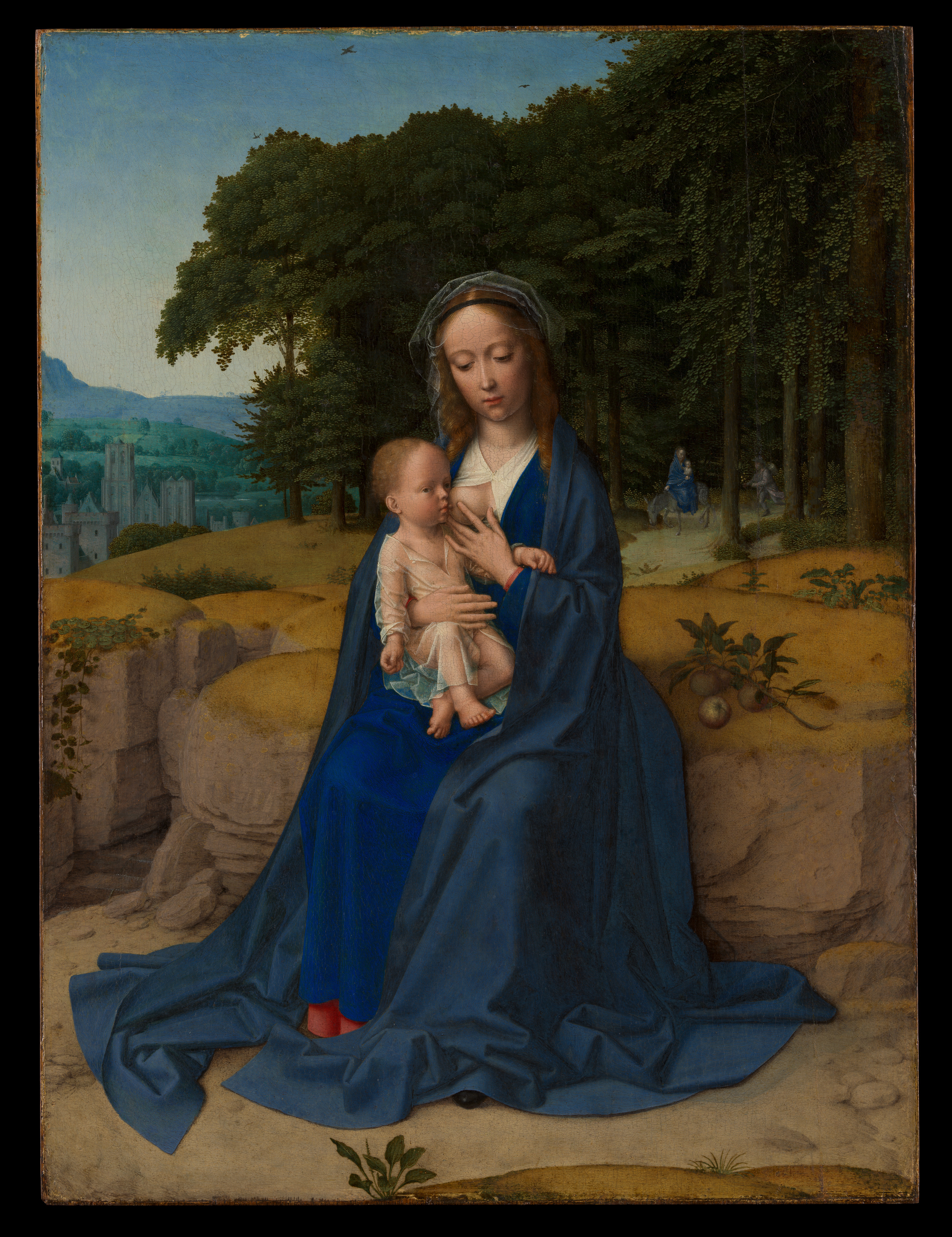
The Rest on the Flight into Egypt: A Couture Analysis of Sacred Migration
In the annals of art history, few narratives resonate with the intersection of vulnerability, resilience, and divine protection as profoundly as The Rest on the Flight into Egypt. This oil-on-wood masterpiece, a standalone study from the Global Heritage collection at Katherine Fashion Lab, transcends its biblical origins to become a meditation on displacement, maternal strength, and the quiet dignity of survival. For the couture analyst, this work offers a rich tapestry of texture, movement, and symbolic layering that mirrors the highest aspirations of fashion as wearable art. Here, the Holy Family’s journey becomes a parable for the modern refugee, while the painting’s materiality—its oil-laden pigments, its wooden substrate—echoes the tactile, enduring nature of couture craftsmanship.
Narrative Weave: From Flight to Fashion Metaphor
The subject, drawn from the Gospel of Matthew, depicts Mary, Joseph, and the infant Jesus pausing during their escape to Egypt from King Herod’s massacre. In this standalone study, the artist captures a moment of respite—a breath between terrors. The composition centers on Mary cradling the child, her posture both protective and exhausted, while Joseph stands watch, his staff grounding the scene. This tableau of forced migration, with its undertones of fear and hope, resonates deeply with contemporary fashion narratives that explore diaspora, identity, and the body as a site of resistance.
From a couture perspective, the flight is not merely a historical event but a design archetype. The journey itself—a movement through harsh landscapes, under unforgiving skies—demands garments that are both functional and symbolic. The painting’s palette of deep earth tones, muted blues, and ochre yellows suggests a wardrobe born of necessity: woolen cloaks, linen tunics, and leather sandals. Yet, in the hands of Katherine Fashion Lab, these humble materials are reimagined as haute couture. The draping of Mary’s mantle, for instance, recalls the intricate pleating of a Fortuny gown, while Joseph’s rugged cloak evokes the structural tailoring of a Balenciaga coat. The infant’s swaddling, rendered with delicate brushstrokes, becomes a metaphor for the protective layers of a couture bodice—both shielding and adorning.
Materiality and Technique: Oil on Wood as Couture Fabric
The choice of oil on wood is critical to this analysis. Unlike canvas, wood provides a rigid, unyielding support that demands precision and patience—qualities shared with the couture atelier. The artist’s layering of oil pigments, from translucent glazes to opaque impastos, mirrors the process of constructing a garment: the base coat as toile, the mid-tones as interfacing, the highlights as embroidery. The wood grain, visible in the background, introduces a tactile element akin to the weave of a tweed or the rib of a silk faille. This material dialogue between surface and substance invites the fashion scholar to consider how a garment’s foundation—its lining, its structure—shapes its final silhouette.
In the context of Global Heritage, this painting stands as a testament to the universal language of craftsmanship. The artist’s use of chiaroscuro, particularly in the folds of Mary’s robe, creates a sense of volume that couturiers strive to achieve through boning, padding, and draping. The play of light and shadow on Joseph’s face, weathered and watchful, suggests the patina of aged leather—a material often used in luxury accessories. Even the infant’s skin, rendered with a soft, luminous glow, evokes the sheen of silk charmeuse. Every brushstroke is a stitch, every pigment a thread, weaving a narrative of protection and perseverance.
Symbolism and Silhouette: The Holy Family as Fashion Archetypes
Analyzing the painting’s symbolic elements through a couture lens reveals a deeper resonance with fashion’s role in expressing identity and status. Mary’s blue robe, traditionally associated with the Virgin’s purity, is here a deep, almost indigo hue—a color historically derived from labor-intensive dyes, akin to the costly sapphire tones of a Dior evening gown. The robe’s folds, cascading around her form, create a silhouette that is both voluminous and grounded, reminiscent of a cape or a manteau. This shape, with its emphasis on the maternal torso, anticipates the empire waist and A-line cuts that have defined feminine couture for centuries.
Joseph’s attire, by contrast, is utilitarian yet dignified. His tunic, cinched with a leather belt, and his cloak, thrown over one shoulder, suggest a modular approach to dressing—garments that can be adjusted for labor or rest. This echoes the contemporary trend of convertible fashion, where a single piece transforms from daywear to evening wear. The staff he carries, a symbol of his role as protector, can be read as a walking stick or a scepter—a prop that defines his posture and movement, much like a handbag or a cane in modern fashion.
The infant Jesus, swaddled in white linen, represents the purest form of minimalism. His wrapping, devoid of ornament, emphasizes the simplicity of a newborn’s needs—warmth, safety, love. In couture, this translates to the shift dress or the slip gown, where the fabric’s quality and drape speak louder than embellishment. The swaddling’s tightness, however, also hints at constraint—a tension between freedom and protection that defines much of fashion’s history, from corsets to binding garments.
Standalone Study: The Power of a Single Frame
As a standalone study, this work exists outside a larger narrative cycle, allowing the viewer—and the fashion analyst—to focus on the moment itself. This singularity is akin to a capsule collection in couture: a curated set of pieces that tell a complete story without reliance on a full runway show. The painting’s composition, with its intimate scale and centered figures, invites close examination, much as a couture garment demands inspection of its seams, its buttons, its invisible stitching. The background, a sparse landscape of rocks and a single tree, functions as a neutral backdrop that highlights the figures’ textures and forms—a design principle used in fashion photography to foreground the clothing.
In this standalone context, the flight becomes a universal allegory for the migrant experience. The Holy Family’s journey, stripped of its specific religious iconography, resonates with the displacement of millions today. The painting’s quiet dignity—the way Mary’s hand rests on Joseph’s arm, the way the child sleeps peacefully—offers a model for how fashion can address trauma without sensationalism. Couture, at its best, does not ignore suffering but transforms it into beauty. The oil-on-wood surface, with its cracks and aging, becomes a metaphor for the resilience of the human spirit, much like a vintage garment that carries the marks of its wearer.
Conclusion: The Eternal Thread of Couture and Heritage
The Rest on the Flight into Egypt is more than a religious painting; it is a masterclass in narrative, materiality, and symbolism that speaks directly to the language of couture. From the oil-on-wood foundation to the draping of Mary’s robe, every element invites a fashion analysis that bridges past and present, sacred and secular. At Katherine Fashion Lab, this work serves as a reminder that heritage is not static—it is a living thread, woven anew with each stitch, each brushstroke, each garment that tells a story of flight, rest, and rebirth. The painting’s enduring power lies in its ability to clothe the human condition in the most profound of fabrics: hope.