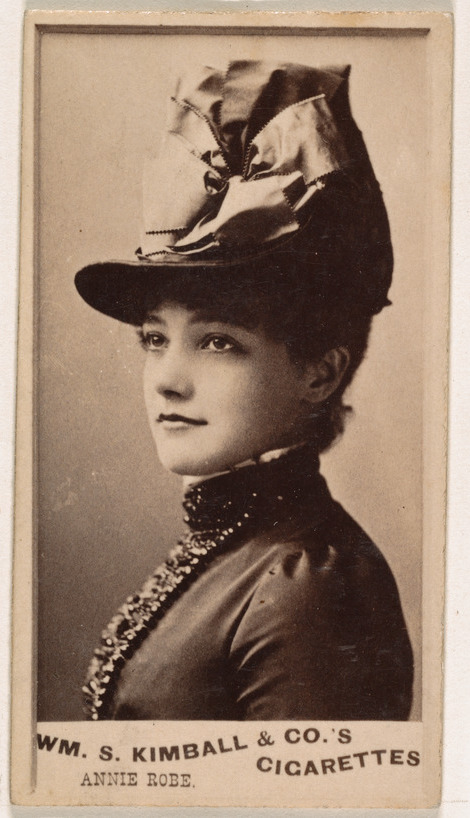
The Annie Robe: An Analysis of Theatrical Femininity and Commercial Artistry in Wm. S. Kimball & Co.’s Actresses Series
Introduction: The Intersection of Commerce and Couture
The Annie Robe card, part of the Actresses series (N203) issued by Wm. S. Kimball & Co. at the turn of the 20th century, represents a fascinating artifact of global heritage and commercial artistry. As a standalone study, this commercial color lithograph transcends its original purpose as a promotional collectible to become a window into the evolving language of fashion, femininity, and theatrical performance. At Katherine Fashion Lab, we analyze this piece not merely as a historical document but as a strategic expression of identity—one that leverages visual aesthetics to communicate status, allure, and cultural aspiration. The Annie Robe card, printed on modest cardstock yet rich in chromatic detail, encapsulates a moment when fashion became a mass-market phenomenon, bridging the gap between haute couture and accessible imagery.
Historical Context: The Actresses Series as a Cultural Mirror
Wm. S. Kimball & Co., a prominent tobacco manufacturer, issued the N203 series as part of a broader trend in late 19th- and early 20th-century advertising: the use of celebrity endorsements and theatrical imagery to sell consumer goods. Actresses of the era were among the first public figures to embody modern femininity, navigating the tension between respectable domesticity and the allure of the stage. The Annie Robe card thus functions as a commercial artifact that capitalizes on the public’s fascination with both fashion and performance. The lithograph’s commercial color process, while limited by the technology of its time, demonstrates a sophisticated understanding of hue and contrast—vibrant reds, deep blacks, and soft flesh tones that draw the eye and evoke a sense of luxury and accessibility simultaneously.
From a global heritage perspective, the card reflects the transatlantic exchange of style that defined the Gilded Age. American audiences were consuming European fashion trends filtered through the lens of popular entertainment, and the Annie Robe image serves as a visual bridge between Parisian couture houses and Main Street America. The actress herself, likely a stage performer of moderate fame, becomes a brand ambassador for a lifestyle that was both aspirational and attainable—a precursor to the modern influencer economy.
Materiality and Technique: The Art of Commercial Color Lithography
The commercial color lithograph process used for the Annie Robe card demands attention as a technical achievement in mass communication. Unlike fine art prints, which prioritized subtlety and texture, commercial lithography for trade cards emphasized bold, saturated colors that could compete for attention in crowded retail spaces. The Annie Robe card exhibits a limited but effective palette: the actress’s gown likely features a deep crimson or burgundy, offset by pale skin and dark hair, creating a dramatic focal point. The use of chromolithography allowed for multiple color layers, resulting in a richness that belied the card’s humble materiality.
From a fashion analysis standpoint, the materiality of the print itself informs our understanding of the garment. The lithograph’s flat, graphic quality simplifies the gown’s construction, emphasizing silhouette over detail. This abstraction is not a flaw but a strategic choice that aligns with the card’s commercial purpose: to convey an immediate impression of elegance without the complexity of actual textile rendering. The Annie Robe, as depicted, becomes a symbolic garment—one that exists in the imagination of the viewer as much as in the historical record.
Fashion Analysis: The Gown as a Statement of Power and Performance
The gown worn by Annie Robe in this lithograph is a study in theatrical femininity. Its silhouette, likely a princess-line or hourglass shape, emphasizes the waist and hips, creating a sculptural form that commands attention. The bodice appears fitted, possibly with boning or darts, while the skirt flows in soft folds that suggest movement and grace. This construction is typical of late Victorian and Edwardian stage costumes, which were designed to be visible from a distance and to enhance the actress’s presence under gaslight.
The neckline is a critical element: a sweetheart or off-the-shoulder cut that exposes the shoulders and décolletage, balancing modesty with allure. This design choice is not merely aesthetic but functional—it allows for ease of movement and breathability under hot stage lights, while also signaling the actress’s availability as a spectacle. The sleeves, if present, are likely short or nonexistent, further emphasizing the arms and hands, which were essential for expressive gestures in silent or early sound performances.
The color and texture of the gown, as rendered in the lithograph, suggest a luxurious fabric such as silk, velvet, or brocade. The deep red or burgundy hue is particularly significant: in the language of fashion, red has long been associated with passion, power, and theatricality. For a stage actress, wearing red was a declaration of confidence—a visual cue that she was the center of attention. The sheen implied by the lithograph’s highlights further enhances this effect, creating a sense of opulence that aligns with the card’s promotional goals.
Strategic Implications: The Annie Robe as a Brand Asset
From a business and branding perspective, the Annie Robe card exemplifies how fashion imagery can be leveraged as a strategic asset. Wm. S. Kimball & Co. understood that the visual appeal of a beautiful woman in a stunning gown would drive consumer engagement and, ultimately, sales. The card’s collectible nature created a sense of scarcity and value that transcended the product it advertised. For the modern fashion analyst, this offers a lesson in experiential marketing: the Annie Robe card is not just an advertisement but a tangible piece of art that consumers could own, trade, and display.
The global heritage dimension adds another layer: the card circulated widely, reaching audiences across the United States and beyond. This democratization of fashion imagery allowed women in rural or less affluent areas to access the same visual language of elegance as their urban counterparts. The Annie Robe card thus functioned as a cultural equalizer, blurring class distinctions through the shared experience of visual consumption.
Conclusion: The Enduring Legacy of Commercial Couture
The Annie Robe card from Wm. S. Kimball & Co.’s Actresses series is far more than a historical curiosity. It is a masterclass in the fusion of fashion, commerce, and art. Through its commercial color lithograph technique, it captures the essence of theatrical femininity while serving as a strategic marketing tool. At Katherine Fashion Lab, we recognize this piece as a precursor to modern branding, where the line between product and identity is deliberately blurred. The Annie Robe endures as a testament to the power of visual storytelling—a reminder that fashion, even in its most commercial form, can transcend its origins to become a global heritage artifact.