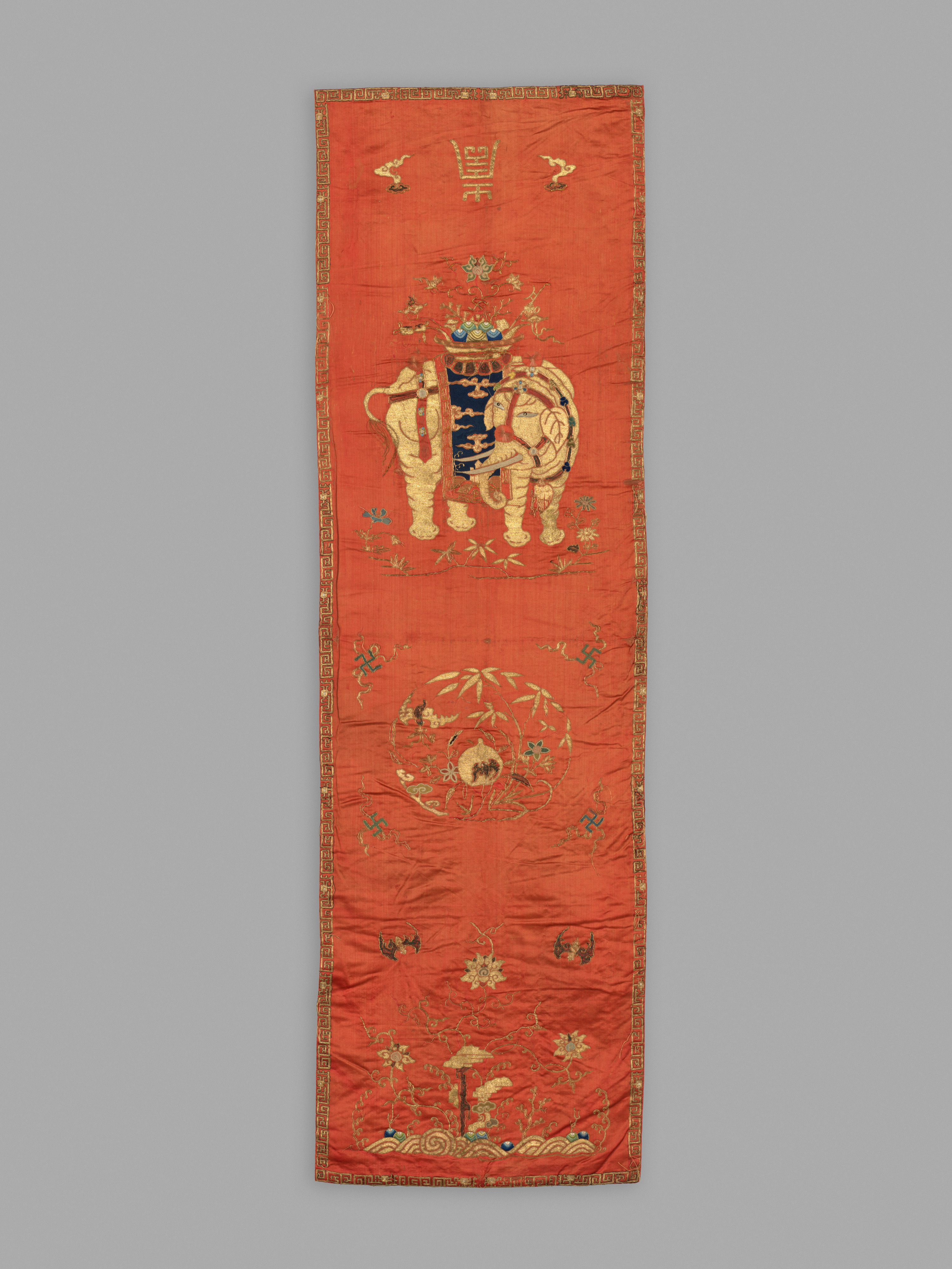
An Ode to Opulence: Deconstructing the Table Vallance with Elephant
In the rarefied echelons of textile artistry, few objects command the same reverence as the ceremonial table vallance. Katherine Fashion Lab is privileged to present a standalone study of an extraordinary specimen: a Chinese table vallance featuring a majestic elephant, meticulously crafted from silk and metal thread embroidery on a luminous silk satin ground. This piece is not merely a decorative furnishing; it is a profound narrative woven in fiber, a testament to the confluence of imperial symbolism, technical virtuosity, and aesthetic refinement. To analyze this vallance is to decode a language of power, prosperity, and the enduring human fascination with the majestic.
Material Lexicon: The Foundation of Luxury
The choice of silk satin as the base fabric is itself a declaration of status. Silk, a material historically guarded as a state secret by the Chinese empire, represents wealth, sensuality, and imperial favor. The satin weave, characterized by its glossy surface and smooth hand, provides an ideal canvas for embroidery. Its reflective quality amplifies the luminosity of the metallic threads, creating a play of light and shadow that animates the elephant motif. The satin’s weight and drape are critical: it must be substantial enough to hang with dignified stillness, yet supple enough to allow the intricate embroidery to breathe without distortion.
The metal thread embroidery elevates this piece from the merely luxurious to the truly ceremonial. These threads, typically composed of silk filaments wrapped in gold or silver leaf, or occasionally gilded paper, are not mere accents. They are the embodiment of wealth and spiritual protection. In Chinese decorative arts, metal threads were reserved for objects of the highest importance—court robes, altar cloths, and furnishings for the elite. The labor involved is staggering: each thread must be carefully couched onto the satin surface using a secondary silk thread, a technique known as couching (or jinxiu in Chinese). This method ensures the metallic luster remains unbroken while securing the thread against wear. The result is a surface that shimmers with a dynamic, almost holographic quality, shifting in brilliance as the viewer moves.
Iconographic Sovereignty: The Elephant as Symbol
The central motif—the elephant—is a masterclass in symbolic layering. In Chinese culture, the elephant ( xiang ) is a potent emblem of strength, wisdom, and longevity. Its pronunciation is a homophone for “auspicious” or “good omen,” rendering it a ubiquitous symbol of good fortune. However, this is not merely a generic auspicious beast. The elephant’s posture, adornment, and context within the vallance’s composition demand deeper scrutiny.
Observe the elephant’s stance: it is typically depicted in a calm, forward-moving posture, its trunk curled upward holding a symbolic object, often a ruyi scepter (symbolizing power and wishes fulfilled) or a lotus flower (representing purity and enlightenment). The trunk’s upward curl is deliberate—it is believed to capture and retain good fortune. The elephant’s skin is rendered not as a solid mass, but through intricate scale-like patterns or auspicious cloud motifs within the embroidery, echoing the cosmic order. This technique, known as xiangwen (elephant pattern), transforms the animal into a microcosm of the universe, its body a tapestry of celestial and terrestrial symbols.
Technical Virtuosity: The Embroidery as Architecture
The construction of this vallance is a feat of textile engineering. The embroidery must navigate the satin’s slippery surface while maintaining tension across the vallance’s width. Artisans employed a combination of long and short stitches for the elephant’s body, creating a subtle gradient of metallic sheen that mimics musculature and volume. The metal threads are often twisted or flat, depending on the desired effect: twisted threads produce a textured, rope-like quality for outlines and details, while flat threads create broad, reflective planes for the elephant’s flanks.
The border design is equally critical. A typical valance of this caliber features a key fret or meander pattern ( leiwen ) along the edges, a geometric motif symbolizing thunder, fertility, and the cyclical nature of life. This border serves both aesthetic and structural functions: it frames the central composition, directing the eye inward, and reinforces the fabric edges against fraying. The tassels or fringe at the bottom, often crafted from the same metal-wrapped silk, add a final note of opulence and weight, ensuring the valance hangs with authoritative grace.
Contextual Resonance: From Altar to Aesthetic Object
This vallance was likely created for a ceremonial or domestic altar in a wealthy household or temple. In traditional Chinese interiors, the table was the focal point of ancestral veneration and social display. The valance served a dual purpose: it concealed the table’s legs, creating an illusion of floating sacred space, and it declared the occupant’s status. The elephant motif, with its imperial and Buddhist associations, would have been particularly appropriate for a study, library, or meditation hall, where intellectual and spiritual pursuits are paramount.
As a standalone study, this piece invites us to consider its journey from functional furnishing to objet d’art. In the West, such valances were often removed from their original contexts and displayed as wall hangings or framed compositions, a practice that both preserves and recontextualizes their meaning. The elephant, once a guardian of the domestic altar, now becomes a silent ambassador of a lost world of craftsmanship and symbolism.
Conservation and Legacy
The preservation of this vallance requires an understanding of its composite materials. Silk satin is vulnerable to light, humidity, and pests; metal threads can tarnish or become brittle. The piece should be stored flat, in a climate-controlled environment, with acid-free tissue supporting the embroidery. The metal threads must never be cleaned with water or solvents; gentle vacuuming through a screen is the preferred method. This fragility underscores the vallance’s value—it is not merely a historical artifact, but a living document of human skill and cultural aspiration.
In conclusion, the Table Vallance with Elephant is a masterpiece of Chinese textile art, where material opulence meets profound symbolism. The silk satin whispers of imperial luxury, the metal thread embroidery glitters with celestial promise, and the elephant stands as a timeless guardian of fortune and wisdom. For Katherine Fashion Lab, this piece is not just a study; it is a dialogue with history, a reminder that the most enduring fashion is that which weaves together thread, meaning, and the human spirit. In the elephant’s gaze, we see not just an animal, but an entire cosmology—a testament to the power of textile art to transcend function and become a vessel for the sublime.