Power, Prestige, and the Unseen Stitch: A Couture Analysis of Diego Pignatelli d'Aragona (1687–1750) and an Enslaved Servant
The Canvas as a Sartorial Document
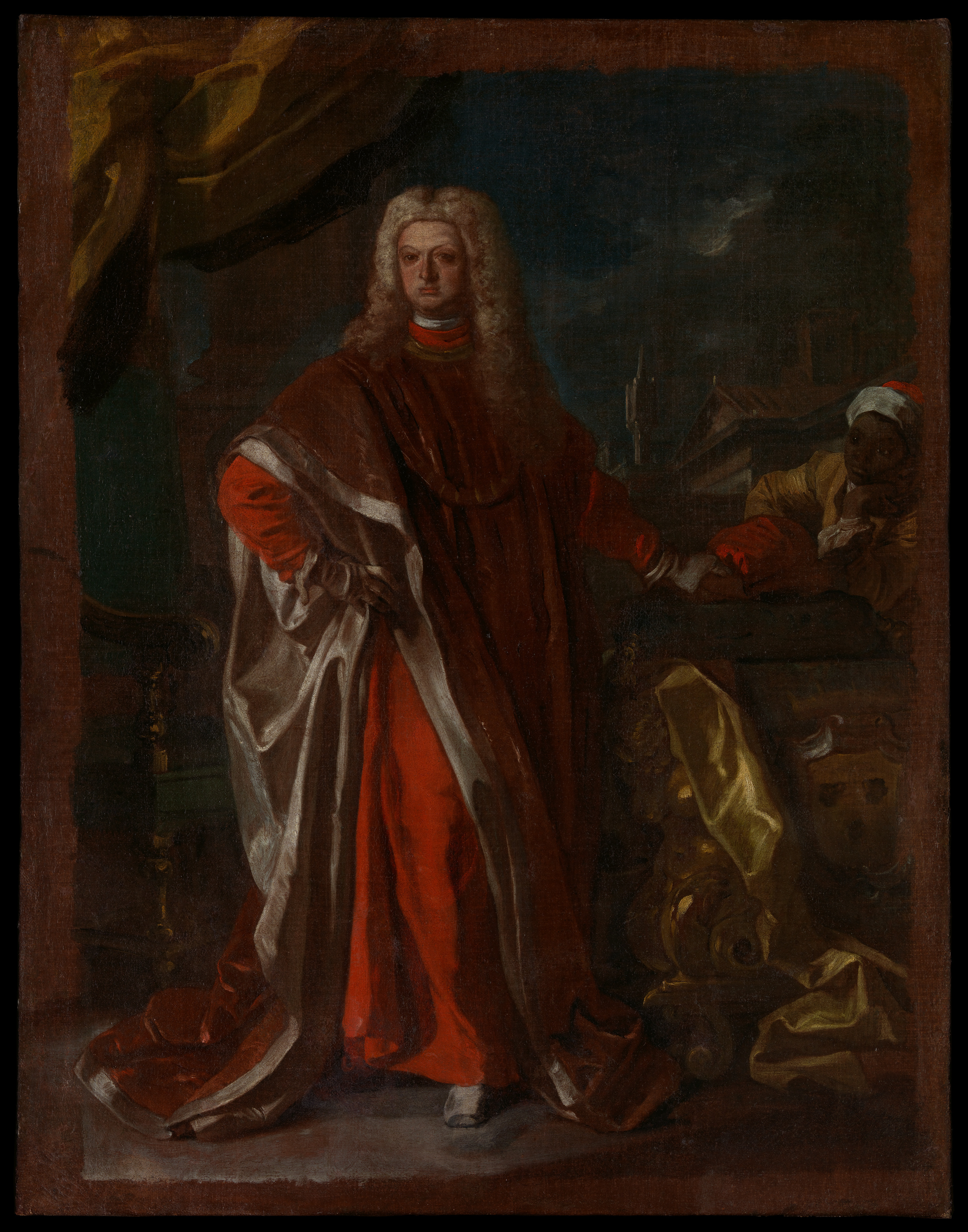
The oil-on-canvas portrait of Diego Pignatelli d'Aragona, a Neapolitan aristocrat of the early 18th century, accompanied by an unnamed enslaved servant, is far more than a static representation of wealth. It is a meticulously constructed narrative of power, global trade, and the profound asymmetry of human dignity. For Katherine Fashion Lab, this painting serves as a critical primary source for understanding how couture—in its most expansive, pre-industrial sense—functioned as a language of dominion. The fabric depicted is not merely cloth; it is a geopolitical statement, woven from threads of colonial exploitation and aristocratic aspiration.
The composition itself is a study in contrasts. The nobleman, presumably Pignatelli, occupies the foreground, his posture commanding and his gaze direct. He is swathed in layers of silk, velvet, and lace that speak to a European lineage of privilege. Behind him, or to the side, the enslaved servant recedes into the shadowed periphery, his attire functional and subdued. Yet, the servant’s presence is not incidental; it is essential. His clothing, though less opulent, is a crucial counterpoint that amplifies the master’s grandeur. The canvas, therefore, is a sartorial document of a global heritage that is simultaneously interconnected and violently divided.
Deconstructing the Aristocratic Silhouette: The Language of Luxury
Pignatelli’s attire is a masterclass in the baroque aesthetic that dominated European courts in the early 1700s. The justaucorps, or long coat, is the centerpiece of his ensemble. Cut from a rich, possibly crimson or deep blue silk velvet, it features elaborate gold or silver embroidery along the edges, buttonholes, and pockets. This is not mere decoration; it is a declaration of financial liquidity. Gold thread was immensely costly, often imported from Venice or Lyon, and the intricate floral or arabesque motifs required hundreds of hours of labor by skilled embroiderers. The coat’s structured fit, with its flared skirts and stiffened front, was designed to project an image of martial readiness and disciplined control.
Beneath the justaucorps, a veste or waistcoat of contrasting silk—likely a lighter hue such as ivory or pale gold—is visible. This garment, often embroidered as richly as the coat, served as a secondary canvas for wealth display. The sleeves of the shirt beneath, crafted from fine linen or cotton cambric, are gathered at the wrist and adorned with deep, cascading lace cuffs. These cuffs, known as engageantes, were a hallmark of aristocratic fashion. The lace, likely from Flanders or France, was a fragile, perishable luxury that required constant replacement, signaling that its wearer could afford to treat even the most delicate fabric as disposable.
The cravat, a precursor to the modern necktie, is tied with studied nonchalance. Fashioned from white linen or silk, it is a symbol of refinement. The wig, a towering, powdered peruke, frames the face with artificial curls that echo the geometry of the coat. This wig was not a natural hairstyle but a constructed accessory, often made from human hair sourced from peasant women or even from the colonies. It is a chilling reminder that the entire aesthetic of power was built upon the labor and bodies of others.
The Enslaved Servant: The Unseen Foundation of Couture
The enslaved servant’s attire is a study in deliberate subordination, yet it is equally rich in meaning. He is typically depicted in a livery—a uniform that marks him as property. This livery is often a simpler version of the master’s coat, cut from a sturdy wool or cotton blend, in a dark, muted color such as brown, gray, or dark blue. The fabric is coarse, lacking the luster of silk, and the tailoring is less precise. The coat may have minimal brass buttons, but no embroidery. The shirt beneath is of plain, unbleached linen, and the cravat, if present, is a simple strip of cloth.
However, the most telling detail is the turban or headwrap. In many 18th-century portraits of European aristocrats with enslaved attendants, the servant is depicted wearing a stylized turban, a visual shorthand for “exotic” origin. This was a deliberate fashioning of the servant’s identity. The turban, often of striped or patterned cotton, was not a faithful representation of African or Asian dress but a European fantasy of the “Orient.” It served to reinforce the master’s cosmopolitanism—his access to global trade networks—while simultaneously dehumanizing the servant, reducing him to a decorative accessory.
The servant’s posture is equally instructive. He is often shown holding an object—a tray, a fan, or the master’s hat—his body angled slightly away from the viewer. His eyes are downcast, avoiding direct engagement. This is not an accident of composition; it is a sartorial and gestural grammar of submission. The servant’s clothing, like his posture, is designed to be invisible, to fade into the background. Yet, it is precisely this invisibility that makes his role so crucial. Without him, the master’s luxury would lack its essential counterpoint. The servant’s plain livery is the dark ground against which the gold embroidery of the justaucorps shines.
Global Heritage: The Threads of Colonial Extraction
The materials in this painting are a map of global exploitation. The silk in Pignatelli’s coat likely came from silkworms raised in Italy or France, but the raw materials—the mulberry leaves and the labor—were part of a complex agricultural system. The cotton of the servant’s livery, if it was Indian cotton, was a product of colonial trade routes. The gold and silver thread was mined in the Americas, extracted by enslaved Indigenous and African laborers. The lace was produced by women in European convents or workshops, often in conditions of near-servitude. Every thread in this painting is stained with the sweat and blood of the unseen.
The presence of the enslaved servant from an unidentified origin—likely African or possibly South Asian—highlights the global nature of the 18th-century luxury economy. The transatlantic slave trade was not a separate enterprise from the fashion industry; it was its foundation. The sugar, tobacco, and cotton produced by enslaved labor in the Americas generated the wealth that funded the aristocratic consumption depicted here. The servant in the painting is a living symbol of this system. His body, like the fabric he wears, is a commodity.
Contextualizing the Standalone Study: A Mirror of Modern Couture
As a standalone study, this portrait offers an unparalleled opportunity for Katherine Fashion Lab to interrogate the ethics of couture. The painting is not a neutral document; it is a propaganda piece designed to naturalize inequality. The master’s beauty is constructed through the servant’s erasure. The luxury of the silk is predicated on the denial of the servant’s humanity.
Modern couture, with its emphasis on artisanal craftsmanship, exotic materials, and global sourcing, inherits this legacy. The high-fashion atelier of today, whether in Paris, Milan, or New York, still relies on a global supply chain that often exploits labor in the Global South. The beaded embroidery on a contemporary gown may be produced by women in India working for subsistence wages. The cashmere from Mongolia may be sheared by herders in precarious conditions. The portrait of Pignatelli and his servant is a stark reminder that luxury has always been built on a foundation of inequality.
For the contemporary designer, this painting is a call to conscious curation. It challenges us to ask: Who made this garment? Whose labor is hidden in the seams? Whose story is being erased? The answer, as the canvas reveals, is that the most beautiful fabric is often woven from the most painful histories.
Conclusion: The Stitch That Binds
In the end, the portrait of Diego Pignatelli d'Aragona and his enslaved servant is a study in sartorial power dynamics. The master’s velvet and gold are a testament to his sovereignty; the servant’s wool and cotton are a testament to his subjugation. Yet, the two figures are inextricably linked. The fabric that separates them also binds them. For Katherine Fashion Lab, this painting is not just an artifact of the past; it is a mirror held up to the present. It reminds us that every stitch is a story, and every story has a cost. The challenge for modern couture is to rewrite that narrative—to weave a future where the unseen are seen, and where the beauty of the garment is matched by the dignity of its creation.