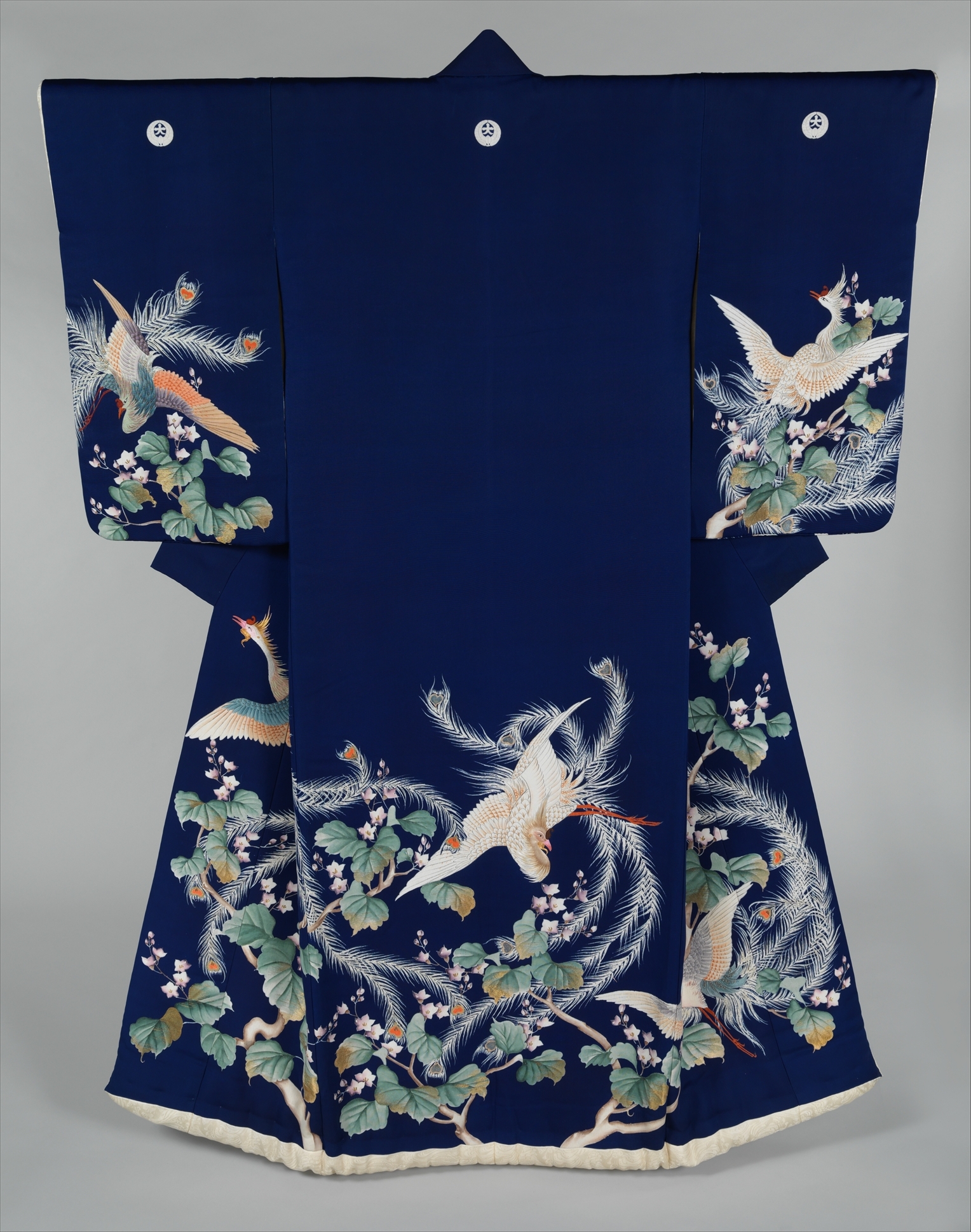
The Uchikake as a Symbolic Manifestation: A Couture Analysis of the Phoenix and Paulownia Outer Robe
Introduction: Beyond Garment, Toward Artifact
In the rarefied echelons of global couture, few garments command the same synthesis of technical mastery, cultural gravitas, and symbolic density as the Japanese Uchikake. At Katherine Fashion Lab, our curatorial lens treats this outer robe—adorned with resist-dyed and painted phoenixes and paulownia motifs on a plain-weave silk ground, embroidered with gold thread—not merely as a historical textile but as a standalone study in luxury as narrative. This piece, originating from Japan’s Edo or Meiji period, transcends its bridal or theatrical context to become a masterclass in how material, technique, and iconography converge to produce a wearable work of art. For the discerning collector or fashion scholar, the Uchikake offers a profound dialogue between ephemeral beauty and enduring symbolism.
Materiality and Technique: The Alchemy of Silk and Gold
The foundational choice of plain-weave silk is deceptively simple. Unlike heavier brocades, this fabric provides a supple, almost fluid canvas that absorbs dye with exceptional precision. The resist-dyeing process—known in Japan as shibori or yuzen—involves applying a paste resist to the silk before immersion in indigo or other natural dyes. This technique creates sharp, enduring boundaries between color fields, allowing the phoenix’s vermilion wings and the paulownia’s violet blossoms to emerge with architectural clarity. The hand-painted accents further elevate the design, introducing gradients of tone that resist-dye alone cannot achieve. Here, the artisan’s brushstroke becomes a signature, imbuing each feather and leaf with a painterly spontaneity that machine production cannot replicate.
The gold thread embroidery—likely couched in flat or twisted kinran technique—serves as the piece’s luminous exclamation point. Gold is not merely decorative; it is a structural and symbolic anchor. The threads catch ambient light, creating a kinetic shimmer that animates the phoenix in flight, as if the bird itself were breathing. This interplay of matte silk and reflective metal generates a textural contrast that demands close inspection. In couture terms, this is the equivalent of haute joaillerie set against haute couture fabric—a deliberate tension between opacity and radiance that rewards the viewer who dares to look beyond first glance.
Iconography: Phoenix and Paulownia as Cosmic Dialogue
The pairing of the phoenix (hō-ō) and paulownia (kiri) is not arbitrary; it is a coded language of imperial authority and cosmic harmony. In Japanese mythology, the phoenix is a celestial bird that appears only during times of peace and virtuous rule. Its five-colored plumage—often rendered here in red, gold, green, blue, and purple—symbolizes the Confucian virtues of benevolence, righteousness, propriety, wisdom, and fidelity. The phoenix does not merely adorn; it asserts the wearer’s alignment with divine order. When paired with the paulownia—a tree whose blossoms are associated with the imperial family and the mythical creature kirin—the design becomes a manifesto of legitimacy. The paulownia’s broad, heart-shaped leaves and trumpet-like flowers evoke protection and renewal, while its wood is traditionally used for sacred instruments and storage chests for imperial regalia.
Together, the phoenix and paulownia create a visual ecosystem of yin and yang balance. The phoenix, often depicted in dynamic flight, represents yang—active, fiery, masculine energy. The paulownia, rooted and generative, embodies yin—receptive, nurturing, feminine force. This duality is not static; it is a perpetual dance. The embroidery’s gold thread traces the phoenix’s trajectory across the robe’s back, while the paulownia branches curl along the sleeves and hem, grounding the composition. For the wearer, this is not costume but armor—a declaration of inner equilibrium and social stature.
Form and Function: The Uchikake as Sculpture in Motion
The Uchikake’s silhouette—a long, trailing outer robe worn unbelted over a kimono—is engineered for ritual rather than daily utility. Its exaggerated length (often exceeding 200 cm) and padded hem create a train that sweeps the floor, transforming the wearer into a moving tableau. The sleeves, or sode, are deep and open, allowing the phoenix motifs to extend across the arms in continuous arcs. This is couture as choreography: every gesture—a bow, a turn, a seated pose—reconfigures the composition. The gold embroidery catches light differently with each movement, ensuring that no two views of the garment are identical.
Critically, the Uchikake is designed to be seen from behind. The most elaborate motifs—the phoenix in full flight, the paulownia in bloom—occupy the back panel, the shoulders, and the trailing hem. This prioritization of rearward visibility is a deliberate inversion of Western couture norms, where the front often commands attention. It speaks to Japanese aesthetic principles of ma (negative space) and kage (shadow), where what is partially hidden or revealed holds greater allure than what is blatantly displayed. For the collector, this demands a reorientation of viewing habits: the Uchikake is a garment that asks to be observed in motion, from multiple perspectives, over time.
Contextual Resonance: From Edo to Contemporary Couture
To appreciate this Uchikake as a standalone study, one must situate it within Japan’s Edo period (1603–1868) and its later revival in Meiji-era luxury markets. During Edo, sumptuary laws restricted the use of gold and specific motifs to the samurai class and court nobility. The phoenix and paulownia were among the most regulated symbols, making their presence on a bridal Uchikake a statement of family lineage and political allegiance. By the Meiji period (1868–1912), as Japan opened to global trade, these robes became coveted export items for Western connoisseurs, who prized them as exemplars of “Oriental” craftsmanship. Yet the Uchikake never lost its ritual significance; it remained a garment for weddings, theater, and ceremonial portraiture.
Today, Katherine Fashion Lab positions this piece within a global couture dialogue. Its resist-dye and gold embroidery techniques anticipate the handcraft revival seen in contemporary ateliers like Maison Margiela’s Artisanal line or Iris van Herpen’s sculptural silks. The phoenix motif, meanwhile, resonates with current fashion’s fascination with mythic symbolism—from Alexander McQueen’s avian imagery to Gucci’s heraldic bestiary. The Uchikake is not a relic; it is a precursor. It challenges modern designers to consider how luxury can encode meaning through material, not merely through brand logo or silhouette.
Conclusion: A Masterclass in Couture as Cultural Capital
In the Katherine Fashion Lab’s assessment, this Japanese Outer Robe with Phoenixes and Paulownia is a benchmark of couture as cultural capital. Its resist-dyed and painted silk, embroidered in gold, demands a literacy that transcends fashion—a knowledge of Japanese history, Buddhist cosmology, and textile alchemy. Yet its beauty is immediate, visceral, and undeniably luxurious. For the collector, it offers a rare convergence of rarity, provenance, and symbolic depth. For the scholar, it is a text that reads equally in the language of art history and fashion theory. And for the observer, it is simply breathtaking—a phoenix that never dies, and a paulownia that never fades, preserved in silk and gold for generations to come.