Heritage Analysis: The Kalpasutra Manuscript and the Symbolic Power of Jain Adornment
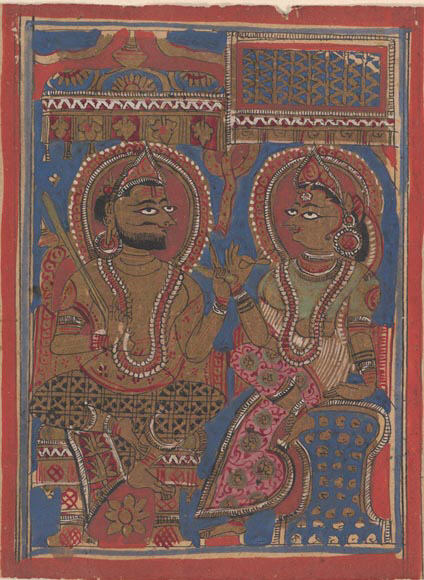
This strategic heritage analysis examines a folio from a Kalpasutra manuscript, originating in Gujarat, India, circa 15th–16th century. The artwork depicts King Siddhartha interpreting Queen Trisala’s fourteen dreams—a foundational narrative in Jain tradition. Executed in ink, opaque watercolor, and gold on paper, this piece offers profound insights into symbolic power, historical adornment, and spiritual meaning. For Katherine Fashion Lab, this analysis serves as a strategic standalone research document, translating ancient visual language into actionable principles for a 2026 high-end luxury strategy.
Symbolic Power: The Fourteen Dreams as Emblems of Destiny and Authority
The fourteen dreams of Queen Trisala—including the elephant, bull, lion, and celestial goddess—are not merely prophetic; they are visual declarations of sovereignty and spiritual elevation. Each dream symbol carries layered meaning: the elephant signifies royal strength and wisdom; the lion represents fearlessness and leadership; the celestial goddess embodies purity and transcendence. In Jain cosmology, these dreams foretell the birth of Mahavira, the 24th Tirthankara, thereby linking maternal vision with divine lineage.
From a luxury branding perspective, the strategic deployment of symbolic power is essential. The dreams function as a curated lexicon of authority, where each motif conveys a distinct attribute of power. For Katherine Fashion Lab’s 2026 strategy, this suggests a collection built on motif-as-message—where each garment or accessory carries a deliberate emblem of strength, wisdom, or transcendence. The dreams are not random; they are a systematic narrative of destiny. Similarly, a high-end luxury line should embed symbols that tell a coherent story of heritage and aspiration, appealing to clients who seek meaning beyond aesthetics.
Historical Adornment: Gold, Form, and the Architecture of Prestige
The manuscript’s medium—opaque watercolor and gold on paper—reveals the historical primacy of material value in signaling status. Gold leaf is applied not merely as decoration but as a spiritual and economic currency. In Jain manuscript painting, gold denotes the sacred, the eternal, and the divinely sanctioned. The figures are adorned with elaborate crowns, necklaces, and garments rendered in precise, geometric patterns. These adornments are not arbitrary; they follow strict iconographic codes that define rank, purity, and spiritual attainment.
For Katherine Fashion Lab, historical adornment offers a blueprint for material storytelling. The use of gold in the manuscript suggests that precious materials should be employed with intention, not excess. In 2026, high-end luxury clients will increasingly value craftsmanship transparency—knowing that a gold thread or hand-painted motif carries centuries of symbolic weight. The lab can draw on this by incorporating archival-quality metals, hand-embroidered motifs, and layered textile techniques that echo the manuscript’s precision. The geometric patterns in the figures’ adornments also point to a modular design language that can be adapted for contemporary silhouettes, creating a bridge between historical form and modern luxury wearability.
Spiritual Meaning: Transcendence Through Materiality
Jain philosophy emphasizes non-attachment and spiritual liberation, yet the Kalpasutra manuscript employs lavish materials to convey the highest truths. This paradox—using opulence to express transcendence—is central to the artwork’s spiritual meaning. The dreams are interpreted not as omens of earthly fortune but as signs of the soul’s journey toward enlightenment. Queen Trisala’s adorned body becomes a vessel for divine communication; her jewelry and garments are not ends in themselves but conduits for a higher narrative.
For a 2026 luxury strategy, this offers a powerful repositioning: luxury as a vehicle for spiritual and ethical expression. The modern high-end consumer increasingly seeks brands that align with values of mindfulness, sustainability, and deeper purpose. Katherine Fashion Lab can translate this by positioning its collections as meditative objects—each piece imbued with intention, craftsmanship, and a narrative of transcendence. The lab could develop a “Dream Series” collection, where each garment or accessory corresponds to one of the fourteen dreams, accompanied by interpretive storytelling. This transforms adornment from mere decoration into a personal talisman, resonating with clients who view fashion as an extension of their inner journey.
2026 High-End Luxury Strategy: Integrating Heritage, Symbolism, and Exclusivity
Based on this analysis, Katherine Fashion Lab’s 2026 strategy should center on three pillars: symbolic curation, material integrity, and narrative exclusivity.
Symbolic Curation: Develop a proprietary visual language inspired by Jain dream symbols. Each motif—elephant, lion, lotus, celestial being—should be trademarked and used across limited-edition pieces. This creates a heritage code that distinguishes the lab from competitors. Clients will recognize the collection as part of an ancient lineage of power and spirituality.
Material Integrity: Use precious materials only when they serve a symbolic or structural purpose. Gold thread, semi-precious stones, and hand-dyed natural fabrics should be sourced with provenance documentation. This aligns with the manuscript’s ethos of material as meaning, not mere opulence. For 2026, transparency in sourcing and craftsmanship will be a key differentiator in the high-end market.
Narrative Exclusivity: Each piece should be accompanied by a digital heritage card—a QR-coded document detailing the dream symbol, its Jain interpretation, and the artisan’s process. This transforms the garment into an collectible artifact, appealing to clients who value intellectual and spiritual depth. The lab could host private exhibitions or virtual reality experiences where clients explore the Kalpasutra manuscript’s iconography, creating an immersive brand ecosystem.
In conclusion, the Kalpasutra manuscript offers Katherine Fashion Lab a rich repository of symbolic power, historical adornment, and spiritual meaning. By translating these elements into a coherent luxury strategy, the lab can position itself at the intersection of heritage and innovation, serving a discerning clientele who seek not just fashion, but meaningful adornment for the soul.