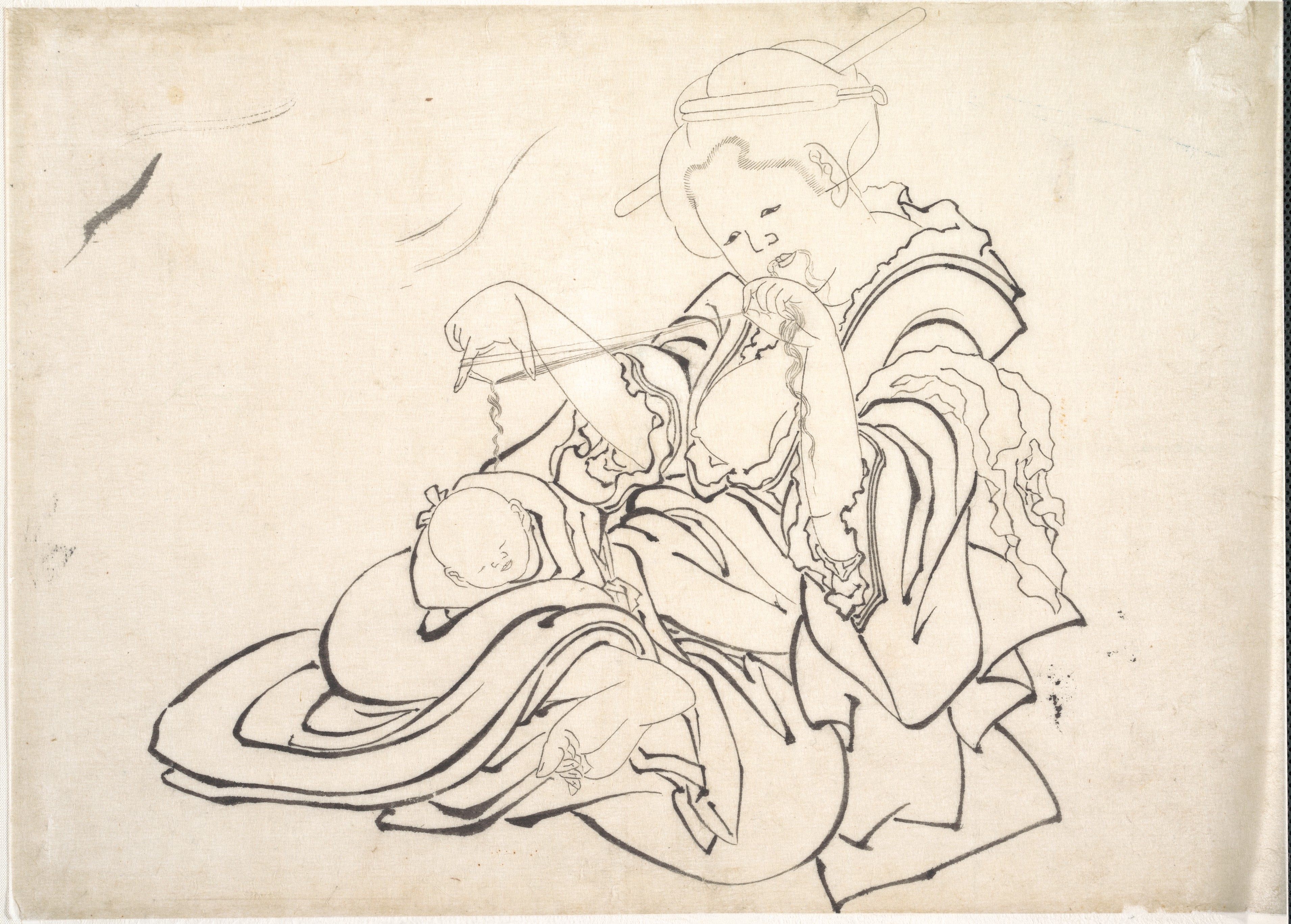
Deconstructing the Maternal: A Couture Analysis of “A Woman and Baby”
In the hallowed halls of fashion history, the maternal figure has often been rendered as a passive symbol—a vessel of nurture, draped in soft, flowing fabrics that speak to comfort and domesticity. Yet, the subject of our analysis, a monochrome woodblock print from Japan titled “A Woman and Baby,” defies such reductive categorization. This standalone study, executed in stark ink on paper, presents a radical reimagining of motherhood through the lens of Katherine Fashion Lab’s couture sensibilities. By dissecting the print’s formal elements—its bold negative space, the tension of its lines, and the unyielding contrast of black and white—we uncover a garment that is not merely clothing, but a manifesto. This analysis argues that the print’s aesthetic is a deliberate, avant-garde statement on the architectural rigor of maternal identity, where the bond between woman and child is rendered as a structural, almost militaristic, silhouette.
The Palette of Absence: Monochrome as Couture Strategy
The print’s exclusive use of black ink on white paper is not a limitation but a strategic choice. In the context of Katherine Fashion Lab, monochrome is a language of precision. The absence of color forces the viewer to confront the purity of form—the sharp, angular folds of the woman’s kimono-like garment, the geometric simplicity of the baby’s swaddle. This is not the soft, pastel-hued motherhood of Western romanticism. Instead, it is a study in negative space, where the white paper becomes as much a material as the ink. The woman’s silhouette is defined by what is left out: the unprinted areas around her shoulders and the baby’s head create a sense of isolation, of a dyad suspended in a void. For the couturier, this translates into a design philosophy where absence is presence—a garment that uses cutouts, sheer panels, and stark contrasts to articulate the body’s architecture rather than its softness.
The ink itself is applied with a calligraphic vigor that suggests movement. The woman’s sleeve, for instance, appears to be in mid-swing, its hemline jagged and unfinished. This is a deliberate departure from the idealized, static maternity robes of the past. Instead, the garment is performative—it captures the kinetic energy of a mother in action, whether adjusting her child or shielding them from an unseen force. The monochrome treatment amplifies this dynamism, creating a visual rhythm that is both jarring and hypnotic. In the language of haute couture, this would be realized through the use of structured silk organza or crisp cotton poplin, cut on the bias to mimic the ink’s fluid yet controlled strokes. The result is a garment that is less about comfort and more about narrative tension.
Architectural Silhouettes: The Mother as Structure
Central to this analysis is the woman’s posture. She is not reclining or nurturing in a passive sense; rather, she stands upright, her body forming a near-perfect vertical line. The baby is cradled not in the crook of her arm but against her chest, as if the infant is an extension of her own torso. This architectural integration is the print’s most radical couture statement. The woman’s garment—a layered, asymmetrical robe—appears to be constructed from interlocking panels, each one a geometric counterpoint to the next. The collar is high and severe, resembling a structural collar from a 1940s Balenciaga suit, while the obi (sash) is wide and unyielding, cinching the waist with a precision that borders on the martial.
This is not a garment that yields to the body; it is a garment that disciplines it. The baby, too, is swaddled in a tight, rectangular cloth that echoes the woman’s own rigid lines. Together, they form a unified architectural unit—a mother-and-child dyad that is less about emotional bonding and more about structural integrity. For Katherine Fashion Lab, this suggests a collection where maternal wear is reimagined as armor. The fabrics would be heavy, non-stretch materials like wool crepe or double-faced satin, cut with sharp darts and seams that create a second skin. The baby’s swaddle, in turn, would be a modular component, perhaps a detachable pouch or a rigid carrier that clips into the mother’s garment, transforming the maternal silhouette into a functional sculpture.
The Tension of Ink: Line as Fabric
Woodblock printing is a medium of controlled violence—the artist carves into the block, and the resulting lines are inevitably sharp, unforgiving. In “A Woman and Baby,” these lines serve as the fabric’s very texture. The woman’s robe is covered in a pattern of thin, parallel strokes that suggest a woven material, yet the strokes are uneven, almost agitated. This is not the calm, repetitive weave of traditional Japanese textiles; it is a graphic disturbance, a visual representation of the mother’s internal state. The baby’s swaddle, by contrast, is rendered in broader, more uniform strokes, suggesting a calmness that contrasts with the mother’s tension.
This dichotomy is a masterclass in couture detailing. The mother’s garment would require a fabric that can hold a crisp, linear pattern—perhaps a jacquard with a metallic thread that catches the light, creating a shimmering, almost kinetic effect. The baby’s swaddle, on the other hand, would be a matte, brushed cotton, soft to the touch but visually flat, absorbing light rather than reflecting it. The contrast between the two textures would be a tactile dialogue, a conversation between the mother’s sharp, protective exterior and the child’s soft, vulnerable interior. In the print, this is achieved through the ink’s varying density; in couture, it would be achieved through the juxtaposition of materials—a mix of stiff brocade and plush velvet, or of structured leather and airy tulle.
Cultural Context: Japan’s Edo Period and the Modernist Gaze
To fully appreciate this print, we must consider its origins in Japan’s Edo period, a time when woodblock prints were a popular art form, often depicting scenes of everyday life. Yet, this work is not a typical ukiyo-e—it is a standalone study, likely created as a preparatory sketch or a personal exploration. The absence of background elements, such as a domestic interior or a garden, forces the viewer to focus solely on the figures. This minimalism is a precursor to modernist aesthetics, and it is this quality that makes the print so resonant for Katherine Fashion Lab. The lab’s ethos is one of deconstruction and recontextualization—taking traditional forms and stripping them down to their essential lines. Here, the maternal figure is stripped of sentimentality, reduced to a pure graphic statement.
The baby, too, is not a cherubic icon but a geometric form—a bundle of lines and angles that mirrors the mother’s own angularity. This is not a sentimental portrait; it is a structural analysis of the mother-child relationship. For the modern couturier, this translates into a design that challenges the viewer to see motherhood not as a soft, nurturing state but as a dynamic, even aggressive, act of protection. The garment becomes a second skin, a layer of defense that is both beautiful and formidable.
Conclusion: The Maternal as Avant-Garde
In conclusion, “A Woman and Baby” is far more than a historical artifact; it is a blueprint for a new couture aesthetic. Through its monochrome palette, architectural silhouettes, and agitated lines, the print presents motherhood as a rigorous, intellectual project—one that demands precision, strength, and a willingness to break from tradition. For Katherine Fashion Lab, this analysis offers a path forward: a collection that honors the maternal body not through softness but through structural clarity. The woman in the print is not a mother in the conventional sense; she is a guardian, a sculptor, a force. Her garment is her armor, and her baby is her most precious, and most challenging, accessory. In the world of haute couture, this is a vision that is both timeless and radical—a testament to the power of ink, paper, and the unyielding line.