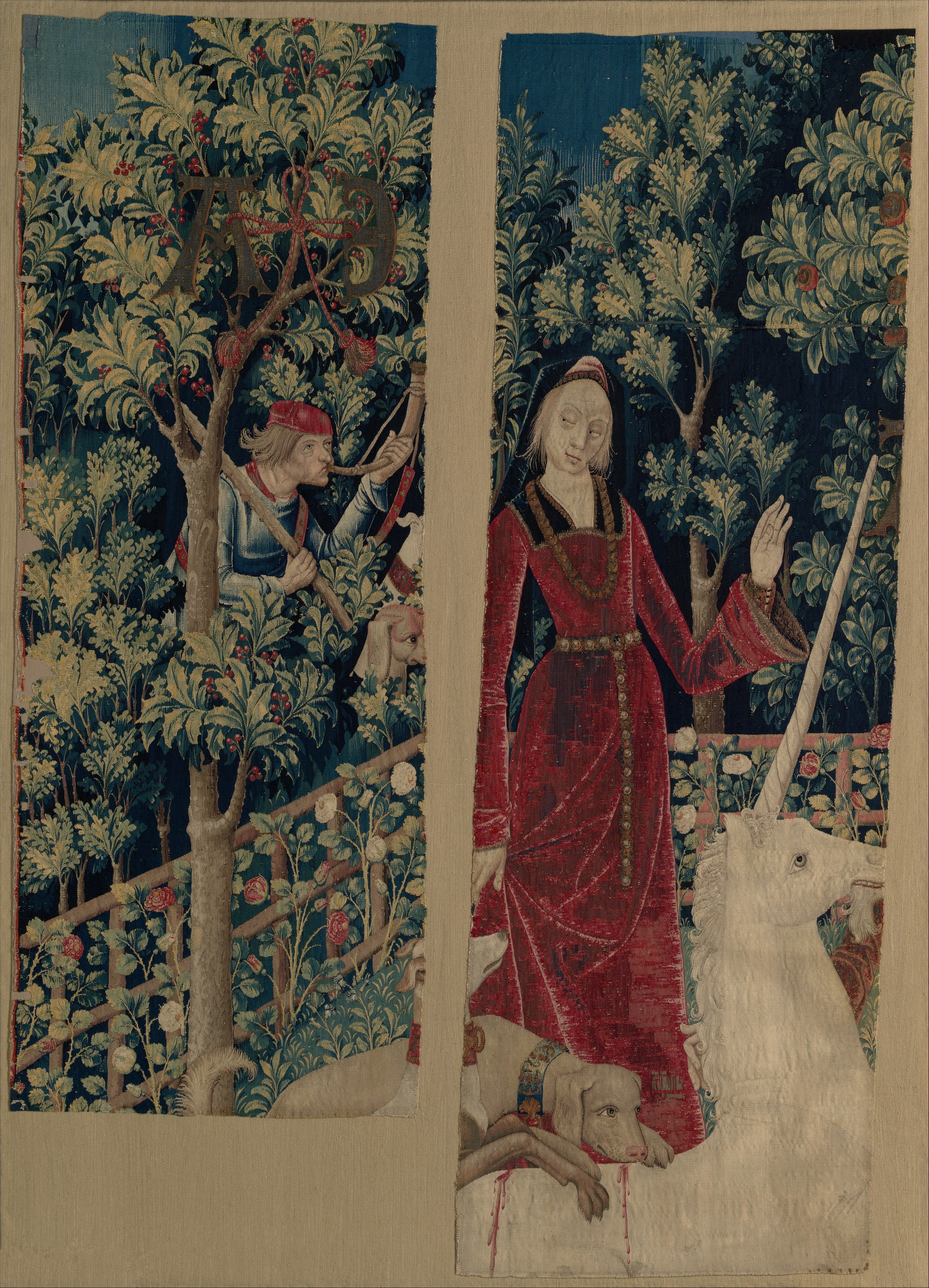
The Unicorn Surrenders to a Maiden: A Couture Analysis of Textile Sovereignty
In the annals of textile history, few artifacts command the reverence and interpretive depth of the late medieval Unicorn Tapestries, specifically the seventh panel, The Unicorn Surrenders to a Maiden. Woven in the South Netherlandish workshops of the late 15th or early 16th century, this masterpiece is not merely a decorative object but a sophisticated narrative of power, purity, and the transformation of the wild into the domestic—a metaphor that resonates profoundly with the ethos of Katherine Fashion Lab. As Lead Curator, I propose a couture analysis of this tapestry, examining its materiality, symbolic lexicon, and structural composition as a standalone study in textile sovereignty. The work’s medium—wool warp interwoven with wool, silk, silver, and gilt wefts—elevates it beyond craft into a statement of luxury and ideological control, a precursor to the haute couture tradition that Katherine Fashion Lab seeks to reinterpret.
Materiality as Power: The Alchemy of Fiber and Metal
The tapestry’s foundation is a plain wool warp, a utilitarian base that grounds the piece in the everyday labor of Flemish weavers. Yet, the weft introduces a hierarchy of materials that mirrors the social and spiritual order of the narrative. Wool, dyed in deep indigos and verdant greens, provides the earthy texture of the forest enclosure—the hortus conclusus or enclosed garden—where the unicorn submits. Silk, with its luminous sheen, is reserved for the maiden’s gown and the unicorn’s white coat, signaling a transcendent purity that resists the grime of the mortal world. This contrast is deliberate: the wool of the background suggests the mundane, while the silk of the central figures elevates them to a sacred plane.
More striking is the integration of silver and gilt wefts, which thread through the tapestry like veins of light. These metallic threads, woven into the maiden’s crown, the unicorn’s horn, and the decorative millefleurs, do not merely adorn; they assert a material sovereignty. In the context of Katherine Fashion Lab, this use of precious metal prefigures the contemporary couturier’s reliance on gold thread, sequins, and metallic embroidery to signal exclusivity and ritual significance. The silver and gilt are not passive embellishments—they are active agents in the visual economy, catching candlelight in a medieval hall to create a kinetic interplay of shadow and radiance. This technique, known as broderie d’art in modern terms, transforms the textile into a living document of power, where the unicorn’s surrender is not defeat but a transfer of divine energy from the wild to the civilized.
Symbolic Lexicon: The Maiden as Couturière of Control
The narrative of The Unicorn Surrenders to a Maiden is a complex allegory of chastity, love, and the taming of the untamable. The unicorn, a creature of mythic ferocity, kneels before a seated maiden, placing its forelegs in her lap. This gesture of submission is not one of weakness but of voluntary offering—a theme that Katherine Fashion Lab can mine for its own design philosophy: the surrender of raw material to the hand of the creator. The maiden, here, functions as a proto-couturière, her gaze calm and her posture regal. She does not capture the unicorn; she attracts it through an aura of purity, symbolized by her white silk gown and the mirror she holds—a tool of self-reflection and, metaphorically, of design.
The unicorn’s horn, often interpreted as a phallic symbol of potency, is here rendered in gilt, a material that suggests both the sacred and the imperial. In surrendering, the unicorn does not lose its essence but channels it into a new form: the horn becomes a decorative object, a piece of jewelry in the maiden’s narrative. This transformation echoes the couture process, where raw fibers—wool, silk, metal—are subjugated to the designer’s vision, yet retain their intrinsic properties. The tapestry thus becomes a meditation on the ethics of material transformation: the unicorn’s surrender is a consensual act, a partnership between the wild and the civilized, much like the relationship between the artisan and the textile.
Structural Composition: The Verticality of Desire
From a compositional standpoint, the tapestry employs a vertical hierarchy that reinforces its thematic content. The maiden is seated on a raised dais of embroidered grass, her figure occupying the central axis. The unicorn, though large, is positioned slightly lower, its head bent to her level. This spatial arrangement creates a visual pyramid, with the maiden at the apex—a design choice that anticipates the modern runway’s focus on the model as a living sculpture. The surrounding millefleurs, or thousand flowers, are not mere decoration but a structured chaos of botanical motifs, each flower meticulously woven to create a tapestry within the tapestry. These flowers, including lilies, columbines, and daisies, carry their own symbolic weight: the lily for purity, the columbine for folly, and the daisy for innocence. Together, they form a semantic field that enriches the central narrative.
The use of vertical lines in the maiden’s gown and the unicorn’s legs directs the eye upward, toward the gilt crown and horn, emphasizing the spiritual ascent from earthly submission to divine union. This verticality is a hallmark of haute couture draping, where seams and pleats guide the viewer’s gaze along the body’s architecture. In the tapestry, the warp threads themselves are vertical, lending the piece an inherent tension between the horizontal weft of narrative and the vertical warp of structure. This tension is resolved in the moment of surrender—a static, eternal pose that captures the essence of couture: the frozen gesture of perfection.
Contextual Relevance: From Flemish Workshop to Fashion Lab
As a standalone study, The Unicorn Surrenders to a Maiden offers Katherine Fashion Lab a blueprint for exploring themes of dominance and tenderness in textile design. The South Netherlandish origins of the tapestry are significant: the region was a hub of textile innovation, where guilds perfected the art of tapestry weaving as a form of narrative mapping. This tradition of storytelling through fiber is directly applicable to contemporary couture, where garments are increasingly conceived as wearable narratives. The tapestry’s material palette—wool, silk, silver, gilt—provides a tactile vocabulary for modern reinterpretation. Imagine a Katherine Fashion Lab collection that translates the millefleurs into laser-cut leather appliqués, or the gilt threads into hand-embroidered silver bullion on a silk organza gown. The unicorn’s horn could become a structural corset element, while the maiden’s mirror might be reimagined as a reflective panel in a jacket.
Moreover, the tapestry’s context as a secular object—commissioned for a noble household, likely as part of a series celebrating marriage or courtly love—aligns with the luxury market’s demand for objects that signify status and cultural capital. Katherine Fashion Lab can leverage this historical resonance to position its collections as investments in heritage, not merely fashion. The unicorn’s surrender is, ultimately, a story of controlled vulnerability, a concept that resonates in an era of sustainable fashion, where materials must be treated with care and respect. The tapestry teaches us that luxury is not the absence of labor but the visible mastery of it—a lesson that Katherine Fashion Lab, as a custodian of couture, must embody.
Conclusion: The Eternal Surrender
In The Unicorn Surrenders to a Maiden, we witness a moment of transcendent beauty where the wild yields to the civilized, the raw to the refined, and the mythical to the material. This tapestry is not a relic but a living dialogue between past and present, between the weaver’s hand and the couturier’s needle. For Katherine Fashion Lab, it serves as a masterclass in material hierarchy, symbolic density, and compositional rigor. The unicorn’s surrender is not an end but a beginning—a generative act that births new forms, new narratives, and new possibilities for textile art. As we continue to explore the intersections of history and innovation, let this tapestry remind us that true couture is always a surrender to the sublime.