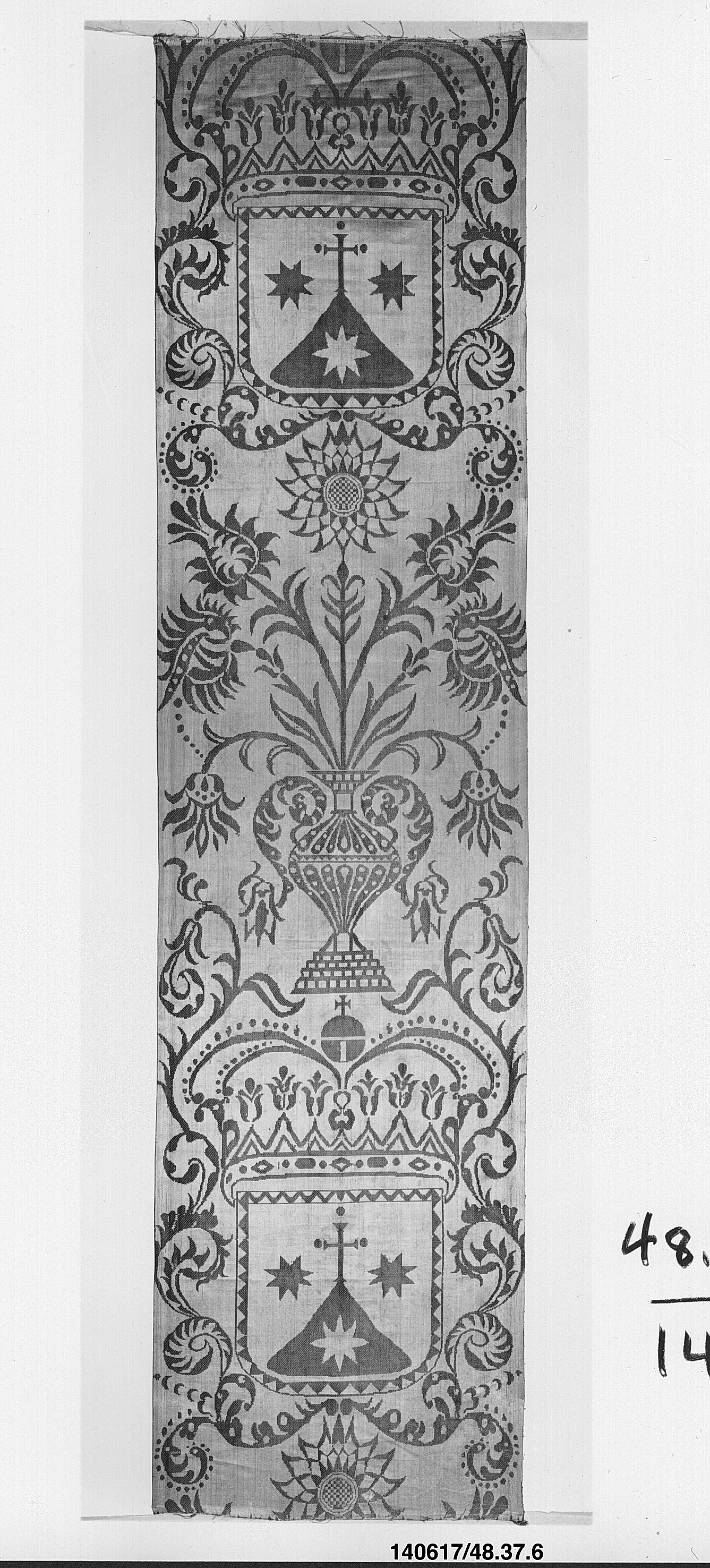
Heritage Analysis: The Carmelite Order Silk Fragment
This report presents a strategic heritage analysis of a length of silk bearing the coat-of-arms of the Carmelite Order, examined through the lens of symbolic power, historical adornment, spiritual meaning, and its potential application in 2026 high-end luxury strategy. Commissioned as a Standalone Research project for Katherine Fashion Lab, this study positions the artifact not merely as a textile but as a repository of layered cultural authority—a material witness to the convergence of sacred iconography, aristocratic patronage, and artisanal mastery. The analysis proceeds through four distinct yet interconnected dimensions, culminating in actionable insights for luxury brand positioning in the coming season.
Symbolic Power: The Heraldic Language of Authority
The coat-of-arms of the Carmelite Order is a semiotic system of profound hierarchical resonance. Historically, the Carmelites—a Catholic mendicant order founded on Mount Carmel in the 12th century—adopted a shield divided into three fields: a central star, a mountain, and a cloud, often accompanied by a cross or the motto Zelo zelatus sum pro Domino Deo exercituum (“With zeal have I been zealous for the Lord God of Hosts”). On this silk fragment, the heraldic motifs are rendered in gold and deep crimson threads, materials that themselves signify divine light and sacrificial blood. The star, representing the Virgin Mary as Stella Maris, anchors the composition as a celestial guide, while the mountain evokes the original hermitage of the order’s founders.
Symbolic power here operates on multiple registers. First, the coat-of-arms functions as a mark of institutional sovereignty, akin to a royal warrant, signaling that the silk was produced under the order’s direct commission or for a high-ranking prelate. Second, the use of silk—a material historically associated with imperial courts and sacred vestments—elevates the object from mere fabric to a medium of sacral authority. In the context of ancient civilizations, silk was a commodity of immense value, often traded along the Silk Road and reserved for elite consumption. By imprinting the Carmelite coat-of-arms onto silk, the order asserted its participation in a global economy of luxury while simultaneously claiming a transcendent, non-commercial legitimacy. For Katherine Fashion Lab, this duality—worldly prestige married to spiritual gravitas—offers a powerful template for 2026 luxury branding: the creation of objects that speak to both status and meaning, where the emblem is not merely decorative but a declaration of lineage and purpose.
Historical Adornment: From Ritual Vestment to Courtly Garment
The historical context of this silk fragment reveals its role as a vehicle for adornment in both sacred and secular spheres. In the medieval and early modern periods, the Carmelite Order maintained a strict visual identity through its white mantle and brown scapular, but its coat-of-arms was reserved for liturgical vestments, altar cloths, and banners used in processions. The silk’s weight and weave suggest it was likely intended for a chasuble or cope—garments worn by priests during the Eucharist, where the heraldic imagery would have been visible to congregants as a reminder of the order’s intercessory power. The crimson ground, a color historically associated with cardinals and the blood of martyrs, further underscores the garment’s ritual function.
Yet adornment in this context was never purely aesthetic. The silk’s shimmering surface, achieved through a complex twill weave and metallic thread, created a visual hierarchy within the liturgical space. Light catching the gold threads would have drawn the eye to the coat-of-arms, reinforcing the Carmelites’ claim to spiritual authority and their role as mediators between heaven and earth. This interplay between material splendor and sacred function mirrors the dynamics of contemporary luxury: adornment that commands attention while conveying depth. For Katherine Fashion Lab’s 2026 strategy, the lesson lies in the integration of insignia with craftsmanship. Just as the Carmelite silk used heraldry to transform a garment into a statement of identity, high-end brands can employ emblematic motifs—whether monograms, crests, or abstract symbols—as anchors for collections that resonate with heritage-conscious consumers. The key is to ensure that the emblem is not a superficial addition but is woven into the fabric’s very structure, as was done here with the silk’s warp and weft.
Spiritual Meaning: The Textile as Devotional Object
Beyond its material and heraldic dimensions, this silk fragment carries a profound spiritual meaning rooted in Carmelite theology. The order’s spirituality emphasizes contemplation, solitude, and union with God, themes that are encoded in the coat-of-arms. The central star, or Stella Maris, is a direct reference to the Virgin Mary, whom the Carmelites venerate as their patroness and protector. The mountain represents Mount Carmel, the site of Elijah’s prophetic encounter with God, and by extension, the soul’s ascent toward divine illumination. The cloud, often depicted as a stylized nimbus, alludes to the cloud of unknowing—a mystical concept of approaching God through love rather than intellect.
When these symbols are rendered in silk, a material that was itself considered a gift from God in many ancient cultures, the textile becomes a devotional object—a tangible aid to prayer and meditation. The act of wearing or beholding the silk was believed to confer blessings, protect the wearer, and align them with the order’s spiritual mission. This sacral dimension is critical for understanding the artifact’s power: it was not merely a status symbol but a conduit for the divine. In the 2026 luxury landscape, where consumers increasingly seek meaning alongside material value, the Carmelite silk offers a model for how brands can infuse products with spiritual or philosophical resonance. A luxury garment or accessory can be positioned as a “talisman”—an object that connects the wearer to a tradition, a set of values, or a higher purpose. Katherine Fashion Lab might explore collaborations with artisans who specialize in sacred textiles, or develop a capsule collection inspired by monastic aesthetics, where simplicity and symbolism take precedence over ostentation.
2026 High-End Luxury Strategy: Translating Heritage into Market Authority
For Katherine Fashion Lab, the strategic implications of this Carmelite silk fragment are threefold, each aligning with emerging trends in the 2026 luxury market. First, the artifact exemplifies heritage as a differentiator. In a market saturated with fast-moving trends, consumers are gravitating toward brands that can narrate a compelling history. The silk’s provenance—its connection to an ancient order, its use in ritual, its material rarity—provides a rich story that can be leveraged through exclusive exhibitions, limited-edition reproductions, or digital storytelling campaigns. Katherine Fashion Lab should consider curating a “Sacred Textiles” archive, where such pieces are displayed alongside contemporary interpretations, positioning the brand as a custodian of cultural memory.
Second, the silk’s symbolic density offers a blueprint for product development. The 2026 luxury consumer is not merely buying a garment; they are buying an identity. By incorporating heraldic motifs—reinterpreted through modern design—Katherine Fashion Lab can create pieces that function as status markers with depth. For example, a silk scarf bearing a stylized version of the Carmelite star could be marketed as a “stella maris” piece, with accompanying narratives of protection and guidance. The use of sustainable silk, hand-embroidered with metallic threads, would echo the original’s artisanal rigor while appealing to eco-conscious buyers.
Third, the artifact’s spiritual dimension aligns with the growing demand for wellness-oriented luxury. In 2026, brands are increasingly integrating mindfulness, meditation, and ritual into their offerings. Katherine Fashion Lab could launch a “Contemplative Collections” line, where garments and accessories are designed to be worn during moments of reflection—a cashmere wrap with a discreet embroidered symbol, or a silk lining in a jacket that reveals a hidden motif. This approach transforms luxury from a display of wealth into a tool for personal transformation, mirroring the Carmelite silk’s original function as a devotional aid.
Finally, the strategic pricing of such pieces should reflect their aura of rarity. Just as the Carmelite silk was produced in limited quantities for a select audience, Katherine Fashion Lab should adopt a “by appointment” model for heritage-inspired collections, offering bespoke consultations and made-to-order options. This scarcity, combined with the narrative of sacred craftsmanship, justifies a premium price point and reinforces the brand’s positioning at the apex of the market.
In conclusion, this length of silk with the Carmelite Order coat-of-arms is far more than a historical artifact. It is a masterclass in the fusion of symbolic power, artisanal excellence, and spiritual meaning—a template that Katherine Fashion Lab can adapt for the 2026 luxury landscape. By honoring the artifact’s heritage while translating its lessons into contemporary strategy, the brand can achieve a rare synthesis: luxury that is both exclusive and profound, desirable and meaningful.