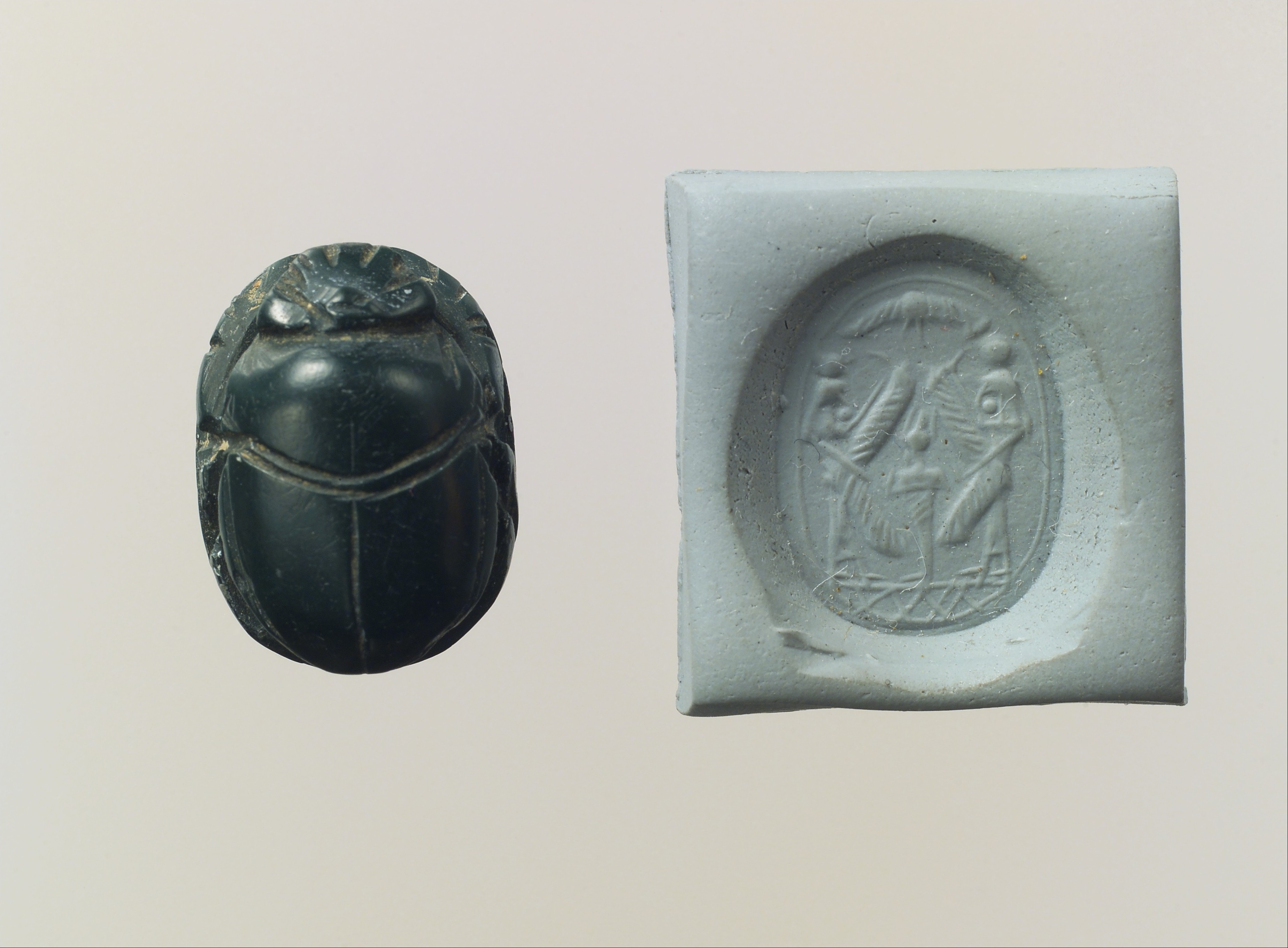
The Scarab’s Legacy: Osiris, Protective Deities, and the Reimagining of Epochal Power
In the rarefied arena of haute couture, where fabric meets philosophy and ornament becomes narrative, the analysis of a single artifact can unlock a lexicon of design. At Katherine Fashion Lab, we approach the Scarab seal and modern impression: Osiris flanked by protective deities not merely as a relic of ancient funerary practice, but as a prescriptive text for contemporary luxury. Crafted from green jasper, this Global Heritage piece embodies a convergence of material, myth, and symbolic geometry that resonates profoundly with the Lab’s ethos of transformative storytelling. This standalone study deconstructs the artifact’s formal and metaphysical architecture, extracting principles that inform a couture language of protection, resurrection, and sovereign authority.
Material Alchemy: The Green Jasper as a Couture Substrate
The choice of green jasper is neither arbitrary nor merely aesthetic. In the ancient world, jasper was revered as a stone of endurance and grounding—a material believed to carry the vital force of the earth itself. For the couture analyst, this mineralogical specificity offers a profound lesson in material hierarchy. Green jasper, with its opaque, variegated depth, resists the transparency of more fragile gems. It is a stone of permanence, suggesting that true luxury is not in fragility but in resilience. In the context of Katherine Fashion Lab, this translates into a design philosophy where textiles are selected for their capacity to hold form, weight, and narrative over time. The jasper’s green hue—a color straddling life (vegetation) and death (decay)—becomes a chromatic keynote for a collection that explores the liminal space between mortality and rebirth. The Lab might interpret this through structured jacquard weaves in emerald and malachite tones, their surfaces embossed with scarab motifs that catch light like polished stone.
Iconographic Symmetry: Osiris and the Protective Dyad
At the seal’s core lies the figure of Osiris, the god of the underworld, resurrection, and agricultural renewal. He is flanked by protective deities—likely Isis and Nephthys, or the more esoteric guardians of the Duat. This triadic composition is not decorative; it is a diagram of power. Osiris, mummified and enthroned, represents the axis mundi—the still point of the turning world. The flanking deities are agents of boundary, their outstretched wings or arms forming a prophylactic enclosure. For couture, this spatial logic is revolutionary. It suggests that the garment itself can function as a protective field, a second skin that delineates the wearer’s sacred space. The Lab might translate this into a severe, architectural silhouette: a columnar gown with a high, structured collar and asymmetrical panels that sweep outward like protective wings. The Osiris figure becomes the central seam or the spine of the garment, while the deities are rendered as embroidered or appliquéd guardians along the shoulders and hips.
The Scarab as Temporal Operator
The scarab beetle is the seal’s ultimate protagonist. In Egyptian cosmology, the scarab (Khepri) rolled the sun across the sky, symbolizing self-creation and cyclical rebirth. As a seal, it performed a dual function: it authenticated authority and, when pressed into clay, left a negative impression that could be read as a positive mark. This dialectic of presence and absence, positive and negative, is a fertile ground for design innovation. Katherine Fashion Lab could explore this through reversible construction or negative-space cutouts that reveal a contrasting layer beneath—a lining that mirrors the outer form but in a different texture or color. The scarab itself might be reinterpreted as a structural clasp or a detachable brooch, serving both as ornament and as functional fastener. The act of “sealing” the garment—closing it with a scarab motif—becomes a ritual of completion, a symbolic locking of the wearer’s identity.
Color Theory and the Chromatic of the Underworld
The green jasper’s specific hue—a deep, almost black-green with lighter veining—dictates a restrained yet potent palette. This is not the bright green of spring, but the sober green of eternity. For a couture collection, this suggests a foundation of olive, bottle green, and verdigris, punctuated by accents of gold (the sun’s metal) and lapis lazuli blue (the sky of the gods). The protective deities might be rendered in metallic thread or jet-black beads, their forms emerging from the green ground like hieroglyphs from papyrus. The Lab’s color story would be one of controlled opulence, where richness is achieved through depth of tone rather than brightness. The Osiris figure, perhaps in a burnished gold lamé, would stand as a beacon of light within the dark, fertile matrix of the fabric.
Impression and Imprint: The Negative Space as Narrative
Perhaps the most intellectually provocative element of this artifact is the modern impression it creates. The seal, when pressed into clay or wax, leaves a reversed image. This act of imprinting—of transferring a design from one surface to another—is the very essence of textile design. A pattern is carved, inked, and pressed onto cloth. Katherine Fashion Lab can leverage this concept by reversing the figure-ground relationship in its garments. A dress might feature a positive scarab motif on the front, while the back bears the same motif in negative, as if the beetle has passed through the fabric. Alternatively, the Lab could produce a limited-edition series of silk scarves where the seal’s impression is screen-printed in a deliberate, off-register manner, creating a ghost image that speaks to the passage of time and the erosion of memory. This technique honors the artifact’s dual existence as both object and action.
Prophylactic Geometry: The Architecture of Protection
The protective deities flanking Osiris are not passive; their postures suggest active guardianship. This introduces a geometric vocabulary of defense. In couture, this can be manifested through sharp, angular shoulder lines, corseted bodices that mimic the rigidity of a shrine, and layered skirts that create a sense of impenetrable volume. The Lab might experiment with 3D-printed elements—small, scarab-shaped tiles or deity silhouettes—that are strategically placed along the seams and hems, functioning as both armor and ornament. The garment becomes a portable sanctuary, a wearable temple where the wearer is the Osiris figure, protected by the very structure of the dress.
Conclusion: The Seal as a Couture Manifesto
The Scarab seal and modern impression: Osiris flanked by protective deities is more than a historical curiosity; it is a design manifesto for the modern age. It teaches us that true luxury is rooted in meaning, that protection can be beautiful, and that the act of imprinting—of leaving a mark—is the highest form of authorship. For Katherine Fashion Lab, this artifact demands a collection that is architectural, symbolic, and deeply personal. It calls for garments that do not merely cover the body but encase the spirit, that transform the wearer into a living seal of their own identity. In the green jasper’s eternal stillness, we find the blueprint for a fashion that endures—not as a relic, but as a living impression of power, protection, and perpetual rebirth.