The Embroidered Darning Sampler: A Study in Material Virtuosity and Global Heritage
In the realm of couture, the distinction between craft and art is often a matter of perspective. At Katherine Fashion Lab, we examine garments and textile artifacts not merely as functional objects but as repositories of technical mastery, cultural memory, and aesthetic innovation. The embroidered darning sampler, a standalone study piece composed of silk on linen, offers a profound case in point. This object, rooted in the global heritage of needlework, transcends its utilitarian origins to become a testament to the enduring dialogue between material, technique, and human expression.
The Sampler as a Document of Technical Virtuosity
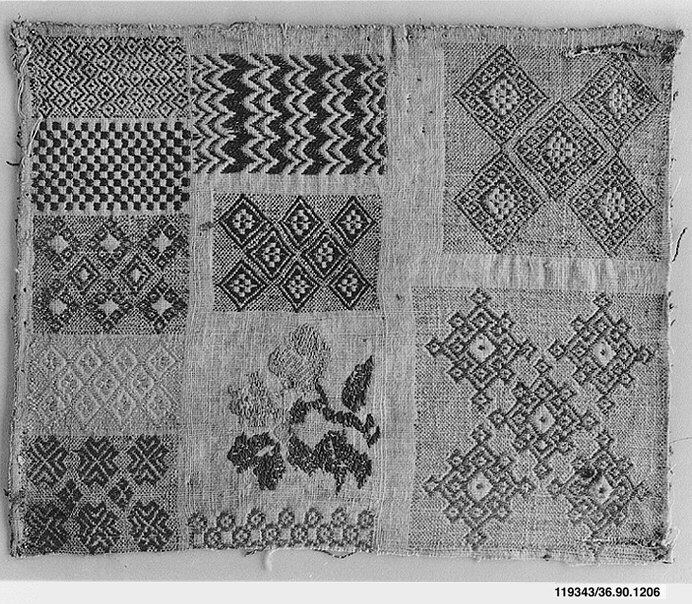
The darning sampler, historically a pedagogical tool for teaching mending and decorative stitching, is elevated here to an object of pure study. The choice of materials—silk thread on a linen ground—is deliberate and significant. Linen, with its sturdy, even weave, provides an ideal substrate for precise, repetitive stitching, while silk introduces a lustrous, almost luminous quality that transforms the act of repair into an act of adornment. The sampler’s composition is a carefully orchestrated grid of patterns: geometric motifs, floral arabesques, and abstract textures that mimic woven fabrics. Each segment represents a different darning technique—pattern darning, Swiss darning, and net darning—executed with a meticulousness that borders on the obsessive.
This technical virtuosity is not mere ornamentation. In couture, the mastery of such techniques signals a deep understanding of fabric behavior and structural integrity. The silk thread, while delicate, is employed in ways that reinforce the linen’s tensile strength, creating areas of density that resist wear. The sampler thus functions as a living lexicon of material problem-solving, where each stitch is a decision about tension, rhythm, and durability. For the modern designer, this piece offers a silent curriculum: how to marry fragility with resilience, and how to make the invisible—the act of mending—visible as art.
Global Heritage: The Sampler as a Cross-Cultural Artifact
The global heritage of this sampler is not a passive attribution but an active, layered history. While the specific origin of this piece is “Global Heritage,” its techniques and motifs draw from a rich tapestry of traditions. The geometric patterns echo the Bargello work of Renaissance Italy, where flame-like stitches created vibrant, undulating forms. The floral motifs recall the chikan embroidery of South Asia, where delicate white-on-white stitching on muslin mimicked the texture of lace. The net darning sections, with their open, grid-like structures, reference the filet lace of Europe, often used in ecclesiastical textiles and household linens.
What makes this sampler a singular artifact is its synthesis of these disparate traditions into a cohesive whole. It is not a pastiche but a convergent narrative, where the needle becomes a tool of cultural translation. The silk thread, a material historically traded along the Silk Road, connects the East and West, while the linen ground—a staple of European and Middle Eastern textile production—anchors the piece in a shared global economy. The sampler, therefore, is a microcosm of global heritage: a physical record of how techniques and aesthetics traveled, adapted, and merged through centuries of trade, migration, and exchange.
The Standalone Study: Context and Intent
The designation of this piece as a “standalone study” is critical to its interpretation. Unlike samplers created as part of a larger trousseau or as instructional tools for apprentices, this object is presented as an autonomous work. It is not meant to be framed, worn, or used in a functional context. Instead, it is an object of contemplation, a specimen for close reading. This contextual shift reframes the sampler from a preparatory exercise to a finished statement. The absence of practical utility liberates the viewer to focus solely on the interplay of texture, color, and pattern.
In the context of Katherine Fashion Lab, the standalone study serves as a pedagogical and curatorial anchor. It invites the observer to consider the sampler as a precursor to contemporary design thinking. The study of darning—historically a repair technique—becomes a metaphor for sustainability and resourcefulness in fashion. Each stitch is a conscious act of preservation, a refusal to discard. In an era of fast fashion, this sampler stands as a quiet manifesto: that beauty and utility are not opposing forces, but partners in a dialogue of care.
Material and Process: Silk on Linen
The material pairing of silk on linen is a study in contrasts. Linen, derived from the flax plant, is a bast fiber known for its strength, absorbency, and tendency to wrinkle. It is a material of honest, unadorned utility. Silk, by contrast, is a protein fiber produced by silkworms, celebrated for its smoothness, luster, and drape. It is a material of luxury and refinement. When silk is stitched into linen, a tension arises: the humble ground is elevated by the precious thread, while the thread is disciplined by the linen’s firm hand.
This tension is the source of the sampler’s visual and tactile complexity. The silk catches light differently depending on the stitch direction, creating a moiré effect that shifts with the viewer’s angle. The linen ground, with its subtle slubs and irregularities, provides a textural counterpoint. The result is a surface that is both disciplined and dynamic, a controlled explosion of pattern and light. For the couturier, this interplay offers a lesson in material hierarchy: how to let two opposing fibers coexist without one overpowering the other.
Conclusion: The Sampler as a Blueprint for Couture Thinking
The embroidered darning sampler, as a standalone study, is far more than a historical curiosity. It is a blueprint for couture thinking, a reminder that the highest form of design emerges from the deepest understanding of materials and techniques. Its global heritage speaks to the interconnectedness of human creativity, while its technical precision demonstrates the power of discipline in artistic expression. At Katherine Fashion Lab, we regard this sampler as a foundational text—a source of inspiration for designers who seek to honor tradition while pushing the boundaries of innovation.
In the end, the sampler teaches us that couture is not about novelty for its own sake, but about the perfection of the known. It is a meditation on how the simple act of mending, when executed with intention and skill, can become an act of creation. This piece, with its silk threads woven into linen, is a quiet but resolute assertion: that in fashion, as in life, the most profound beauty often lies in the details we choose to preserve.