The Kerchief as Couture: A Study in American Cotton Craft
Historical Precedence and the Reclamation of the Kerchief
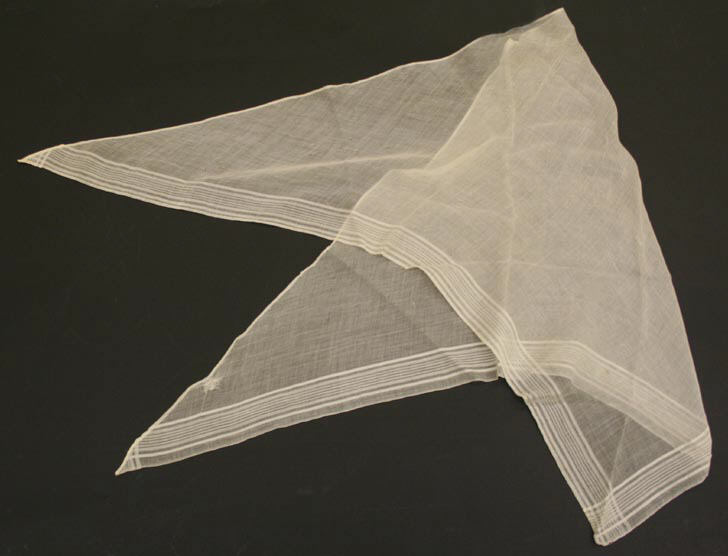
The kerchief, often dismissed as a utilitarian accessory or a relic of agrarian and immigrant labor, occupies a paradoxical space in American fashion history. For Katherine Fashion Lab, this humble square of fabric is not merely a nostalgic nod to the past but a sophisticated canvas for exploring the intersection of materiality, cultural memory, and high craft. In this standalone study, the kerchief is elevated from its origins as a functional neckerchief, headwrap, or pocket square into a statement of couture-level design. The choice of American cotton as the sole material is neither incidental nor merely patriotic; it is a deliberate curatorial decision that anchors the piece in a lineage of textile innovation, from the antebellum plantations to the modern mills of the South.
The kerchief’s history in America is deeply entwined with narratives of labor, resilience, and identity. From the bandanas of cowboys and railroad workers to the headscarves of domestic workers and the silk squares of jazz-era flappers, the kerchief has always been a marker of class, vocation, and subculture. Katherine Fashion Lab’s reinterpretation strips away these historical specificities to focus on the object’s essential geometry and tactile potential. By doing so, the lab invites a re-examination of what constitutes “American luxury” — not through imported silks or European tailoring, but through the refined manipulation of a domestic, democratic fiber.
Materiality and the American Cotton Ethos
Cotton, in this context, is not a compromise but a provocation. The kerchief is crafted from a single, continuous piece of long-staple American cotton, sourced from a heritage mill in the Carolinas known for its commitment to regenerative agriculture. The fiber’s natural breathability, drape, and ability to hold a crisp fold are treated as technical assets rather than limitations. The lab’s design team has subjected the cotton to a proprietary finishing process that enhances its luster and resistance to creasing, creating a surface that catches light with a subtle, matte sheen — a counterpoint to the high-gloss finishes of synthetic couture.
The color palette is restrained, drawing from the American landscape: “Dust Bowl Ochre,” “Mississippi Mud,” “Appalachian Fog,” and “Cornflower Blue.” Each hue is achieved through low-impact, plant-based dyes that echo the organic origins of the fiber. The absence of synthetic colorants underscores the lab’s commitment to environmental stewardship, but it also serves a conceptual purpose: the kerchief becomes a document of place, a wearable fragment of the American terrain.
Construction and the Geometry of Restraint
Where conventional couture often celebrates excess — layers of tulle, hand-beading, and structural boning — the kerchief study is an exercise in restrained precision. The square is cut with laser accuracy to ensure perfect 90-degree angles, then hand-finished with a rolled hem that takes a single artisan over four hours to complete. The hem is not merely decorative; it provides the necessary weight and tension to allow the kerchief to be folded, tied, or draped in multiple configurations without losing its integrity.
The lab has developed three signature folds for this study, each referencing a distinct American archetype. The “Homesteader’s Knot” mimics the utilitarian wraps of pioneer women, with a central twist that creates a sculptural volume at the nape of the neck. The “Jazzman’s Drape” is a more fluid, asymmetrical fold that cascades over one shoulder, evoking the nonchalant elegance of 1920s Harlem. The “Industrial Crisscross” is a modern, modular construction that allows the kerchief to be worn as a top, a belt, or a bag handle, reflecting the lab’s interest in multi-functional luxury.
Couture Techniques Applied to a Common Object
The kerchief’s apparent simplicity belies the complexity of its execution. Katherine Fashion Lab employs hand-stitched French seams on the interior edges, a technique usually reserved for fine lingerie or tailored jackets. These seams prevent fraying and create a clean, reversible finish — the kerchief is as beautiful on the inside as it is on the outside, a hallmark of true couture. Additionally, the fabric is block-printed with a bespoke pattern derived from archival photographs of American textile mills. The pattern is so subtle that it reads as a texture rather than a print, revealing itself only under close inspection or in certain lighting conditions.
The lab has also introduced a micro-pleating technique along one edge of the kerchief, achieved through a combination of heat-setting and hand-stitching. This pleating allows the wearer to adjust the volume and silhouette of the kerchief, transforming it from a flat square into a three-dimensional accessory. This adaptability is central to the lab’s philosophy: the kerchief is not a static object but a dynamic tool for personal expression.
Cultural and Sartorial Implications
In positioning the kerchief as a standalone couture piece, Katherine Fashion Lab challenges the hierarchical distinctions between “high” and “low” fashion. The kerchief is inherently democratic — it requires no fitting, no sizing, and no specialized knowledge to wear. Yet, through the application of couture-level craftsmanship, it becomes a vehicle for sartorial agency. The wearer is not merely consuming a product but participating in a dialogue about value, labor, and American identity.
This study also resonates with contemporary conversations about slow fashion and artisanal preservation. By focusing on a single, small object, the lab highlights the potential for luxury to exist in scale and simplicity rather than in excess. The kerchief’s production supports a network of American artisans — from the cotton farmers to the dyers to the stitchers — creating a supply chain that is transparent, ethical, and deeply rooted in place.
Conclusion: The Kerchief as a Manifesto
The kerchief study by Katherine Fashion Lab is not merely a product; it is a manifesto for a new kind of American couture — one that values material honesty, cultural depth, and functional beauty. In a fashion landscape often dominated by spectacle and disposability, this humble square of cotton reminds us that true luxury lies not in what is seen, but in what is felt, remembered, and transformed. The kerchief, once a symbol of necessity, becomes a symbol of possibility — a testament to the enduring power of American craft when elevated by intention and skill.