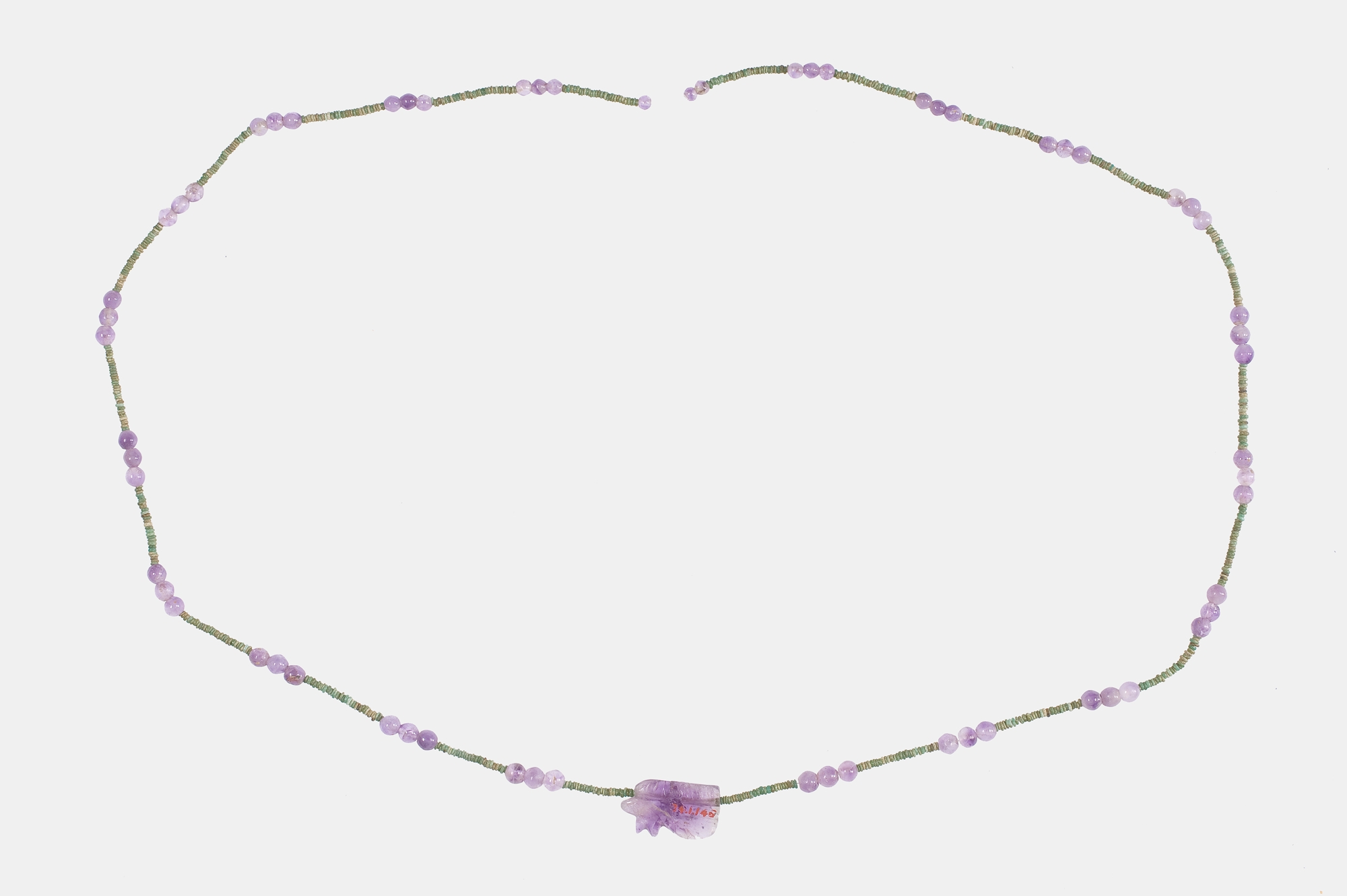
Heritage Analysis: The String of 63 Ball Beads and Wedjat Amulet of Hepy
Introduction: Defining the Artifact’s Strategic Significance
As Lead Heritage Curator for Katherine Fashion Lab, I present this formal heritage analysis of the String of 63 Ball Beads and 1 Wedjat Amulet of Hepy—an ancient Egyptian composite adornment crafted from amethyst and green faience. This artifact, dating to the Middle Kingdom or later, embodies a sophisticated interplay of symbolic power, historical adornment, and spiritual meaning. For Katherine Fashion Lab, this analysis serves as a strategic standalone research document, intended to inform our 2026 high-end luxury strategy by translating ancient material culture into contemporary brand narratives. The piece is not merely decorative; it is a coded object of protection, status, and cosmic alignment, offering profound lessons for modern luxury positioning.
Material Analysis: Amethyst and Green Faience as Carriers of Meaning
The medium of this artifact—amethyst and green faience—demands rigorous attention. Amethyst, a semi-precious quartz, was highly prized in ancient Egypt for its violet hue, which symbolized royalty, spiritual clarity, and protection against intoxication. Its hardness and rarity made it a material of the elite, often reserved for amulets and burial goods. The 63 ball beads, each meticulously carved, represent not only technical mastery but also a deliberate choice of material that conveyed the owner’s status and connection to the divine. In contrast, green faience—a self-glazing ceramic—was a synthetic material accessible to a broader social spectrum, yet its vibrant green color was associated with rebirth, fertility, and the god Osiris. The juxtaposition of amethyst and faience in a single string suggests a hierarchical yet complementary symbolic system: the amethyst beads anchor the piece in royal and protective energy, while the faience wedjat amulet amplifies regenerative power. For Katherine Fashion Lab, this material duality offers a strategic template for 2026 luxury: combining rare, high-value materials with accessible, symbolically rich synthetics to create layered narratives of exclusivity and inclusivity.
Symbolic Power: The Wedjat Eye and the Number 63
The wedjat amulet—the Eye of Horus—is the focal point of this adornment. In ancient Egyptian cosmology, the wedjat was a potent symbol of healing, protection, and royal authority. It represented the eye lost by Horus in his battle with Seth, restored by Thoth, and thus signified wholeness, sacrifice, and divine intervention. When worn, the wedjat acted as a talisman against evil, illness, and misfortune, channeling the protective gaze of the gods. Its placement on a string of 63 beads is numerically significant. The number 63, while not as overtly symbolic as 7 or 12, appears in funerary contexts—notably in the 63 days of the Canopic cycle or as a multiple of 7 (7 x 9), linking it to completeness and eternal cycles. In the context of this artifact, 63 beads may represent a protective sequence, each bead a prayer or invocation, culminating in the wedjat’s apex power. For high-end luxury strategy, this numerical precision underscores the importance of intentionality in design. Katherine Fashion Lab can leverage this by adopting “ritual numbers” in limited-edition collections—e.g., 63 pieces per drop—to imbue products with a sense of sacred scarcity and narrative depth.
Historical Adornment: The Bead as Social and Spiritual Currency
In ancient Egypt, bead strings were not merely decorative; they were functional objects of social currency and spiritual insurance. The 63 ball beads, likely worn as a necklace or girdle, would have been visible markers of the owner’s wealth, piety, and network. Amethyst beads, sourced from the Eastern Desert or possibly imported from Nubia, indicated access to long-distance trade routes and royal patronage. The wedjat amulet, often placed at the center or clasp, served as a focal point for ritual attention. Historical records from the Middle Kingdom suggest that such strings were used in daily life, temple ceremonies, and burial rites—transitioning from adornment to afterlife equipment. This dual function—ornamental and apotropaic—is key to understanding historical adornment as a strategic investment. For Katherine Fashion Lab’s 2026 strategy, this suggests a pivot toward “functional luxury”: pieces that serve both aesthetic and metaphysical purposes. For instance, a contemporary necklace could integrate a protective symbol (e.g., a stylized wedjat) with customizable bead sequences, allowing clients to “program” their adornment with personal intentions—a blend of heritage and personalization that appeals to the modern luxury consumer’s desire for meaning.
Spiritual Meaning: Protection, Rebirth, and Cosmic Order
The spiritual dimension of this artifact is rooted in the ancient Egyptian concept of ma’at—cosmic order, balance, and truth. The wedjat amulet, in particular, was believed to restore ma’at to the wearer, warding off chaos (Isfet). The green faience of the wedjat connects it to the regenerative powers of the Nile, while the amethyst beads act as a conduit for divine light. When worn together, the string becomes a microcosm of the universe: the beads represent the multiplicity of existence, and the wedjat the unifying eye of divine perception. This spiritual architecture is highly relevant for 2026 luxury branding, where consumers increasingly seek products that offer psychological and spiritual comfort. Katherine Fashion Lab can position its collections as “wearable talismans,” using heritage motifs to address contemporary anxieties—such as digital overload, environmental uncertainty, or social fragmentation. The 63-bead format, for example, could be adapted into a “mindfulness necklace” for meditation, each bead representing a breath or affirmation, merging ancient practice with modern wellness trends.
2026 High-End Luxury Strategy: Translating Heritage into Brand Equity
To operationalize this analysis, Katherine Fashion Lab must adopt a multi-layered strategy for 2026 that honors the artifact’s symbolic power while translating it into a contemporary luxury context. First, material storytelling: leverage the duality of amethyst and faience to create capsule collections that juxtapose rare gemstones with innovative, sustainable synthetics. This aligns with the luxury sector’s shift toward ethical sourcing and narrative-driven materials. Second, ritualized product design: introduce limited-edition “Wedjat Series” pieces, each with 63 components (beads, links, or charms), accompanied by a digital booklet explaining the protective symbolism. This creates a sense of initiation and exclusivity, appealing to the luxury consumer’s desire for belonging to a select community. Third, experiential retail: design in-store or virtual “adornment rituals” where clients can customize their bead sequences and wedjat motifs, guided by heritage curators. This transforms the purchase into a meaningful ceremony, reinforcing brand loyalty and word-of-mouth value. Finally, collaborative heritage: partner with Egyptologists or contemporary artists to co-create pieces that reimagine the wedjat for modern aesthetics—e.g., using oxidized silver or laser-cut faience—ensuring relevance without losing authenticity. By embedding these strategies, Katherine Fashion Lab positions itself not just as a fashion house but as a custodian of cultural wisdom, offering luxury that heals, protects, and elevates.
Conclusion: The Artifact as a Strategic Blueprint
The String of 63 Ball Beads and 1 Wedjat Amulet of Hepy is far more than an archaeological curiosity. It is a sophisticated system of symbolic power, material hierarchy, and spiritual technology—a blueprint for how adornment can serve as a bridge between the material and the metaphysical. For Katherine Fashion Lab, this heritage analysis provides a rigorous foundation for 2026 high-end luxury strategy, emphasizing intentionality, ritual, and narrative depth. By integrating the wedjat’s protective ethos, the amethyst’s royal resonance, and the faience’s regenerative promise, the Lab can create collections that resonate deeply with discerning clients who seek meaning as much as beauty. In an era of information overload and commoditized luxury, this artifact reminds us that true exclusivity lies in the power of symbols to transform the wearer—a lesson Katherine Fashion Lab is uniquely positioned to embody.