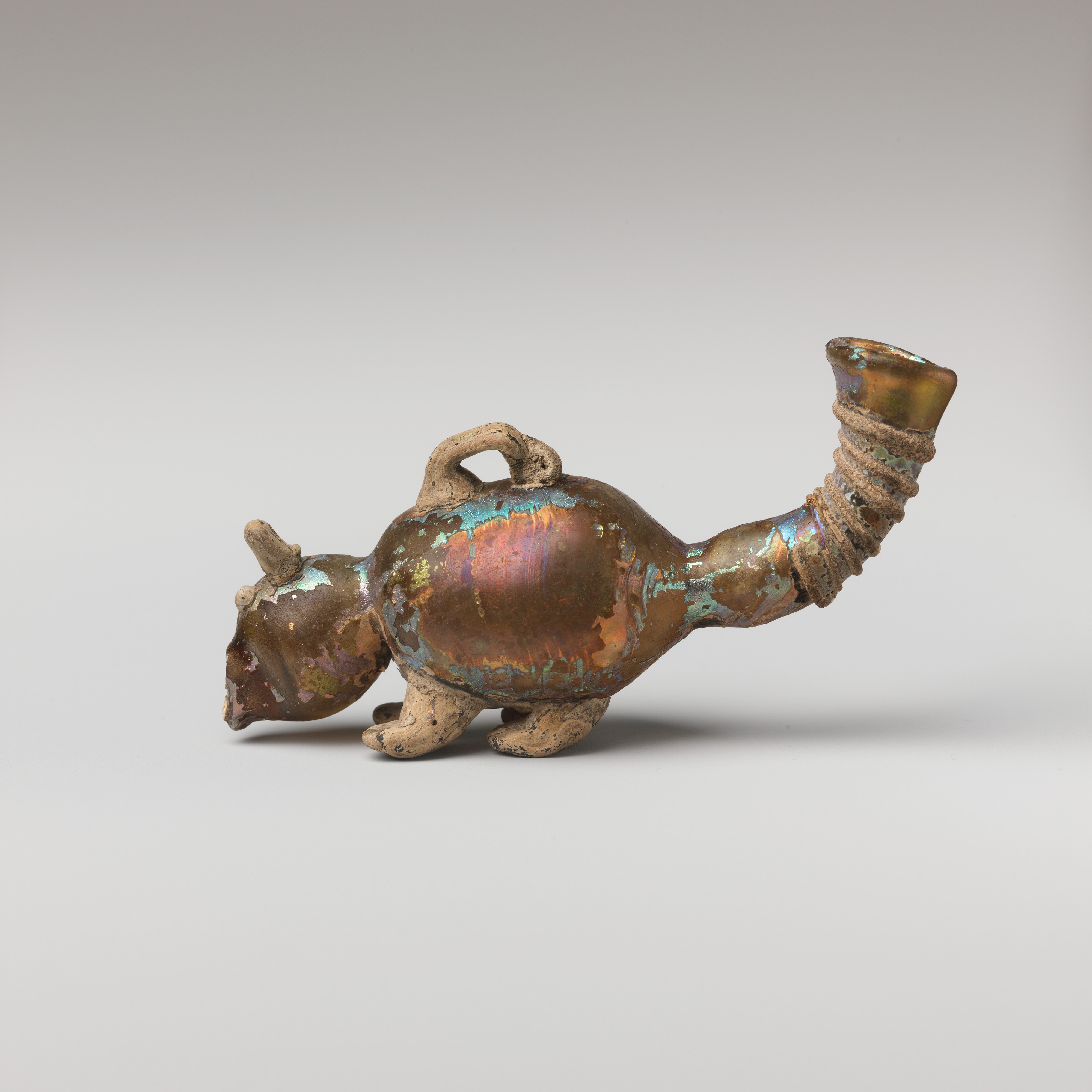
An Heirloom of Form and Function: The Roman Animal-Shaped Glass Bottle
Introduction: The Intersection of Craft and Symbolism
In the annals of material culture, few artifacts capture the convergence of aesthetic ambition and utilitarian necessity as profoundly as the Roman glass bottle shaped in the form of an animal. At Katherine Fashion Lab, we approach this object not merely as an archaeological relic but as a timeless couture statement—a testament to the Roman Empire’s mastery of glassblowing, its sophisticated trade networks, and its enduring fascination with the natural world. This standalone study dissects the bottle’s design, production techniques, and cultural resonance, positioning it as a precursor to modern luxury’s obsession with sculptural form and narrative function.
The Roman glass industry, flourishing from the first century BCE through the fourth century CE, revolutionized the ancient world’s relationship with containers. Prior to the invention of glassblowing in Syria around the first century BCE, glass was laboriously cast, carved, or formed around cores—a process reserved for elite patronage. The advent of blowpipes democratized glass production, yet the animal-shaped bottle remained a niche of high craftsmanship, often reserved for perfumes, oils, or ritual unguents. Its form—a stylized hare, a dignified lion, or a sinuous dolphin—was not arbitrary. Each creature carried symbolic weight, from the hare’s association with fertility and speed to the lion’s embodiment of imperial power and protection.
Material Alchemy: The Roman Glass Revolution
The bottle’s materiality is its first point of analysis. Roman glass, composed primarily of silica (sand), soda (natron), and lime, achieved a translucent quality that ancient artisans manipulated through additives like manganese for clarity or copper and iron for hues of blue, green, and amber. The animal-shaped bottle under study exhibits a pale aquamarine tone—a signature of naturally occurring iron impurities—which suggests a production date in the early to mid-imperial period, likely the first or second century CE. This color, far from being a flaw, enhances the object’s organic allure, mimicking the shimmer of water or the iridescence of a sea creature’s skin.
The glass’s thin walls, preserved through careful burial or dry deposition, reveal the blower’s virtuosity. Unlike thick-walled vessels intended for storage, this bottle’s delicate construction indicates a primary use for precious liquids—perhaps imported frankincense or rose oil—where weight and opacity were sacrificed for visual elegance. The surface, now patinated with millennia of chemical weathering, presents a subtle iridescence that modern luxury brands often replicate through labor-intensive etching or metallic finishes. This natural aging transforms the bottle into a living artifact, its imperfections narrating a history of use, burial, and rediscovery.
Form as Narrative: The Animal Motif in Roman Design
To understand the bottle’s couture significance, one must decode its sculptural language. The animal form is not a literal representation but a stylized abstraction: a hare crouched in mid-leap, its ears flattened against a rounded body that serves as the bottle’s core. The creature’s legs are reduced to minimal protrusions, while a small opening at the top—often sealed with a now-lost stopper—suggests the animal’s mouth or snout. This design philosophy echoes modern minimalism, where form follows function but never sacrifices narrative.
Roman artisans drew from a rich iconographic repertoire. Hares, frequently depicted in mosaics and frescoes as symbols of the hunt or the goddess Venus, conveyed sensuality and speed. Lions, on the other hand, evoked the might of Rome and its emperors, often adorning military standards or public fountains. Dolphins, a recurring motif in Roman glass, signified salvation and the sea’s bounty, linking the bottle to maritime trade and the god Neptune. The choice of animal thus tailored the bottle’s meaning to its owner’s identity or purpose—a personalized luxury that anticipates the bespoke ethos of haute couture.
Production Techniques: The Artisan’s Mastery
The creation of an animal-shaped glass bottle demanded a synthesis of skills that modern couturiers would recognize. The glassblower began by gathering a molten glob on the blowpipe, inflating it into a preliminary bubble. Using pincers, wooden molds, and marvering (rolling on a flat stone), the artisan shaped the body, then added details—ears, tails, or fins—by applying separate gathers of glass. The process required split-second timing; glass cools rapidly, and any misstep could collapse the structure. This precision echoes the hand-sewing of a couture gown, where each stitch must align with the garment’s drape and silhouette.
Notably, the bottle’s base is slightly concave, a technical feature that prevented rocking on uneven surfaces—a pragmatic detail that underscores Roman engineering’s integration into luxury design. The neck, often elongated and narrow, controlled the flow of liquid, much like a modern perfume atomizer. These functional elements, far from detracting from the object’s artistry, elevate it by proving that beauty and utility are not adversaries but partners in enduring design.
Cultural Context: Luxury, Trade, and Ritual
The bottle’s provenance—likely from a Roman villa in Campania or a burial site in the eastern provinces—places it within a network of elite consumption. Roman glass bottles were traded across the empire, from the Rhine to the Nile, and their animal forms often imitated Hellenistic prototypes or Egyptian zoomorphic vessels. This cross-cultural pollination prefigures the globalized luxury market of today, where design elements migrate across borders to create hybrid aesthetics.
In domestic settings, such bottles adorned dining couches or toilette tables, their forms sparking conversation and admiration. In funerary contexts, they were deposited as grave goods, their animal shapes perhaps guiding the soul or protecting the deceased in the afterlife. This duality of use—daily pleasure and eternal guardianship—imbues the bottle with a narrative depth that modern luxury brands strive to achieve through storytelling. The bottle is not just a container; it is a character in the owner’s life story.
Comparative Analysis: Roman Glass and Contemporary Couture
Drawing a line from this Roman artifact to Katherine Fashion Lab’s philosophy reveals striking parallels. The bottle’s sculptural silhouette—its curves, negative spaces, and tactile surface—mirrors the draping techniques of a bias-cut silk gown or the structural folds of a tailored jacket. The animal motif, abstracted to its essence, anticipates the work of modern designers like Iris van Herpen, who uses 3D printing to create organic forms that blur the line between nature and artifice. Similarly, the bottle’s material fragility—glass that can shatter with a single blow—echoes the ephemeral beauty of haute couture, where garments are often too delicate for daily wear yet prized for their artistry.
Moreover, the bottle’s production as a limited-edition object, crafted by a single artisan or small workshop, aligns with the exclusivity of couture collections. Each bottle, like a runway piece, bears the hand of its maker—a fingerprint of skill that mass production cannot replicate. The Roman glassblower’s anonymity, however, contrasts with the celebrity of modern designers, reminding us that true luxury often resides in the object’s intrinsic quality rather than its creator’s name.
Conclusion: The Bottle as an Enduring Couture Statement
The Roman animal-shaped glass bottle stands as a masterclass in the fusion of material, form, and meaning. Its aquamarine translucency, its stylized creature, and its delicate construction speak to a civilization that valued beauty as an essential component of daily life. For Katherine Fashion Lab, this artifact is not a static relic but a dynamic inspiration—a reminder that the principles of couture—craftsmanship, narrative, and material reverence—transcend time.
As we analyze this bottle, we are compelled to ask: What does it mean to create objects that endure? The Roman artisan, working with fire and sand, sought not just utility but transcendence. Their legacy lives in every curve of glass, every echo of a hare’s leap, every whisper of a lion’s roar. In a world of disposable fashion, this bottle teaches us that true luxury is an investment in permanence—a commitment to form that outlasts function, and a story that continues to unfold with each new gaze.