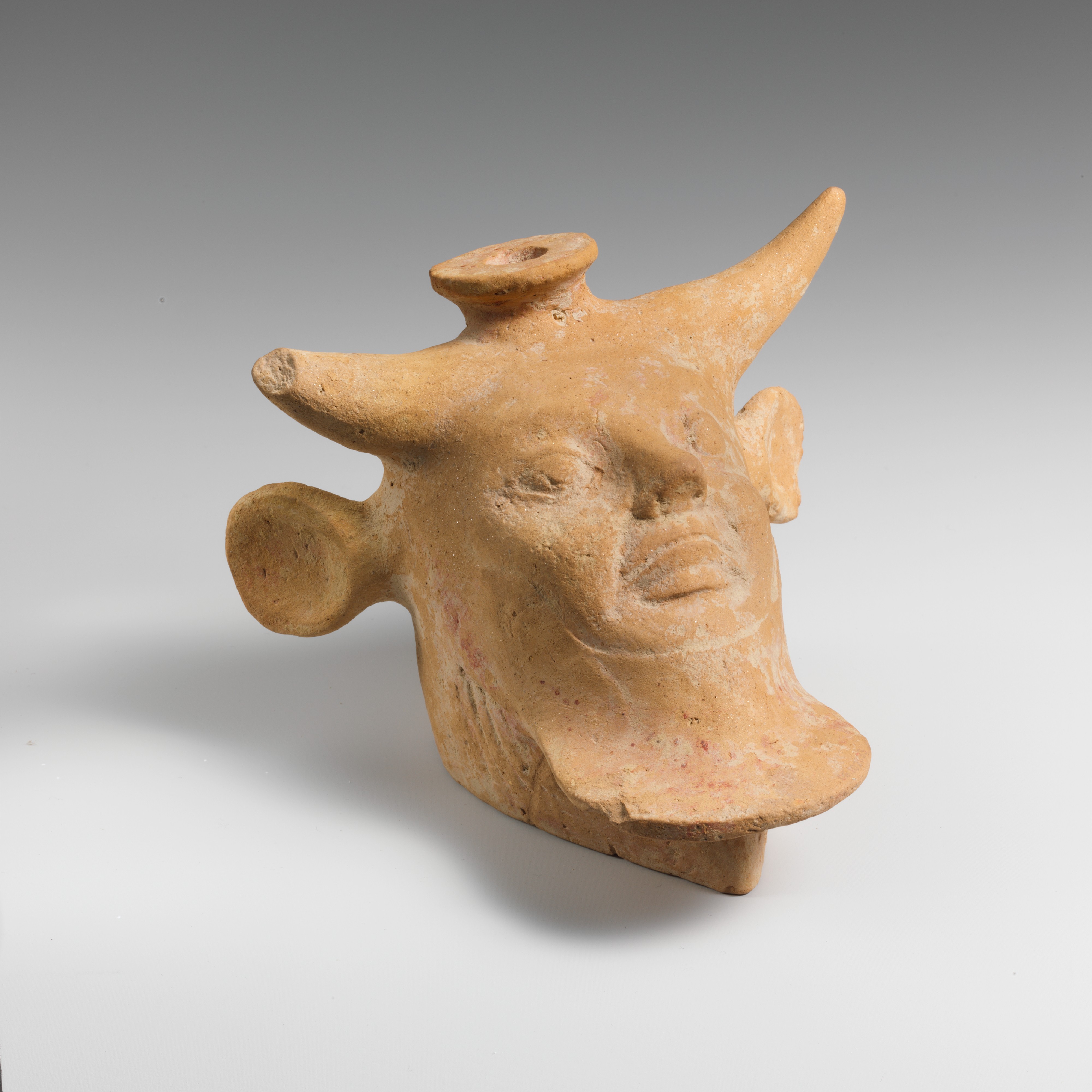
Heritage Analysis: The Vase in the Form of a Head of Acheloos
Katherine Fashion Lab, as a purveyor of high-end luxury, understands that true distinction arises not merely from aesthetic novelty but from the profound resonance of cultural symbolism. This heritage analysis examines an East Greek terracotta vase, circa 6th century BCE, shaped as the head of the river god Acheloos. This object, a fusion of utility and divinity, offers a strategic blueprint for a 2026 luxury strategy rooted in symbolic power, historical adornment, and spiritual meaning.
Symbolic Power: The River God as a Marker of Primordial Authority
Acheloos, in Greek mythology, was the eldest of the three thousand river gods, a titan of freshwater and fertility. His representation on this vase—a hybrid form blending human features with bovine horns, a shaggy beard, and pointed ears—encapsulates a dual symbolism. On one level, the horned visage evokes raw, untamed nature, the life-giving yet unpredictable force of rivers. On another, it signifies primordial authority. In the ancient Greek world, to possess or display an image of Acheloos was to invoke the power of transformation and abundance. The god famously wrestled Heracles, shifting shapes (bull, serpent, man) in a contest for the hand of Deianira. This myth encodes the concept of adaptive resilience—a quality that luxury brands must cultivate in a volatile market.
For Katherine Fashion Lab, the symbolic power of Acheloos can be strategically harnessed to communicate brand lineage and resilience. The horn motif, often co-opted by contemporary fashion as a mere decorative flourish, here regains its original gravitas. A 2026 collection could reinterpret the Acheloos horn as a symbol of controlled power—not aggression, but the quiet strength of a brand that has weathered cultural shifts. This is not about literal horn-shaped accessories, but about embedding the idea of the river god into design language: fluid lines that suggest movement, textures that evoke water-worn stone, and color palettes drawn from riverine silt and oxblood. The symbolic power of Acheloos lies in its ability to anchor a brand narrative in pre-classical antiquity, offering a depth that fast-fashion cannot replicate.
Historical Adornment: The Vase as a Body-Object
This terracotta vase, while a functional vessel for oil, wine, or perfume, was also an object of adornment. In East Greek culture, such vases were often placed in sanctuaries or tombs, or used in symposia, where they served as both pouring vessels and conversation pieces. The head of Acheloos, with its expressive face and textured beard, was designed to be held, seen, and touched. The tactile quality of the terracotta—rough, warm, and earthy—contrasts with the polished marble of later classical sculpture, offering a more intimate, haptic experience.
From a historical adornment perspective, the vase represents a pre-monumental approach to luxury. Adornment in this context was not merely decorative but ritualistic and communicative. The object adorned the space, the ritual, and the wearer’s identity by association. For Katherine Fashion Lab, this suggests a return to tactile luxury in 2026. In an era of digital saturation, the physicality of materials becomes a premium. A strategic line of accessories—scarves, belts, or handbags—could incorporate embossed textures that mimic the terracotta’s grain, or hardware cast in bronze with patinated finishes that evoke ancient river-worn metal. The historical precedent teaches that adornment is most powerful when it invites touch and contemplation, not just visual consumption. This aligns with the growing luxury trend of slow fashion and haptic branding, where the feel of a material is as important as its look.
Spiritual Meaning: The Vessel as a Mediator Between Realms
In East Greek religious practice, the river god Acheloos was a liminal figure, bridging the human world and the divine, the land and the water. Vases in his form were often used in libation rituals, pouring offerings to the gods. The act of pouring from an Acheloos head vase was a symbolic act of communication with the divine—a spiritual transaction. The vessel itself was not merely a container but a mediator, a sacred object that channeled earthly substances (wine, oil) into spiritual acts.
This spiritual dimension offers a powerful framework for luxury branding in 2026. Modern luxury consumers increasingly seek meaningful consumption—objects that serve as conduits for personal values, heritage, or transcendence. Katherine Fashion Lab can position its creations as modern-day vessels of intention. A limited-edition fragrance, for example, could be packaged in a ceramic bottle inspired by the Acheloos vase, with the scent itself designed to evoke “the river’s memory”—notes of petrichor, wet stone, and wild herbs. Marketing copy would not describe the scent but the ritual of application: a moment of stillness, a libation to one’s own aspirations. The spiritual meaning of the original vase—transformation, offering, connection—becomes a brand ethos. This strategy taps into the millennial and Gen Z fascination with ritual and mindfulness, offering a luxury experience that is both ancient and urgently contemporary.
2026 High-End Luxury Strategy: The Acheloos Codex
For Katherine Fashion Lab, the Acheloos vase is not merely a curatorial artifact but a strategic asset. The following framework outlines a 2026 luxury strategy derived from this analysis:
1. The Horn as a Brand Icon: Develop a signature “Acheloos Horn” motif, abstracted into a geometric or sculptural form, used in hardware, embroidery, and print. This icon will carry the symbolic weight of primordial authority, distinguishing the brand from competitors who use generic animal motifs.
2. Tactile Materiality: Prioritize materials that evoke the terracotta’s texture and warmth. Launch a “Terracotta Collection” of leather goods with a matte, granular finish, and ceramic jewelry that mimics the vase’s hand-thrown irregularity. These pieces are designed to be touched and held, fostering a haptic bond with the wearer.
3. Ritual-Based Marketing: Replace traditional product launches with “Libation Events”—invitation-only gatherings where guests pour a ceremonial blend of wine or oil from a custom Acheloos-inspired vessel, symbolizing the brand’s commitment to transformation and abundance. Each purchase of a flagship piece includes a small ceramic “votive” (a miniature vase) as a token of the ritual.
4. Collaboration with Artisans: Partner with contemporary ceramicists and metalworkers who specialize in ancient techniques. Limited runs of handcrafted Acheloos-inspired objects—vases, urns, or wearable art—will command premium prices and generate press for their artisanal authenticity.
5. Narrative of Resilience: The brand’s 2026 campaign will center on the myth of Acheloos wrestling Heracles, using visual storytelling to emphasize adaptive resilience. Taglines such as “Shape-Shifting Since 600 BCE” or “The River Remembers” position Katherine Fashion Lab as a brand that has evolved across millennia, not just seasons.
Conclusion: The East Greek vase in the form of Acheloos is a masterclass in symbolic compression. It unites utility, divinity, and artistry in a single object. For Katherine Fashion Lab, this heritage analysis reveals that true luxury lies not in novelty but in the recontextualization of archetypal power. By embracing the river god’s symbolism, tactile history, and spiritual function, the brand can craft a 2026 strategy that is both intellectually rigorous and emotionally resonant—a strategy that transforms a terracotta relic into a living emblem of enduring luxury.