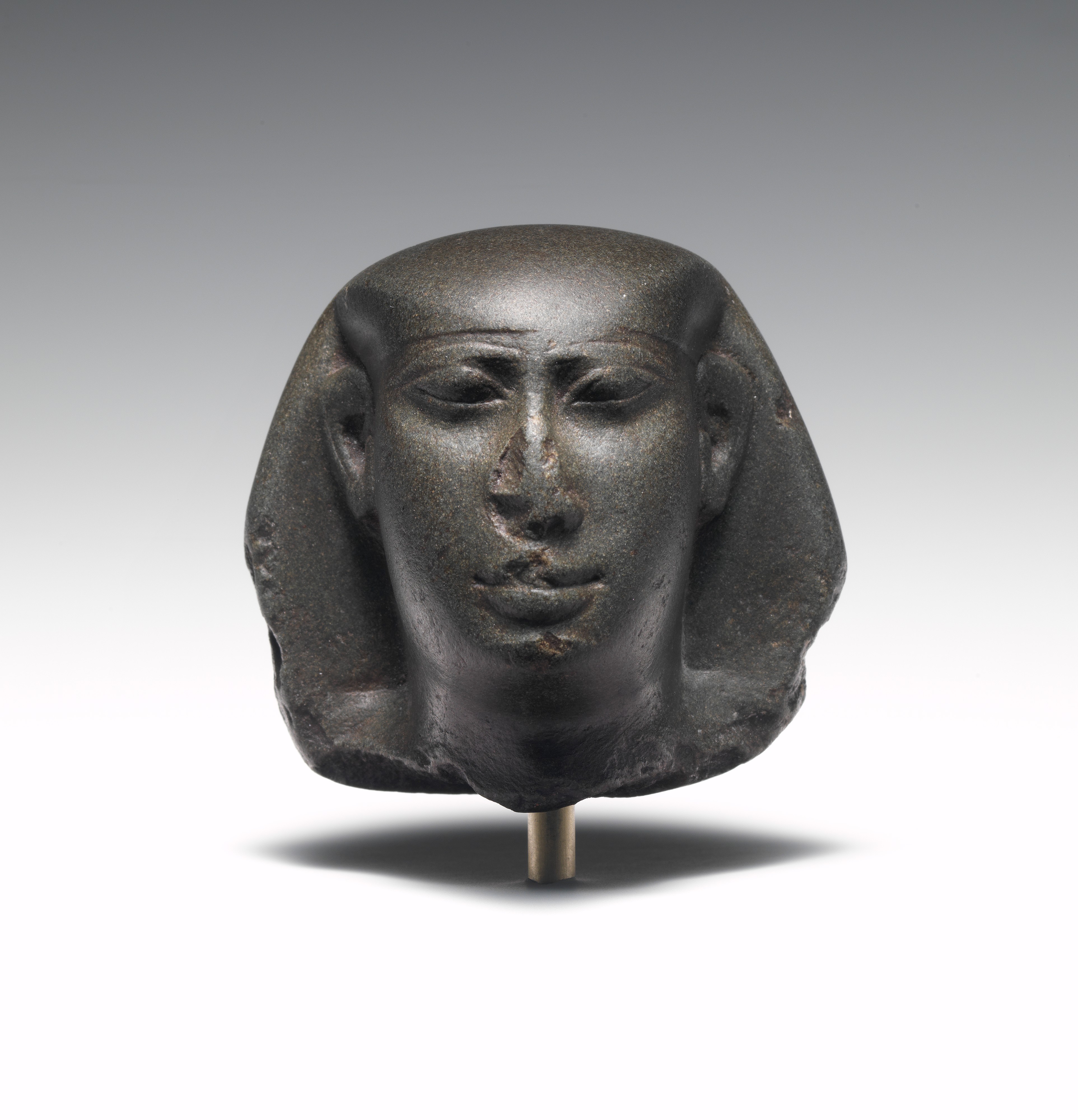
From Royal Canon to Personal Icon: The Head of Amasis and the Strategy of Recontextualized Heritage
For Katherine Fashion Lab, heritage is not a static archive but a dynamic lexicon. Our strategic analysis examines artifacts not merely for their historical value, but for their latent narrative power, which can be decoded and re-encoded for a contemporary luxury ethos. The subject of this standalone research—a greywacke sculptural head depicting the 26th Dynasty Pharaoh Amasis (Ahmose II), reworked in antiquity for a private, non-royal individual—presents a profound case study. It embodies a deliberate transference of symbolic capital, offering a foundational metaphor for a 2026 high-end luxury strategy built on the pillars of authentic resonance, personal iconography, and spiritual utility.
Deconstructing the Original Symbolic Power: The Pharaoh as Prototype
Carved from dense, dark greywacke—a stone valued for its durability and solemnity—the original portrait of Amasis was a vessel of divine kingship. In the Late Period (570–526 BCE), Egyptian royal portraiture balanced idealized serenity with individual character. The uraeus (rearing cobra) on the brow, the nemes headcloth, and the ceremonial beard were not mere adornments; they were active semiotic devices broadcasting sovereignty, protection, and a conduit to the gods. The stone itself, hard and eternal, was chosen to perform a function: to outlast flesh and cement the Pharaoh's *ka* (spiritual double) in perpetuity. This object was the ultimate luxury good of its era: unique, materially significant, and saturated with immutable power.
The Act of Reworking: Subversion and Personal Adornment of Legacy
The critical pivot in this object's biography is its ancient reworking. An unknown artisan meticulously removed the royal regalia—the uraeus, the nemes striations—and refined the features to represent a private citizen. This was not vandalism but a sophisticated act of cultural appropriation at the individual level. The new owner was not claiming the throne but was annexing the artifact's inherent qualities: its permanence (greywacke), its craftsmanship, and its residual spiritual potency. They adorned themselves not with jewels, but with the very substance of history, transforming a symbol of state power into one of personal prestige and perhaps pious aspiration. The head became a bespoke heirloom, its value magnified by its layered past—a palimpsest of identity.
Spiritual Meaning and the Transfer of Essence
Beyond status, the reworking engages deep spiritual mechanics. In Egyptian thought, the image housed presence. By repurposing the Pharaoh's sculpted head, the private individual engaged in a nuanced spiritual transaction. They were not becoming divine but were perhaps seeking the stone's established connection to the eternal, its proven efficacy as a vessel for the *ka*. The greywacke block, once charged with the spirit of a king, could be seen as a pre-consecrated medium. This act reflects a human desire not for *new* luxury, but for validated luxury—objects whose significance is proven by time and ritual. The spiritual meaning thus shifts from a public, prescribed divinity to a private, curated sanctity.
Strategic Application: A 2026 Luxury Framework for Katherine Fashion Lab
This analysis directly informs a forward-looking, high-end strategy for 2026, moving beyond retrospection to active philosophy. The "Amasis Model" provides a three-tiered framework.
1. The Recontextualization Principle: Beyond Inspiration
Katherine Fashion Lab must not simply draw inspiration from heritage; it must recontextualize archetypes. The 2026 collection should feature pieces that are intellectual "reworkings." Imagine a tiara motif where the central gem is set in a way that references the removed uraeus, its absence as powerful as its presence. Or, a garment cut from a single, uncompromising textile (our modern greywacke) that retains the "ghost" of a royal silhouette adapted for fluid, personal movement. The story is not "inspired by a pharaoh," but rather "embodies the moment a royal icon became a personal heirloom." This is storytelling with narrative friction and intellectual depth, appealing to a client who collects meaning as much as objects.
2. Material as Narrative: The Modern Greywacke
Our material selection must carry analogous gravity. For 2026, we invest in materials with a documented, ethical provenance and inherent technical legend—aged Scottish tweeds woven with gold-wrapped threads (echoing stone striations), ceramics fused with precious metals, or patented composites that tell a story of innovation and permanence. Each material dossier will include its "biography," much like the greywacke's journey from royal quarry to private sanctuary. The focus is on tactile archaeology and emotional weight, ensuring every piece feels *charged* by its own substance and story.
3. Cultivating Personal Iconography & Spiritual Utility
The final, most crucial strategy addresses the modern desire for spiritual utility. The contemporary luxury client seeks objects that function as talismans and define personal iconography. Katherine Fashion Lab will position its pieces as modern votives. This involves limited, numbered editions where the client's personal mark (a monogram, a chosen symbol) is integrated into the design as the "reworking" was integrated into the stone. We will offer a complimentary service—"Iconography Curation"—where our heritage specialists help clients align pieces with personal milestones or aspirations, effectively consecrating the object to their own narrative. The product is not a garment or jewel; it is a personalized medium for legacy.
Conclusion: The Sovereign Individual
The reworked Head of Amasis teaches us that the ultimate luxury is the authority to reshape legacy. For 2026, Katherine Fashion Lab's strategy will be to provide clients with the tools to become sovereigns of their own aesthetic and spiritual narrative. We will not sell a necklace; we will offer a recontextualized symbol. We will not create a coat; we will craft a personal medium. By applying the principles of symbolic transfer, material narrative, and spiritual utility, we position the brand not at the end of a fashion timeline, but as the curator of a continuous, evolving heritage—where the client is both the inheritor and the re-worker, the conclusion and the new beginning.