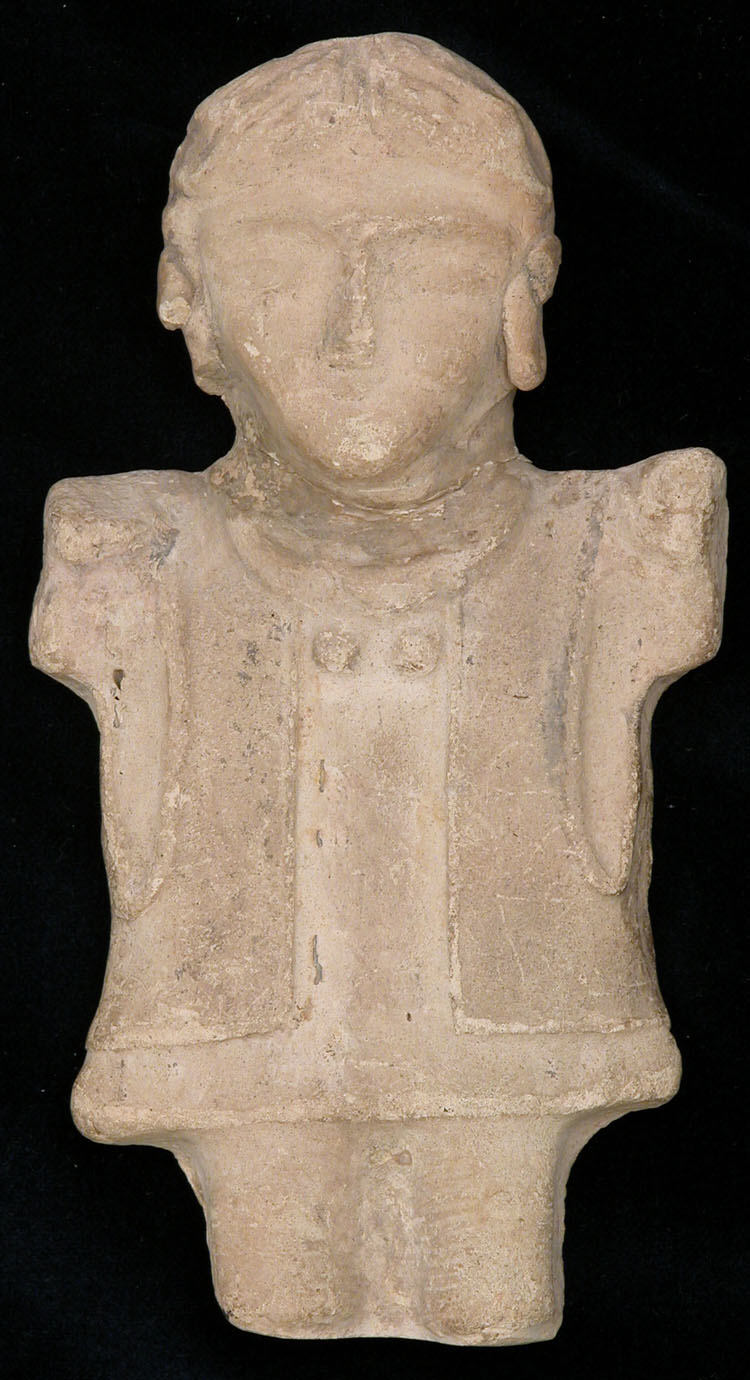
The Unfinished Self: A Couture Analysis of the Figurine of a Female (?) Standing Personage
In the rarefied world of haute couture, the unfinished is often the most provocative. A raw hem, a basted seam, a silhouette left deliberately unrefined—these are not failures of craftsmanship but invitations to narrative. At Katherine Fashion Lab, we approach the Figurine of a Female (?) Standing Personage not as an archaeological artifact, but as a proto-couture statement. This earthenware figure, unglazed and stripped of color, stands as a profound meditation on identity, materiality, and the eternal tension between form and ambiguity. Its global heritage—neither definitively tied to a single culture nor epoch—renders it a universal archetype, a blank canvas upon which the fashion imagination can project its deepest inquiries.
Materiality as a Couture Statement
The choice of unglazed earthenware is the first and most arresting couture decision. In fashion, texture is the silent language of luxury. Here, the surface is matte, porous, and tactile—a deliberate rejection of gloss, glaze, or polish. This is not a vessel meant for display in a vitrine; it is a body that breathes. The clay’s granularity evokes raw silk, unbleached linen, or the hand-knotted wool of a Chanel jacket before it is finished. It speaks to a couture philosophy of honest materiality, where the hand of the maker is not erased but celebrated. The absence of glaze is a refusal to conceal the material’s origins, a decision that resonates with contemporary fashion’s turn toward sustainability and traceability. This figurine is not “finished” in the conventional sense; it is perpetually becoming, much like the garments that define our identities.
The question mark in the title—“Female (?)”—is not a limitation but a liberation. It invites us to consider the figurine as a gender-fluid couture prototype. The posture is upright, commanding, yet the anatomical markers are deliberately subdued. The chest is flat, the hips narrow, the waist undefined. This is not a body constrained by binary fashion norms. It is a silhouette that anticipates the androgynous tailoring of Yohji Yamamoto or the sculptural unisex forms of Rick Owens. The ambiguity is a couture choice: it forces the viewer to focus on the architecture of the form rather than the biology. The standing personage becomes a standalone study in presence, a lesson in how clothing—or its absence—can define identity without relying on gendered cues.
Silhouette and the Architecture of Standing
The figurine’s stance is its most powerful couture element. It stands erect, feet planted firmly, arms held close to the body or perhaps missing entirely. This is not a dancer’s pose or a model’s languid lean; it is a posture of monumental stillness. In fashion, the silhouette is the first conversation. Here, the verticality is unbroken, a column of clay that recalls the clean lines of a Balenciaga cocoon coat or the severe geometry of a Thierry Mugler power suit. The lack of articulation in the arms suggests a garment that envelops rather than reveals—a caftan, a cape, or a tailored sheath that prioritizes shape over gesture. The figurine’s form is a study in negative space, where the absence of detail becomes the most defining feature.
Consider the neck: elongated, unadorned, rising from the shoulders like a stem. This is a couture detail that whispers of high jewelry—not the presence of a necklace, but the space where a necklace might rest. The head is featureless, a blank oval. There are no eyes, no mouth, no hair. This is the ultimate deconstruction of the fashion face: the erasure of expression forces the viewer to read the body alone. It is a radical act, one that aligns with the avant-garde traditions of Comme des Garçons, where garments often obscure or replace the face. The figurine becomes a wearable sculpture, a totem of identity that exists beyond the individual.
Global Heritage as a Couture Palette
The figurine’s global heritage is not a weakness but a curatorial strength. It cannot be pinned to a single culture—Cycladic, Pre-Columbian, or ancient Anatolian—and that multiplicity is its luxury. In couture, references are layered: a Japanese obi knot meets a Victorian bustle; a Maasai beadwork pattern is reinterpreted in silk organza. This figurine embodies that same ethos. Its simplicity is a universal language, a primal aesthetic that transcends geography. The unglazed surface could be the desert sands of the Sahara, the clay of the Nile, or the terra-cotta of the Mediterranean. It is a material that carries the memory of earth, fire, and human hands—a narrative that no single origin can contain.
This global ambiguity also allows for a decolonial reading of fashion history. The figurine refuses to be claimed by any one tradition, challenging the Western canon’s tendency to categorize and commodify. It stands as a pre-luxury object, existing before the hierarchies of silk, brocade, or gold thread defined value. In the Katherine Fashion Lab, we see this as a call to reimagine couture’s foundations: to value the hand-built, the raw, the unfinished as the highest form of artistry. This figurine is not a primitive ancestor of fashion; it is a contemporary equal, a dialogue partner in the ongoing conversation about what it means to adorn the human form.
The Standalone Study: A Couture Manifesto
The figurine is presented as a standalone study, removed from any archaeological or ritual context. This isolation is a deliberate curatorial act, one that mirrors the fashion runway. A single garment, stripped of accessories, models, and narrative, must hold its own. Here, the figurine does just that. It is a couture manifesto in clay, declaring that the essential—the silhouette, the material, the posture—is sufficient. It requires no embellishment, no color, no context. It is a pure form, a lesson in restraint that every designer must learn.
In conclusion, the Figurine of a Female (?) Standing Personage is not a relic but a revelation. It teaches us that couture is not about excess but about essence. The unglazed earthenware, the ambiguous gender, the global heritage, the standalone presentation—these are not limitations but choices. They are the choices of a designer who understands that the unfinished self is the most compelling canvas. At Katherine Fashion Lab, we honor this figurine as a masterclass in material honesty and silhouette, a timeless invitation to strip away the superfluous and stand, simply, in the architecture of our own becoming.