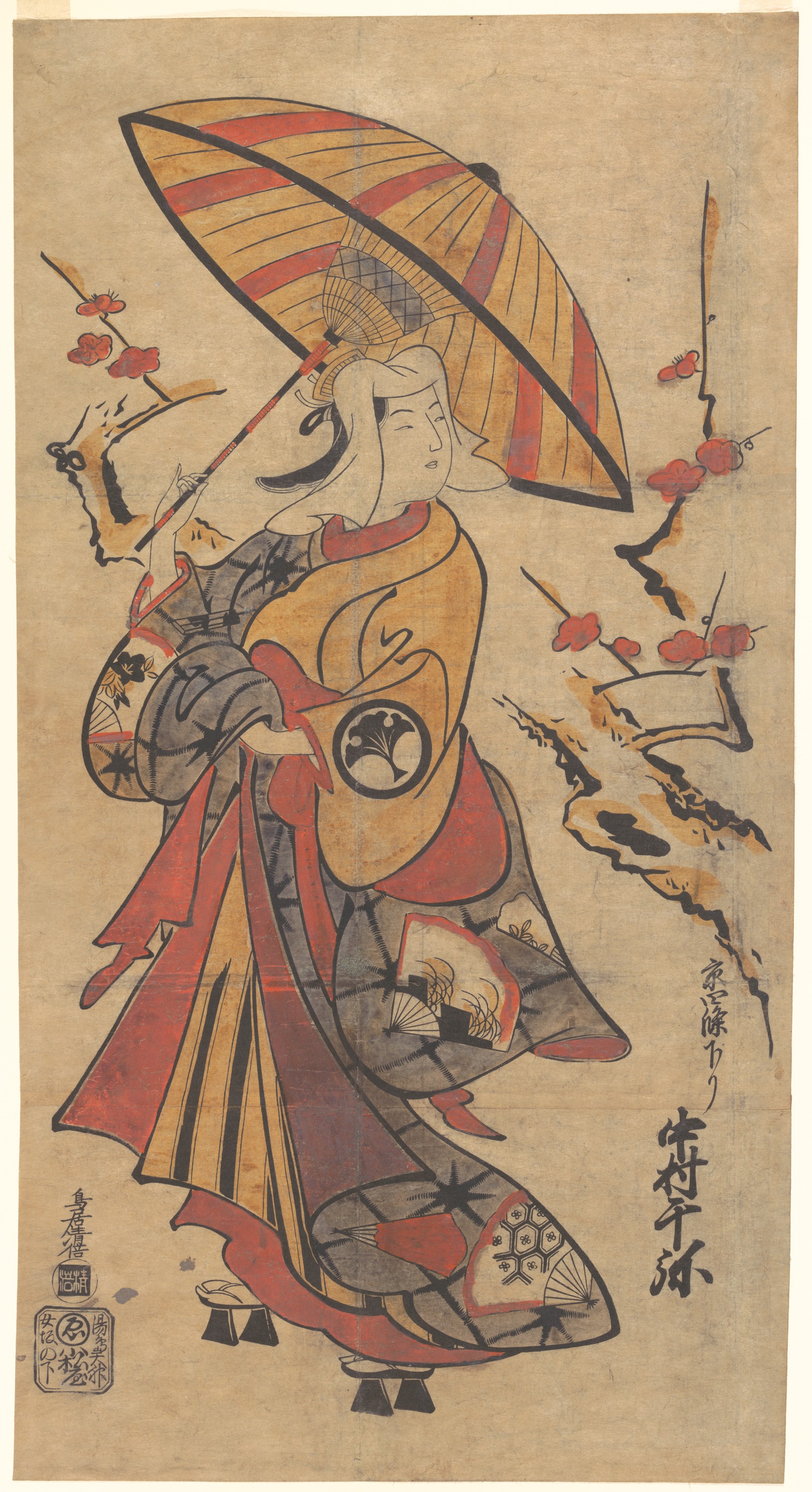
The Actor Nakamura Sen'ya as Tokonatsu: A Couture Analysis of Kabuki's Sartorial Legacy
Introduction: The Intersection of Performance and Textile Art
The woodblock print "The Actor Nakamura Sen'ya as Tokonatsu in the Kabuki Play, 'The Legacy of the Three-Comma Family Crest Revealed' (Mitsudomoe katoku-biraki)" represents a pivotal moment in the history of Japanese visual culture and fashion. Created as a standalone study, this tan-e print—hand-colored with ink and pigment on paper—captures not merely a theatrical performance but a sophisticated dialogue between costume, identity, and social semiotics. For Katherine Fashion Lab, this artifact offers a profound case study in how couture principles of silhouette, texture, and symbolic ornamentation were already flourishing in Edo-period Japan, long before the term "haute couture" entered Western lexicons. The print demands an analysis that transcends mere description, positioning the actor's attire as a deliberate, codified system of visual communication—a precursor to the narrative-driven fashion of today's runways.
Historical Context: Kabuki as a Crucible for Fashion Innovation
Kabuki theater, emerging in the early 17th century, was more than entertainment; it was a cultural engine that drove trends in dress, fabric, and ornamentation. The play "Mitsudomoe katoku-biraki" belongs to a tradition where costume was integral to storytelling, with each garment layer revealing character status, emotional state, and moral alignment. The actor Nakamura Sen'ya, performing the role of Tokonatsu, embodies this synthesis of performance and textile art. The tan-e technique—a monochromatic print with selective hand-coloring—further emphasizes the couture-like focus on specific details: the bold lines of the kimono, the precise placement of the three-comma family crest (mitsudomoe), and the deliberate contrast between ink and applied pigment. This print is not a mere record but a curated aesthetic statement, akin to a fashion illustration that isolates and celebrates a single, iconic look.
Deconstructing the Silhouette: The Kimono as Architectural Garment
The central garment worn by Nakamura Sen'ya as Tokonatsu is a kimono of considerable volume and structure. In Edo-period Kabuki, the kimono was not a passive drape but an engineered form, often padded and stiffened to create a distinct silhouette that amplified the actor's presence on stage. The print reveals a garment with broad, sweeping sleeves (furisode-style, though adjusted for male performance) that fall in sharp, angular lines—a deliberate departure from the softer, more fluid shapes of everyday wear. This architectural quality is achieved through the use of multiple layers (jūnihitoe-inspired) and stiffened collars (eri), which project authority and gravitas. For Katherine Fashion Lab, this echoes the couture principle of "sculptural dressing," where fabric becomes a medium for shaping the body into a living monument. The kimono's hem, likely weighted with lead or silk cords, ensures a dramatic, sweeping movement that mirrors the theatricality of modern ball gowns or capes by designers like Alexander McQueen or Rei Kawakubo.
Color and Pigment: The Semiotics of Tan-e Palette
The tan-e technique—primarily using benigara (red lead) and sumi (black ink)—imposes a rigorous color discipline that heightens the couture-like focus on symbolic hues. In this print, the dominant palette is stark black and white, punctuated by selective red and occasionally green or yellow pigments. The black ink defines the kimono's primary structure, suggesting a fabric of profound depth—perhaps deep indigo or charcoal silk, which in Kabuki costume signified formality, restraint, and sometimes villainy or supernatural power. The red pigment, applied by hand, highlights the mitsudomoe crest and possibly the obi (sash) or linings. Red in Kabuki fashion was a color of vitality, passion, and spiritual potency; its sparing use here creates a focal point that draws the eye to the family emblem, reinforcing the play's theme of legacy and identity. This deliberate chromatic restraint mirrors the "less is more" philosophy of minimalist couture, where a single accent color can define an entire collection's narrative.
Ornamentation and the Mitsudomoe Crest: A Study in Branding
The three-comma family crest (mitsudomoe) is the print's most potent couture element. This swirling motif, reminiscent of tomoe symbols found in Shinto and Buddhist iconography, is rendered with precision on the actor's kimono. In Kabuki, such crests were not merely decorative but functioned as a form of personal branding, akin to a modern fashion house's logo or monogram. For Tokonatsu—a character likely of noble or warrior lineage—the crest asserts lineage and moral authority. The placement on the back and shoulders ensures it remains visible even during dynamic stage movement, a strategic sartorial choice that anticipates contemporary "logo-mania" in luxury fashion. The crest's repetition across the garment, perhaps in a repeating pattern (mon-tsuki), creates a rhythmic visual cadence that transforms the kimono into a canvas of identity. Katherine Fashion Lab can draw parallels to how brands like Louis Vuitton or Gucci use repeated motifs to establish visual recognition, but here the crest carries narrative weight—it is a plot device as much as an ornament.
Texture and Materiality: The Illusion of Fabric in Print
Though rendered in ink and pigment, the print conveys a rich sense of texture. The kimono's surface is depicted with fine, parallel lines suggesting a woven fabric—perhaps silk habutae or chirimen (crepe)—which would have rustled and shimmered under stage lights. The obi, likely a stiff brocade (nishiki), is indicated by denser patterning and a distinct band across the waist. The actor's wig and headdress, adorned with kanzashi (ornamental hairpins) and perhaps a court cap, add a layer of tactile contrast: the smoothness of lacquered wood against the softness of silk. This interplay of textures is a hallmark of couture construction, where fabrics are chosen not only for color but for their tactile and reflective properties. The print's ability to suggest these textures through line and color alone underscores the sophistication of both the original costume and the artist's technique.
Cultural Significance: The Actor as Fashion Icon
In Edo-period Japan, Kabuki actors were fashion influencers of the highest order. Their stage costumes, often more extravagant than real-life attire, were reproduced in woodblock prints that circulated among the urban merchant class. These prints served as style guides, with women and men alike adopting elements of Kabuki dress—specific sleeve lengths, collar shapes, or crest patterns—into their wardrobes. Nakamura Sen'ya, by embodying Tokonatsu, becomes a conduit for this fashion transmission. The print, as a standalone study, isolates his costume from the narrative context, allowing it to be appreciated as an autonomous aesthetic object. This prefigures the modern fashion editorial, where a garment is photographed in isolation to emphasize its design merits. For Katherine Fashion Lab, this print demonstrates that the actor's role is not merely performative but curatorial: he is a living mannequin for a couture vision that blends tradition with innovation.
Conclusion: Lessons for Contemporary Couture
The analysis of "The Actor Nakamura Sen'ya as Tokonatsu" reveals a sophisticated fashion system operating within Kabuki theater, one that anticipated many principles of modern haute couture. The deliberate silhouette, the symbolic use of color, the branding power of the crest, and the textural illusionism all point to a culture that understood fashion as a narrative, communicative art. For Katherine Fashion Lab, this print offers a template for how historical garment analysis can inform contemporary design: by embracing the architectural potential of fabric, the strategic deployment of motifs, and the transformative power of the wearer. Tokonatsu's kimono is not just a costume; it is a statement of legacy, identity, and artistic intent—a couture artifact that transcends its medium to speak across centuries.