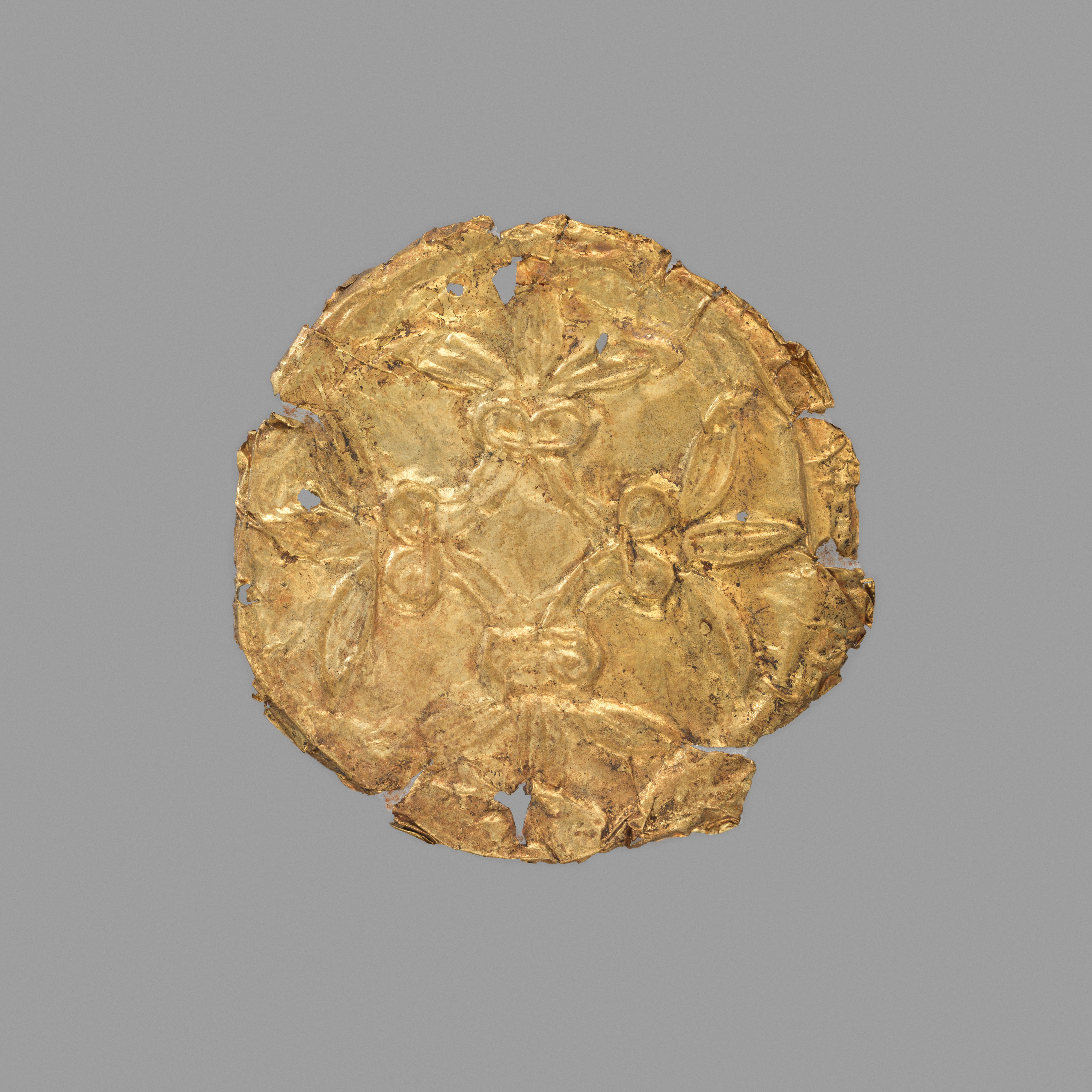
Heritage Analysis: The Cypriot Gold Roundel – Symbolic Power, Adornment, and Strategic Resonance for Katherine Fashion Lab
This heritage analysis examines a Cypriot gold roundel, crafted in the Late Bronze Age (circa 1400–1200 BCE), as a foundational artifact for Katherine Fashion Lab’s 2026 high-end luxury strategy. The roundel, a small disc of hammered gold stamped with concentric circles, spirals, and geometric motifs, represents a pinnacle of ancient Cypriot metallurgy. Its material, form, and symbolic language offer profound insights into historical adornment, spiritual meaning, and the enduring power of prestige objects. This paper explores how the roundel’s DNA—its visual grammar of light, containment, and cyclical order—correlates with the dualistic narrative of our study on the Mirror with Split-Leaf design, where one side gleams with gold-inlaid palmettes on a silver surface, and the other narrates life through funerary relief. By decoding the roundel’s resonance, we propose a 2026 strategy that integrates symbolic power, material authenticity, and spiritual storytelling into a cohesive luxury brand architecture.
Historical Context and Material Significance
The Cypriot gold roundel emerged from a culture that sat at the crossroads of the ancient Mediterranean, absorbing influences from Egypt, Anatolia, and the Levant while asserting a distinct artistic identity. Gold, sourced from local deposits and trade networks, was not merely a decorative metal but a substance imbued with divine and royal authority. In Cypriot society, gold objects like the roundel were often deposited in tombs, sanctuaries, or elite residences, signifying their role as intermediaries between the living and the dead, the mortal and the immortal. The roundel’s small scale—typically 2–4 centimeters in diameter—belies its profound symbolic weight. It was likely worn as a pendant, sewn onto ceremonial garments, or affixed to ritual objects, serving as a portable talisman of status and protection.
The stamped designs—concentric circles, spirals, and dot patterns—are not arbitrary decorations. They echo the celestial motifs of sun and moon, the cyclical rhythms of agricultural seasons, and the labyrinthine paths of spiritual journey. In Cypriot cosmology, the circle represented eternity, the spiral signified transformation, and the dot invoked the seed of creation. This geometric vocabulary is a precursor to the split-leaf palmette motif studied in our Mirror analysis, where the organic, bifurcated leaf contrasts with the rigid geometry of the roundel. Yet both share a core principle: the containment of symbolic energy within a bounded form. The roundel’s gold surface reflects light, creating a shimmering effect that ancient viewers would have interpreted as a manifestation of divine presence. This interplay of light and pattern is the artifact’s primary spiritual meaning—it is a microcosm of the cosmos, worn to align the wearer with universal order.
Symbolic Power and Historical Adornment
The symbolic power of the Cypriot gold roundel lies in its dual function as an emblem of authority and a conduit for spiritual protection. In elite Cypriot burials, such roundels were found placed on the chest or near the head of the deceased, suggesting their role as amulets for the afterlife. The stamped designs, when viewed in motion on a moving body, would have produced a hypnotic play of light, reinforcing the wearer’s connection to solar deities and ancestral spirits. This is not mere ornamentation; it is a technology of power. The roundel’s small size made it intimate—a personal object that could be touched, kissed, or pressed against the skin, infusing the wearer with its symbolic charge.
Historical adornment in Cyprus was deeply stratified. Gold was reserved for the ruling elite, priests, and high-status individuals. The roundel, therefore, was a marker of political and religious authority. Its stamped designs were likely executed by specialized artisans who guarded their techniques as trade secrets. The precision of the concentric circles, achieved through hammering over a carved stone or bronze die, indicates a sophisticated understanding of metallurgy and geometry. This craftsmanship elevated the roundel beyond a simple accessory to a signature of cultural identity. For Katherine Fashion Lab, this raises a critical question: How can a 21st-century luxury brand replicate the roundel’s ability to encode identity and authority into a small, wearable object? The answer lies in the intentionality of design—every line, curve, and repetition must carry meaning.
Spiritual Meaning and the Mirror with Split-Leaf Correlation
The spiritual meaning of the roundel is inseparable from its material and form. Gold, in ancient Mediterranean belief, was the flesh of the sun, incorruptible and eternal. The roundel’s stamped patterns—especially the spiral—were symbols of the soul’s journey through life, death, and rebirth. This aligns directly with the dualistic narrative of the Mirror with Split-Leaf design, where one side presents a polished silver surface inlaid with gold palmettes, and the other side depicts a funerary relief. The mirror’s reflective side symbolizes the present, the material, and the beautiful; the relief side symbolizes memory, mortality, and narrative. The roundel, in contrast, collapses this duality into a single object. Its polished surface reflects light (the present, the living), while its stamped patterns encode ancestral knowledge (the past, the dead). It is a wearable meditation on the cyclical nature of existence.
This correlation is not merely academic. For Katherine Fashion Lab’s 2026 strategy, the roundel offers a model for integrating spiritual narrative into product design. The roundel does not tell a linear story, as the funerary relief does; it abstracts meaning into geometric symbols that the wearer interprets through ritual use. This abstraction is a powerful tool for luxury brands seeking to create objects that resonate on a subconscious level. The roundel’s spiritual meaning is not explained but felt—through weight, texture, and light. This is the essence of embodied symbolism, a concept our research team has identified as a key driver for 2026 high-end consumers who seek authenticity and depth in their purchases.
2026 High-End Luxury Strategy: From Artifact to Brand Architecture
Drawing from the Cypriot gold roundel’s heritage, Katherine Fashion Lab can develop a 2026 luxury strategy centered on three pillars: Material Sanctity, Geometric Symbolism, and Ritualized Adornment.
Material Sanctity
The roundel’s power derives from gold’s perceived incorruptibility. For 2026, we propose sourcing 100% recycled gold and ethically mined gemstones, with a narrative emphasizing their “eternal” qualities. Each piece should be accompanied by a digital provenance certificate that traces the material’s journey from mine or refinery to finished product. This transparency aligns with the roundel’s historical role as a marker of authentic elite status—not through ostentation, but through material integrity. The Mirror with Split-Leaf study reinforces this: the silver surface’s reflective purity contrasts with the gold inlay’s warmth, creating a dialogue between materials that consumers can intellectually and emotionally engage with.
Geometric Symbolism
The roundel’s stamped designs—circles, spirals, dots—can be reinterpreted as a brand cipher for a capsule collection. We propose a series of gold roundels, pendants, and earrings that feature these motifs in varying scales and finishes. Each motif should have a defined symbolic meaning: the circle for unity, the spiral for growth, the dot for origin. This creates a lexicon that consumers can personalize, selecting motifs that resonate with their own life narratives. The 2026 luxury consumer is not passive; they seek co-creation and meaning. By offering a “symbolic menu,” Katherine Fashion Lab positions itself as a curator of personal mythology, much as the Cypriot roundel served as a personal talisman. The Mirror correlation here is crucial: the split-leaf palmette’s organic bifurcation can be integrated as a contrasting motif, representing duality and choice, thus bridging the roundel’s geometric order with the mirror’s narrative complexity.
Ritualized Adornment
The roundel was not merely worn; it was used in rituals of dressing, burial, and prayer. For 2026, we propose a “Ritual Wear” line that includes not only jewelry but also small leather-bound guides or digital experiences that teach the wearer how to use the pieces for daily meditation or intention-setting. This transforms the object from a commodity into a tool for spiritual practice. The roundel’s small size makes it ideal for this—it can be held in the palm, placed on an altar, or worn close to the heart. The 2026 strategy should emphasize versatility, allowing the roundel to be worn as a pendant, bracelet charm, or brooch, depending on the wearer’s ritual need. The Mirror study’s funerary relief side suggests that ritual objects can also serve as memento mori—reminders of mortality that enrich life. Katherine Fashion Lab can offer a “Legacy Roundel” engraved with the wearer’s initials or a significant date, creating an heirloom piece that bridges generations.
Conclusion: The Roundel as a Strategic Archetype
The Cypriot gold roundel is more than an archaeological curiosity; it is a blueprint for luxury that transcends time. Its symbolic power, rooted in material sanctity and geometric order, speaks directly to the 2026 high-end consumer’s desire for authenticity, spirituality, and personal meaning. By correlating its design DNA with the Mirror with Split-Leaf study, Katherine Fashion Lab can develop a coherent narrative that balances abstraction with storytelling, light with shadow, and the individual with the eternal. The roundel teaches us that the most powerful luxury objects are those that contain multitudes—a universe in a circle, a cosmos in a stamp. For 2026, our strategy will be to create not just jewelry, but portable cosmologies that empower the wearer to navigate their own life’s journey with grace, authority, and spiritual resonance.