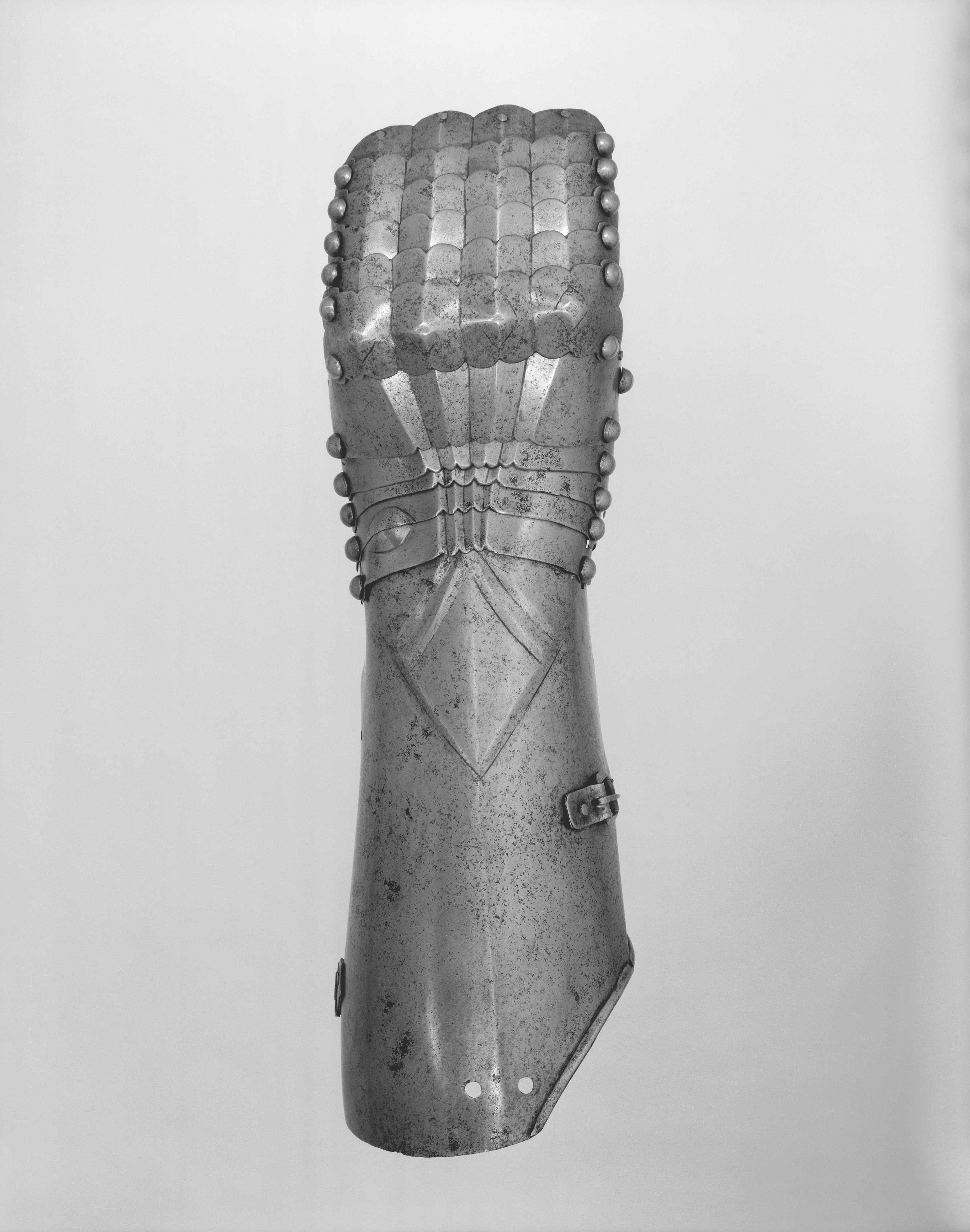
Deconstructing the Armored Gesture: A Couture Analysis of the Left Gauntlet
In the rarefied ateliers of haute couture, the body is not merely adorned but architecturally re-conceived. Garments become exoskeletons, fabrics transform into second skins, and embellishment ascends to the level of structural engineering. It is within this rigorous conceptual framework that Katherine Fashion Lab presents a standalone study: a single Left Gauntlet, of probable Austrian (Innsbruck) origin, crafted in steel. This is not a relic examined for historical battlefield efficacy, but a sartorial specimen analyzed through the lens of avant-garde design. It represents a profound meditation on asymmetry, the semantics of protection, and the articulation of identity through a singular, amplified gesture.
The Poetry of Asymmetry and Intentional Imbalance
To analyze a solitary left gauntlet is to engage immediately with the couture principle of deliberate asymmetry. In fashion, asymmetry challenges classical notions of beauty, introduces dynamic tension, and often signifies a narrative in progress. This gauntlet, presented alone, forces a confrontation with the incomplete, the unresolved. It asks the wearer—and the viewer—to complete the story. Is the right hand, bare, meant to signify vulnerability, diplomacy, or the tools of creation, while the left is armored for defense or decisive action? The imbalance creates a powerful kinetic suggestion; the body adopting a posture where one side is fortified, the other exposed. This is a cornerstone of avant-garde aesthetics: the elevation of the fragment to a complete statement, where absence is as articulate as presence.
From a construction perspective, the focus on the left side is inherently subversive. Historically, the right hand held the weapon, the scepter, the pen. Armoring the left, traditionally the shield-bearing side, inverts the hierarchy. It frames the left not as the passive defender, but as the active, leading guard—a bold reclamation. In a modern couture context, this translates to a garment that privileges one side of the body with elaborate structure, perhaps through an exaggerated shoulder, intricate boning, or dense embellishment, while the other remains streamlined. The gauntlet study teaches us that true power in design often lies not in bilateral symmetry, but in the compelling tension of a calculated, elegant imbalance.
Materiality and the Dialectic of Protection
The core material—steel—is the protagonist of this study. In fashion, material choice is never neutral; it conveys weight, sound, movement, and metaphor. Steel, in the soft world of textiles, is the ultimate transgressive material. It speaks of industrial strength, cold resilience, and formidable barriers. Yet, a masterfully crafted gauntlet is not a blunt carapace; it is a feat of engineering comprising articulated lames, rivets, and carefully shaped plates that follow the anatomy of the hand and wrist. This mirrors the highest level of couture, where fabrics are not simply draped but engineered—through complex pattern-cutting, internal structures like *gambesons* of horsehair or felt, and meticulous seaming—to protect, enhance, and redefine the silhouette.
Here, the "protection" offered is multifaceted. Literally, it guards the physical hand. Symbolically, however, it armors the wearer's intent, their creative gesture, or their vulnerability. In a contemporary translation, this could manifest as a garment with hardened, sculpted elements shielding the heart or the spine, crafted not from steel but from resin-infused fabrics, laser-sintered polymers, or densely layered and quilted textiles that mimic plate armor. The gauntlet study challenges designers to consider: what are we choosing to protect in our designs, and what materials best articulate that defense as an integral part of the aesthetic language?
The Articulated Gesture: From Function to Expression
The most critical lesson from this standalone piece lies in its articulation. A functional gauntlet must allow the hand to open, close, and wield. Each plate, or lame, moves in concert with the metacarpals and phalanges, creating a metallic glove that breathes with motion. This is haute couture's raison d'être: to create breathtaking beauty that does not sacrifice the articulation—the lived experience—of the body. A gown must allow for stride, a jacket for gesture, a sleeve for reach.
The gauntlet elevates the simple act of the gesture into a performative, amplified event. A pointed finger becomes a commanding lance; an open palm, a presented shield; a clenched fist, an impregnable fortress. This transforms clothing from a covering into an instrument of expression. In fashion terms, this inspires sleeves that are not mere tubes of fabric but architectural extensions—coiled, segmented, or amplified—that dramatize every movement of the arm and hand. The wearer becomes acutely aware of their own gestural vocabulary, their body language heightened and encoded by the design. The gauntlet is, ultimately, a tool for making gesture visible and potent.
Contextual Synthesis: The Standalone Study as Creative Catalyst
The designation of this object as a "standalone study" is crucial. At Katherine Fashion Lab, it is not part of a full suit of armor. It is an isolated component, a fragment for intense focus. This methodology is essential for innovation. By decontextualizing the gauntlet from its original martial ensemble, we are free to analyze its form, function, and symbolism purely. How does its curve fit a wrist? How does light reflect off its polished or embossed surfaces? What is the emotional resonance of a single armored hand?
This process directly mirrors the couture practice of studying a single sleeve, a collar, or a bustier for an entire season before integrating it into a collection. It is an exercise in depth over breadth. The probable Innsbruck origin hints at a center of metalworking excellence, akin to the specialized ateliers (*les métiers d'art*) that supply Parisian couture houses with their feathers, flowers, and embroideries. The gauntlet, therefore, stands as a testament to specialized craftsmanship, awaiting its creative deployment by the designer's vision.
In conclusion, this Left Gauntlet is far more than a historical artifact. It is a masterclass in avant-garde design principles: the power of asymmetry, the narrative of materiality, the engineering of articulation, and the poetry of the incomplete statement. It challenges us to design with intention for every part of the body, to consider clothing as both protection and proclamation, and to find inspiration in the most rigorous and unexpected of object lessons. For the modern couturier, it serves as a potent reminder that the most powerful designs often arm the wearer, not for war, but for the profound and beautiful act of making a gesture seen.