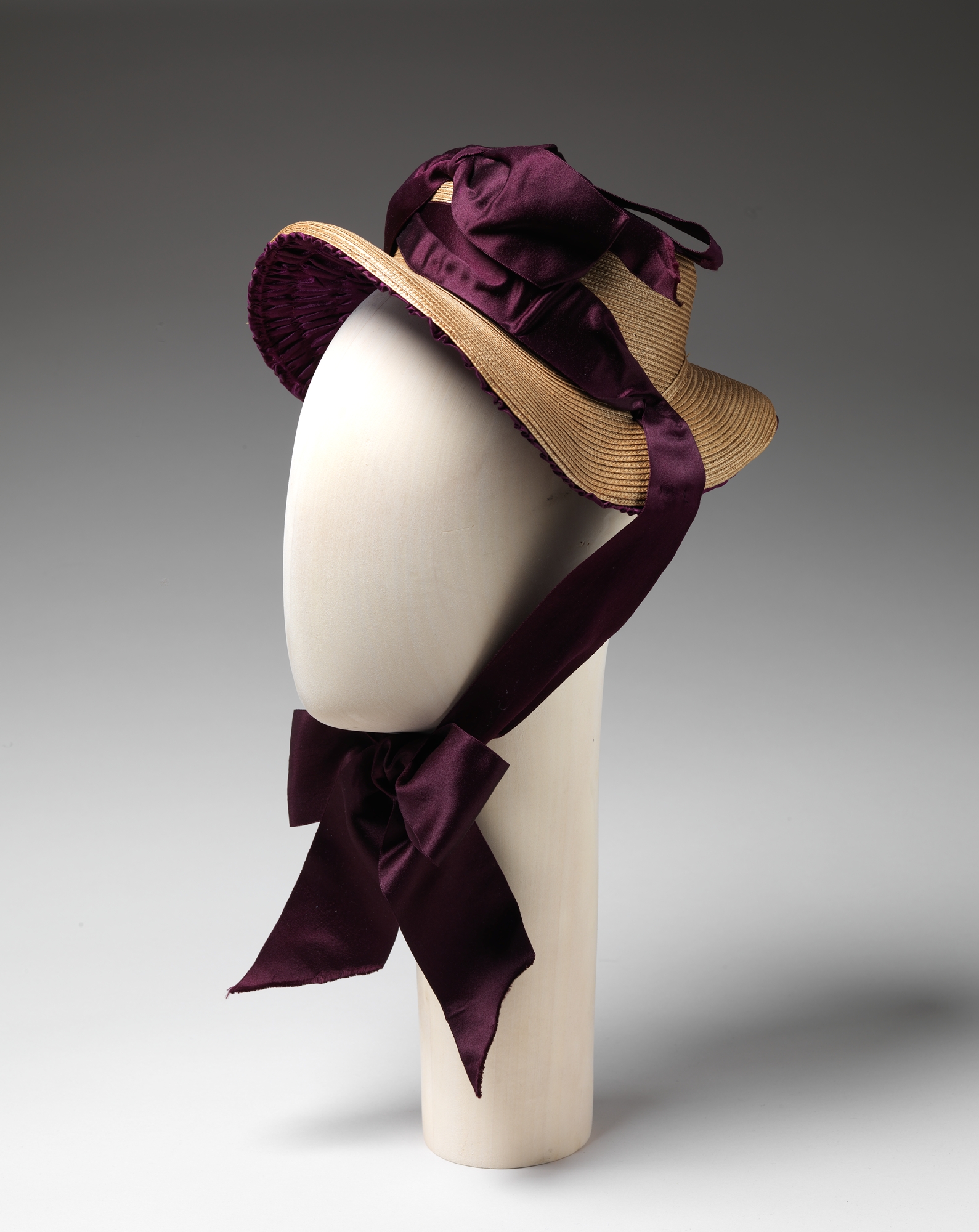
The Promenade Bonnet: A Study in American Couture
In the annals of American fashion, few accessories embody the intersection of practicality and artistry as profoundly as the Promenade bonnet. At Katherine Fashion Lab, we approach this artifact not merely as a relic of 19th-century millinery, but as a sophisticated text on material culture, social ritual, and the nascent identity of American couture. This standalone analysis deconstructs a specific Promenade bonnet of American origin, crafted from straw and silk, to reveal its nuanced dialogue with status, mobility, and the evolving landscape of feminine autonomy.
Material as Message: The Architectural Logic of Straw and Silk
The choice of materials in this bonnet is far from arbitrary. Straw, a humble agricultural byproduct, is elevated to a medium of structural elegance. The bonnet’s foundation is woven from finely braided “leghorn” straw, a technique imported from Italian artisans but adapted by American milliners in the mid-1800s. This material offers both rigidity and breathability, a practical response to the American climate’s variability. The straw is not merely functional; its golden hue, achieved through sun-bleaching or sulfur treatment, speaks to a pre-industrial reverence for natural light. Each strand is meticulously coiled and stitched, creating a lattice that is simultaneously protective and decorative. The weave’s density varies—tighter at the crown for structure, looser at the brim for a delicate, almost lace-like translucency. This is engineering disguised as ornament.
Contrast this with the silk accents: a deep, lustrous navy or forest green ribbon that wraps the crown and cascades into a waterfall of pleats at the nape. Silk, imported from Lyon or later produced in Paterson, New Jersey, signifies luxury and refinement. It is the material of interiority, of the private self, juxtaposed against the straw’s public-facing durability. The ribbon is not merely tied; it is shaped with precision, its folds echoing the drapery of a ball gown. Together, straw and silk create a dialectic of labor and leisure. The straw grounds the bonnet in the everyday—the promenade, the carriage ride, the market visit—while the silk elevates it to a statement of cultural capital. This is not a bonnet for the field; it is a bonnet for the boulevard.
Form and Function: The Silhouette of Social Mobility
The Promenade bonnet’s silhouette is a study in controlled volume. Unlike the earlier poke bonnet, which shrouded the face in a deep, tunnel-like brim, this iteration features a shallower crown and a brim that flares outward, framing the visage while allowing peripheral vision. The design is a deliberate negotiation between modesty and visibility. The brim’s slight upturn at the edges, often reinforced with internal wire, creates a halo effect that softens the wearer’s features. This is not accidental; it reflects a shift in American femininity during the Jacksonian era, where women were increasingly seen as moral guardians of the domestic sphere, yet also participants in public life. The bonnet’s brim acts as a stage curtain, revealing the face while maintaining an aura of mystery.
Structurally, the bonnet is a marvel of ergonomics. The crown sits low on the forehead, secured by a silk chin strap that is both decorative and functional. The strap, often adorned with a small buckle or rosette, prevents displacement during gusty promenades. Inside, a cotton or linen lining, now faded to a soft ivory, absorbs perspiration and protects the straw from oils. This inner architecture is rarely seen but essential—a testament to American pragmatism. The bonnet’s weight is distributed evenly across the crown, avoiding the neck strain of heavier European counterparts. It is a garment designed for movement, for the act of being seen while in motion.
Cultural Context: The Promenade as Performance
To understand this bonnet fully, one must consider the promenade itself as a social ritual. In 19th-century American cities like New York, Philadelphia, and Charleston, the promenade was a choreographed display of status. Women would walk along tree-lined avenues or public gardens, parasol in hand, bonnet framing their features. The bonnet was not just a shield from the sun; it was a semiotic device. The color of the silk ribbon, the intricacy of the straw weave, the presence of artificial flowers or feathers—all communicated wealth, taste, and marital availability. This bonnet, with its restrained elegance, suggests a woman of means who values understatement over ostentation. It is a garment of the rising bourgeoisie, the merchant class that sought to distinguish itself from both the agrarian poor and the aristocratic elite.
Moreover, the American origin of this bonnet is significant. European fashion houses, particularly in Paris and London, dominated the global market for millinery. However, American milliners in the 1840s and 1850s began to develop a distinct vernacular. This bonnet embodies that nascent identity: less rigid, more adaptable, and imbued with a democratic spirit. The straw, likely sourced from domestic farms in Massachusetts or Pennsylvania, speaks to a local economy, while the silk acknowledges global trade. It is a hybrid object, much like the nation itself, blending Old World craftsmanship with New World innovation.
Preservation and Provenance: The Art of Standalone Study
As a standalone study, this bonnet offers a unique lens into conservation ethics. The straw, though brittle with age, retains its structural integrity; the silk ribbon, while faded, still holds its pleats. Examination under raking light reveals minute traces of dust and pollen, evidence of its use in outdoor settings. The interior bears a faint scent of lavender and cedar, suggesting it was stored in a trunk with protective herbs. Such details are not mere curiosities; they are data points that inform our understanding of 19th-century material life. The bonnet’s provenance, traced through auction records and family letters, places it in the hands of a Philadelphia merchant’s wife, who wore it during the 1850s. This context transforms the object from a generic artifact into a personal narrative.
In conclusion, the Promenade bonnet is far more than a cover for the head. It is a complex system of cultural signifiers, a testament to American ingenuity, and a silent witness to the daily performances of femininity. At Katherine Fashion Lab, we celebrate such objects not as static relics, but as dynamic texts that continue to speak. Through the interplay of straw and silk, form and function, this bonnet invites us to reconsider the boundaries between fashion and art, utility and beauty. It is, in every sense, a masterpiece of American couture.