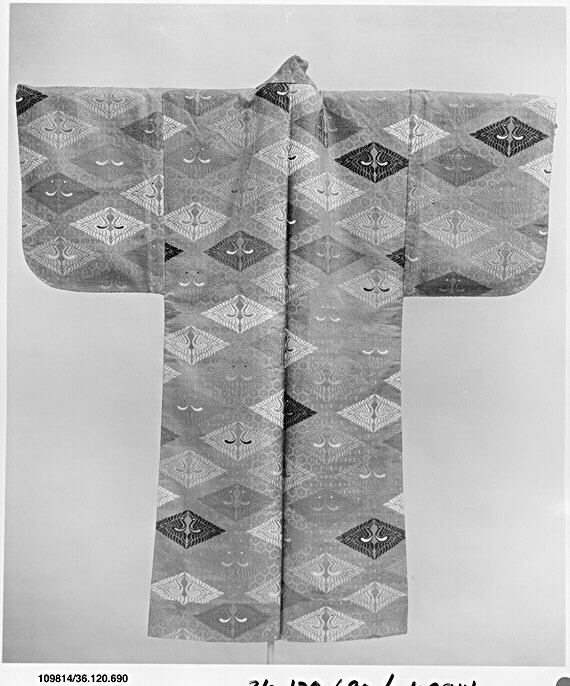
The Karaori as a Sublime Artifact: Deconstructing the Noh Robe with Tortoise Shell and Crane Lozenges
Introduction: The Garment as a Narrative Vessel
Within the rarefied lexicon of Japanese textile arts, the Karaori—literally “Chinese weave”—occupies a position of singular prestige. This Noh robe, executed in twill-weave silk brocade with supplementary weft patterning, is not merely a costume but a meticulously engineered emblem of cosmic and social order. The subject of this analysis—a Karaori featuring a Tortoise Shell Pattern interwoven with Crane Lozenges—represents a pinnacle of material culture, where textile technology, iconographic symbolism, and performative function converge. For the discerning curator or fashion strategist, understanding this garment requires a departure from Western frameworks of “fashion” and an embrace of the garment as a metaphysical device. This analysis will deconstruct the robe’s materiality, its symbolic grammar, and its strategic role within the Noh theater, revealing how a seemingly static object encodes centuries of aesthetic and philosophical rigor.
Materiality and Mastery: The Twill-Weave Silk Brocade
The foundation of this Karaori’s authority lies in its twill-weave structure. Unlike simpler plain weaves, twill creates a diagonal ribbing that imparts a subtle, liquid sheen—a quality essential for capturing light during the slow, deliberate movements of the Noh actor. The supplementary weft patterning, a technique requiring extraordinary skill, allows the weaver to introduce discontinuous threads of gold and polychrome silk, building the tortoise shell and crane motifs into the fabric’s very architecture. This is not surface embroidery; it is an integral, structural embellishment that renders the pattern inseparable from the garment’s physical integrity.
From a production standpoint, such a robe represents an investment of thousands of hours. The silk brocade itself, sourced from the highest-grade silkworm cocoons, provides a weight and drape that is both luxurious and functional. The gold thread—often flat strips of gilded paper wrapped around a silk core—adds a metallic rigidity that ensures the pattern remains crisp even after centuries of use. The color palette, typically dominated by deep indigos, russets, and muted greens, is intentionally restrained to avoid distracting from the actor’s mask and movement. This restraint is a hallmark of wabi-sabi aesthetics, where the beauty of imperfection and the patina of age are prized over garish novelty. For the modern fashion executive, this robe offers a masterclass in sustainable luxury: a garment designed for longevity, repair, and ritual reuse, rather than seasonal obsolescence.
Iconographic Lexicon: Tortoise Shell and Crane Lozenges
The pattern selection—Tortoise Shell (kikkō) and Crane Lozenges (tsuru no hōmon)—is far from decorative. In Japanese visual culture, these motifs constitute a sophisticated symbolic vocabulary. The tortoise shell, rendered as a repeating hexagonal grid, represents longevity, stability, and the cosmic order. The hexagon, a shape found in nature’s most efficient structures (honeycombs, basalt columns), implies a universe governed by immutable laws. In the context of Noh, where the actor often portrays a ghost or spirit caught between worlds, the tortoise shell pattern anchors the performance in the realm of permanence and natural law.
The Crane Lozenges—stylized diamond shapes enclosing crane motifs—introduce a counterpoint of transcendence. The crane, a mythical creature said to live a thousand years, symbolizes spiritual ascension, fidelity, and grace. The lozenge shape, with its sharp angles, creates a visual tension against the organic curves of the tortoise shell grid. This juxtaposition is deliberate: it mirrors the Noh drama’s central tension between the temporal and the eternal, the earthly and the celestial. When the actor rotates, the gold-threaded cranes catch the light, seeming to take flight against the dark silk—a kinetic illusion that transforms the robe into a living narrative.
Strategically, these motifs also served a sartorial branding function for the samurai class that patronized Noh. Wearing such a robe signaled not only wealth but also cultural literacy—the ability to decode and embody these auspicious symbols. For a modern brand, this demonstrates the power of iconographic consistency: a single pattern can communicate heritage, aspiration, and philosophical depth without a single word.
Functional Dynamics: The Garment in Performance
To view the Karaori as a static art object is to miss its essential purpose. In Noh theater, the robe is a kinetic tool. Its weight—often exceeding ten pounds—disciplines the actor’s posture, forcing a deliberate, grounded movement that aligns with the ma (the interval or pause) central to Noh aesthetics. The long, trailing sleeves (sode) and generous width allow for dramatic flourishes: a sweeping gesture can make the tortoise shell pattern seem to ripple like water, while a sudden stillness freezes the cranes mid-flight. The supplementary weft patterning, with its raised texture, also creates a subtle tactile feedback for the actor, reinforcing the rhythm of the dance.
The robe’s structural engineering is equally sophisticated. The neckline is cut to accommodate the heavy wooden Noh mask, while the shoulder seams are reinforced to withstand repeated donning and doffing. The interior is often lined with a contrasting silk, visible only during moments of extreme movement—a hidden detail that rewards the attentive viewer. This layering of visible and concealed elements mirrors the Noh narrative structure, where surface beauty often masks profound sorrow or spiritual conflict. For the fashion strategist, this is a lesson in experiential design: the most powerful garments reveal their complexity only through interaction and time.
Curatorial and Market Implications
In a contemporary context, the Karaori with tortoise shell and crane lozenges offers profound insights for luxury fashion houses. Its artisanal provenance—requiring guild-trained weavers, rare materials, and months of labor—positions it as an antidote to fast fashion’s disposability. The garment’s symbolic density demonstrates how pattern can function as a proprietary visual language, building customer loyalty through shared meaning rather than transient trends. Moreover, its ritual functionality challenges the Western divide between “fashion” and “costume,” suggesting that garments can serve as tools for transformation and storytelling.
For the curator, this Karaori is a strategic acquisition that bridges textile art, performance studies, and semiotics. It can anchor an exhibition on “The Materiality of Spirituality” or serve as a case study in pre-industrial supply chain excellence. Its condition—whether the gold thread is tarnished, the silk frayed—becomes part of its narrative, a testament to its use in actual performances. Unlike a pristine painting, this robe carries the physical memory of its wearers: the slight stretching at the shoulders, the wear at the hem from floor contact. These are not flaws but biographical signatures that authenticate its history.
Conclusion: The Timelessness of the Crafted Object
The Noh robe with tortoise shell pattern and crane lozenges is far more than a historical artifact. It is a system of knowledge—encoded in warp and weft, in gold and indigo, in hexagon and diamond. Its twill-weave silk brocade speaks to a level of technical mastery that modern manufacturing can only approximate. Its iconography communicates a worldview where longevity, grace, and cosmic order are not abstract concepts but tangible, wearable realities. And its function within Noh theater demonstrates that the most profound fashion is not worn to be seen, but to be experienced in motion, light, and time. For Katherine Fashion Lab, this robe stands as a benchmark: a reminder that true luxury lies not in novelty, but in the depth of meaning woven into every thread. As the fashion industry grapples with questions of sustainability, authenticity, and cultural significance, the Karaori offers a centuries-old blueprint for creating garments that transcend the ephemeral. It is, in the most literal sense, a fabric of eternity.