Executive Summary: Partisans as Prototypes of Sovereign Power
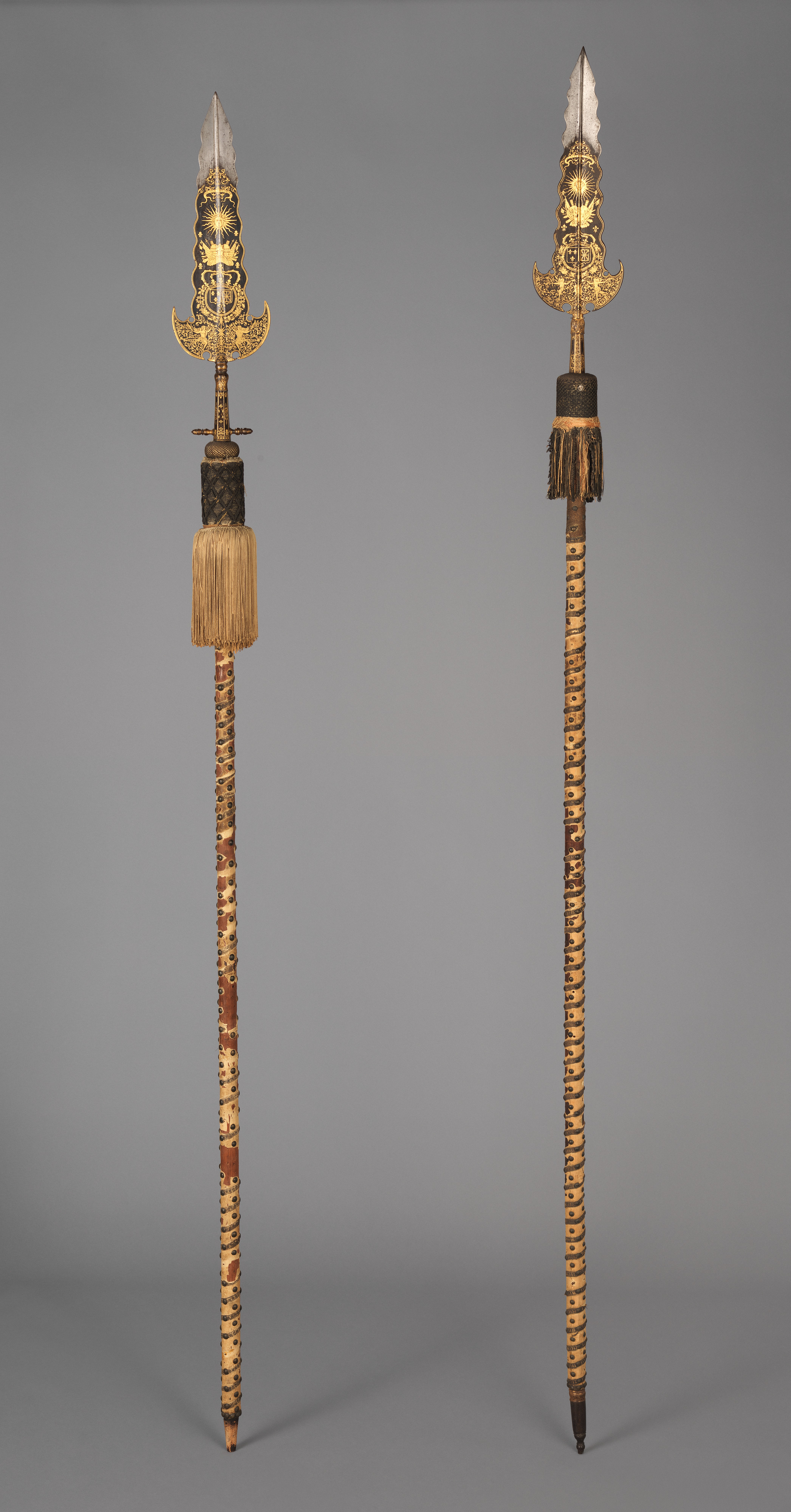
The three partisans carried by the bodyguards of Louis XIV are not merely ceremonial weapons; they are complex, multi-layered instruments of statecraft and personal branding. Created in the Parisian workshops that served the Sun King’s court, these objects—fashioned from steel, gold, wood, textile, and brass—represent a zenith in the strategic application of material culture to political and spiritual ends. This analysis decodes their intrinsic symbolism and historical function to extract a foundational framework for Katherine Fashion Lab’s 2026 high-end luxury strategy. We posit these artifacts as early case studies in total environment branding, where adornment communicates hierarchy, divine mandate, and unassailable authority, directly informing a modern luxury paradigm built on narrative depth, symbolic weight, and immersive experience.
Historical & Material Deconstruction: The Anatomy of Authority
Originating in the mid-17th century, these partisans are polearms characterized by a double-axe head flanking a central spear point. Their form is inherently theatrical, designed for visibility and ceremony rather than battlefield utility. The material palette is a deliberate hierarchy of value and meaning:
Steel as Structural Truth and Martial Foundation
The steel of the blade embodies the unyielding strength and martial readiness of the French state. It is the functional core, a reminder that the splendor of Versailles was underpinned by military might. For the bodyguard, it was a tangible symbol of their sworn duty to interpose themselves physically between threat and monarch. This represents the non-negotiable, foundational quality of a luxury product—its integrity, craftsmanship, and enduring utility beneath the surface adornment.
Gold as Aura of the Divine Right
The application of gold—likely gliding on steel mounts or in intricate inlay—transforms the weapon from a tool of war into a sacred object. Gold was the metal of the sun, a direct material corollary to Louis XIV’s personal mythos as the Sun King (le Roi Soleil). It sanctified the partisan, linking the guard’s protective role to a cosmic order where the king was God’s lieutenant on earth. In luxury terms, gold operates as the supreme signifier of exclusivity, value, and a rarefied, almost celestial, status.
Wood, Textile & Brass: The Hierarchy of Proximity
The wooden shaft, often wrapped in textured textile (such as velvet or silk) and reinforced with brass fittings, completes the object’s narrative. These materials were in direct, tactile contact with the bodyguard. They signify the human element—the grip, the hold, the daily carriage. The quality of these materials would denote the guard’s own rank within the Maison du Roi. This tripartite material structure (steel core, gold aura, tactile interface) offers a blueprint for product architecture: a robust foundation, a transcendent symbolic layer, and an intimately experienced, tactile finish that communicates personalized privilege.
Symbolic Power and Spiritual Meaning: The Theatre of Protection
The partisan’s power was entirely performative and symbolic. Carried in the Hall of Mirrors or during state processions, they were key props in the daily theatrical production of absolutism.
The Bodyguard as Living Pedestal
The guard, by bearing the partisan, became a mobile, living extension of the king’s authority. Their uniformed, disciplined body transformed the object from a static display item into a dynamic component of the royal aura. The partisan did not adorn the guard; the guard served as the adornment for the partisan, and by extension, the monarch. This inverts traditional adornment logic, focusing on how objects elevate the status of the central figure by framing those who surround them.
Spiritual Warding and the Sacred Perimeter
Beyond physical defense, the gilt partisan functioned as a talisman. Its radiant, sun-like gold was apotropaic, designed to ward off not just physical evil but spiritual and political malevolence. It created a sacred perimeter around the king’s person, a buffer zone where sovereign power was made manifest and inviolable. This imbues the object with a spiritual meaning—it is a relic of a belief system where power was divine and required a material liturgy to sustain it.
Strategic Translation: The Katherine Fashion Lab 2026 Luxury Framework
The analysis of these partisans yields four strategic pillars for a forward-looking high-end luxury strategy, moving beyond product-centricity to ecosystem branding.
Pillar 1: Adornment as Armature
Modern luxury must function as both shield and signal—an armature that protects the wearer’s identity and projects a curated personal mythology. Inspired by the partisan’s dual nature (steel core/gold surface), products should offer a narrative of resilient inner value (exceptional craftsmanship, innovative material science) cloaked in an outer language of recognizable, symbolic splendor. This builds authenticity and desirability simultaneously.
Pillar 2: The Creation of Sacred Perimeters
Luxury in 2026 must curate exclusive behavioral and experiential zones—modern sacred perimeters. This translates from VIP concierge services to immersive brand residences, and even to digital access protocols (e.g., token-gated NFT communities). Like the partisan-wielding guard, every brand touchpoint must enforce a sense of privileged inclusion and defended exclusivity, making the client feel at the center of a protected, rarefied universe.
Pillar 3: Symbolic Material Storytelling
Material selection must be re-framed as symbolic storytelling. A handbag is not merely leather and hardware; it is a composition of “structural steel” (a revolutionary, durable lining), “divine gold” (a clasp inspired by heraldic motifs, using ethically sourced precious metal), and “tactile proximity” (an interior lined with a custom textile developed with a historic mill). Each material must carry a chapter of the brand’s heritage and the object’s intended mythos.
Pillar 4: The Guard Archetype and Ecosystem
Develop a brand ecosystem where secondary products and services act as the “modern guard.” This includes everything from meticulously crafted garment bags (the “scabbard” for the main product) to personalized fragrance (the “aura” or ambient identity), and dedicated client advisors (the contemporary equivalent of the loyal, knowledgeable guard). These elements frame and elevate the core product, creating a holistic system of adornment and care that deepens brand loyalty and perceived value.
Conclusion: From Versailles to 2026
The partisans of Louis XIV’s guard are masterclasses in encoded power. They teach us that ultimate luxury is not a passive possession but an active, multi-sensory narrative that constructs reality around the holder. For Katherine Fashion Lab, the path to 2026 lies in embracing this Baroque understanding of total environment branding. By reinterpreting the partisan’s principles—armature, sacred perimeter, symbolic materiality, and the guard ecosystem—the lab can craft a luxury proposition that is as intellectually resonant and spiritually compelling as it is materially exquisite. This strategy moves beyond fashion to curate sovereign personal identity for the contemporary elite, establishing not just a clientele, but a court.