The Sampler as Couture: A Study in Global Heritage and Textile Mastery
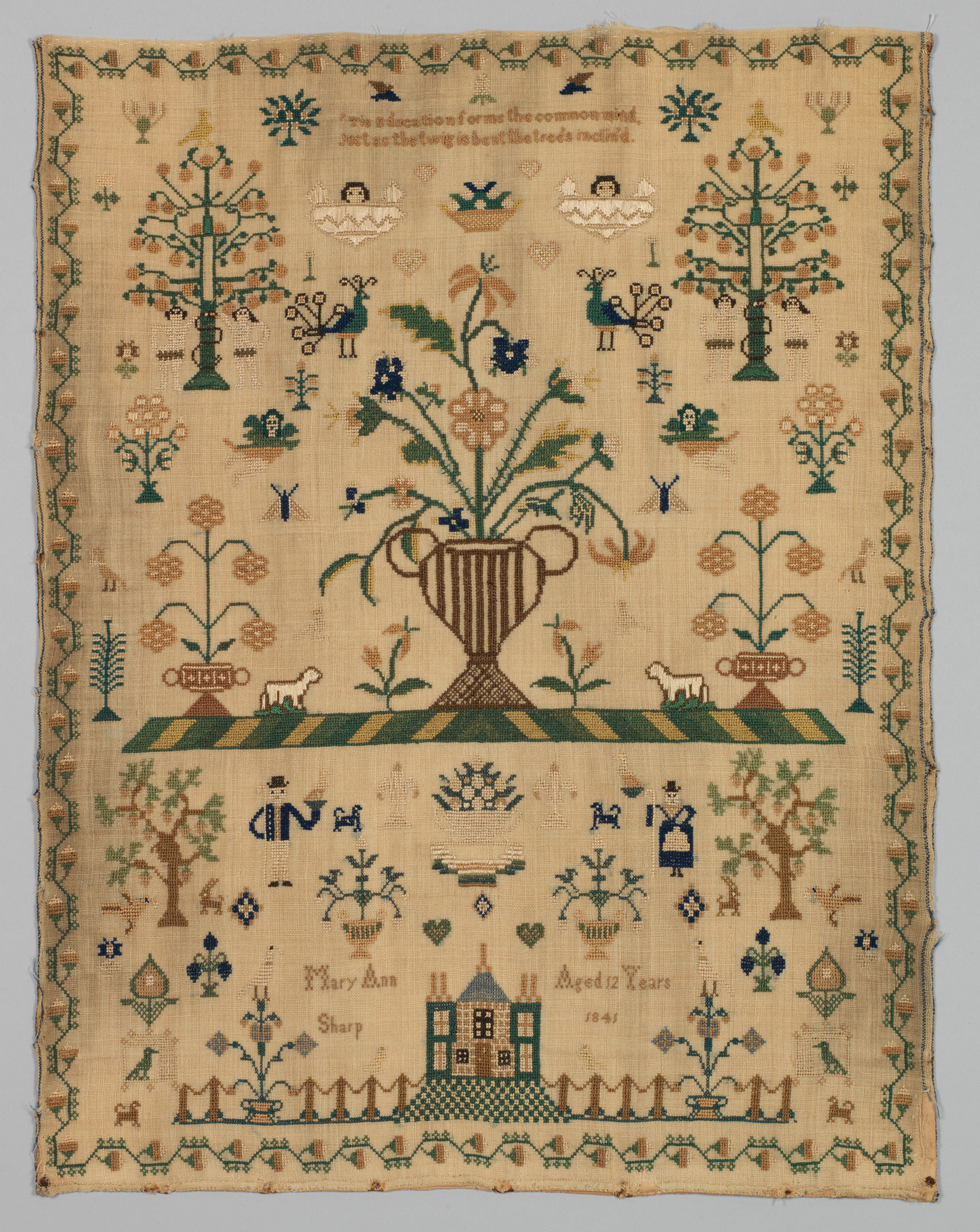
In the rarified air of haute couture, where innovation often masquerades as novelty, the Katherine Fashion Lab presents a profound meditation on craft, memory, and materiality. The subject of this analysis—a Sampler, rendered in silk on wool canvas—transcends its historical nomenclature to become a standalone artifact of global heritage. This is not a preparatory sketch nor a pedagogical exercise; it is a finished statement, a couture piece that demands we reconsider the boundaries between decorative art, textile engineering, and cultural storytelling.
To understand the Sampler’s significance, one must first appreciate its dissonance with contemporary fashion paradigms. In an industry driven by speed, seasonality, and spectacle, the Sampler is deliberately slow, intimate, and rooted in ancestral techniques. It is a study in restraint and abundance simultaneously—a paradox that defines the Katherine Fashion Lab’s ethos. The piece does not rely on silhouette or drape; rather, it communicates entirely through surface, texture, and the narrative embedded in every stitch.
Material Dialogue: Silk on Wool Canvas
The choice of materials is neither arbitrary nor aesthetic alone; it is a strategic dialogue between opposites. Wool canvas provides a structural foundation that is both rigid and porous—a ground that absorbs and resists. Its natural, undyed ecru tone offers a neutral stage, one that evokes the unprimed linen of Renaissance panel paintings or the parchment of illuminated manuscripts. This is a surface that demands intention.
Upon this canvas, silk threads are applied with surgical precision. Silk, with its inherent luster and tensile strength, creates a luminous counterpoint to the wool’s matte, organic grip. The contrast is not merely visual but tactile: the silk slides against the wool’s nap, creating a micro-topography of raised and recessed forms. This interplay of friction and gloss, of opacity and sheen, elevates the Sampler from a two-dimensional pattern to a sculptural relief. The Katherine Fashion Lab exploits this material tension to generate a sense of depth that is both physical and metaphorical—a layering of histories, techniques, and geographies.
The silk threads themselves are dyed in a palette that references global textile traditions: indigo from West Africa, madder red from Central Asia, cochineal carmine from the Americas, and a muted saffron yellow from South Asia. These colors are not applied uniformly; they modulate across the canvas, creating gradients and shadows that mimic the patina of age. This is not a nostalgic imitation of antiquity but a deliberate evocation of the passage of time, of the hands that have touched similar fibers across centuries.
Composition: The Grammar of Global Heritage
The Sampler’s composition is a masterclass in visual syntax. At first glance, it appears as a grid of geometric and floral motifs—a conventional arrangement for a sampler. Yet upon closer inspection, the patterns reveal a sophisticated hybridization of cultural vocabularies. A Mughal-inspired arabesque interlaces with a Scandinavian eight-pointed star; a Japanese asanoha (hemp leaf) pattern abuts a Malian bogolanfini (mud cloth) diamond. These are not mere appropriations but translations—each motif re-stitched with the technical grammar of its origin while being recontextualized within a new, cohesive whole.
This compositional strategy is what the Katherine Fashion Lab terms “design syncretism.” It avoids the pitfalls of cultural pastiche by foregrounding the process of transmission. The stitches themselves—satin, chain, split, and cross—are chosen to echo the hand techniques of their respective regions. The Japanese hemp leaf, for example, is executed in a fine split stitch that mimics the precision of sashiko, while the Malian diamond uses a thicker, more irregular cross-stitch that recalls the rhythmic, improvisational quality of Kuba cloth. Each motif is a node in a global network of textile knowledge, and the Sampler becomes a map of that network.
The negative space is equally deliberate. The wool canvas is left exposed in carefully calibrated areas, allowing the material to “breathe” and to anchor the viewer’s eye. This is not a maximalist surface; it is a curated one. The voids function as pauses, as intervals of silence in a visual symphony. They also serve a conceptual purpose: they remind us that heritage is not a seamless whole but a series of gaps, erasures, and reinterpretations. The Sampler does not claim to present a complete history; it offers fragments, inviting the viewer to complete the narrative.
Standalone Study: Beyond the Pedagogical
Historically, samplers were pedagogical tools—exercises in stitching, literacy, and moral instruction for young women. The Katherine Fashion Lab subverts this legacy by presenting the Sampler as a standalone, autonomous artwork. It is not a prototype for a garment, nor a sample for production. It exists for its own sake, as a complete object of contemplation. This recontextualization challenges the hierarchy of fashion design, where the final garment is often privileged over the process of its making. Here, the process is the product.
The decision to frame the Sampler as a study is a deliberate intellectual gesture. In the fine arts, a study is a preparatory work—a sketch, a maquette—that reveals the artist’s hand and thought process. By adopting this terminology, the Lab positions the Sampler as a window into its own creative methodology. Each stitch is a decision; each motif, a hypothesis. The piece becomes a document of inquiry, a record of the designer’s engagement with global heritage as a living, evolving practice.
This status as a study also liberates the Sampler from the constraints of wearability. It is not subject to the demands of movement, comfort, or commercial viability. It can prioritize material integrity and conceptual depth over ergonomics. This is couture in its most rarefied form—not as clothing, but as a textile object that exists in dialogue with art, anthropology, and history.
Implications for Contemporary Couture
The Sampler’s implications extend far beyond the Katherine Fashion Lab’s atelier. In an era of cultural homogenization and fast fashion’s erasure of craft, this piece advocates for a slower, more deliberate approach to design. It insists that couture can be a site of cultural preservation and reinterpretation, rather than mere spectacle. The Sampler does not seek to shock or dazzle; it seeks to educate and to deepen.
Furthermore, the piece challenges the fashion industry’s obsession with novelty. By explicitly citing historical and global precedents, the Sampler argues that innovation can emerge from deep engagement with tradition. The most forward-looking design may, paradoxically, be the one that looks backward—not with nostalgia, but with critical reverence. The Katherine Fashion Lab demonstrates that heritage is not a static archive but a toolkit for creating new meanings.
In conclusion, the Sampler is a landmark in contemporary couture. It redefines the sampler as a sophisticated, standalone art form; it elevates material and technique to the level of concept; and it proposes a model of global heritage that is inclusive, respectful, and generative. For the discerning observer, this piece is not merely an object to be viewed but a text to be read—a woven manuscript of human ingenuity, endurance, and beauty. The Katherine Fashion Lab has not just made a sampler; it has made a statement about what couture can and should be in the 21st century.