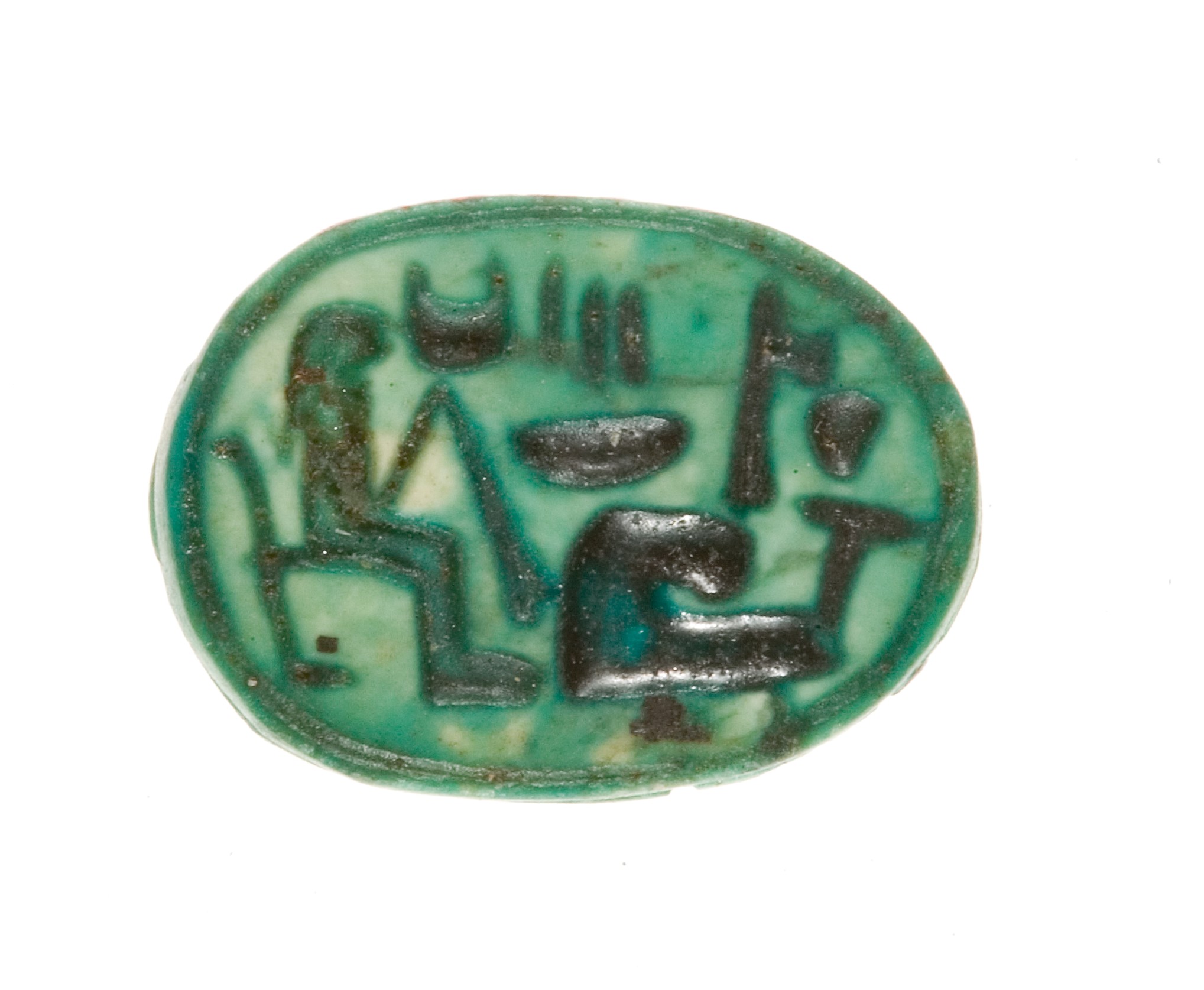
Strategic Heritage Analysis: The Scarab Inscribed for the God's Wife Hatshepsut, Living
This analysis examines the Scarab Inscribed for the God's Wife Hatshepsut, Living, a glazed steatite artifact from ancient Egypt, as a case study for high-end luxury strategy in 2026. As Lead Heritage Curator for Katherine Fashion Lab, I interpret this object not merely as an archaeological curiosity but as a sophisticated emblem of symbolic power, historical adornment, and spiritual meaning. Its strategic relevance lies in its ability to inform a luxury brand narrative that transcends temporal boundaries, offering a blueprint for exclusivity, authority, and metaphysical resonance in contemporary markets.
Symbolic Power: The Scarab as a Mechanism of Royal Legitimacy
The scarab beetle, central to this artifact, was far more than a decorative motif in ancient Egypt. It embodied kheper, the concept of spontaneous creation and transformation, directly linked to the sun god Ra. For Hatshepsut—a female pharaoh who ruled as king during the 18th Dynasty—the scarab served as a potent tool of political and religious authority. By inscribing her name and title, “God’s Wife Hatshepsut, Living,” the scarab functioned as a portable seal of divine endorsement. It declared her not only as a earthly ruler but as an active participant in the cosmic cycle of rebirth.
From a luxury strategy perspective, this scarab exemplifies how objects can encode brand legitimacy. In 2026, high-end consumers seek markers of authenticity that are not mass-produced but singularly linked to heritage. The scarab’s power derived from its uniqueness: each inscription was a bespoke declaration of status. For Katherine Fashion Lab, this translates into a strategy of limited-edition artifacts that carry narrative weight—pieces that are not just accessories but statements of lineage and purpose. The scarab teaches us that symbolic power is most effective when it is exclusive, personal, and historically anchored.
Historical Adornment: Steatite as a Medium of Prestige and Durability
The medium—glazed steatite—is a soft stone that, when fired and glazed, mimics the lustrous finish of more precious materials like turquoise or faience. This technical choice reveals a sophisticated understanding of material hierarchy and visual impact. Steatite was accessible yet transformable; its glaze created a luminous, protective shell that signified permanence and divine favor. For Hatshepsut, the scarab was not merely an ornament but a talisman worn close to the body, often as a ring or pendant. Its placement was deliberate: it adorned the living flesh, connecting the wearer to the amulet’s protective and regenerative powers.
In historical adornment, the scarab bridges the functional and the sacred. It was a seal for official documents, a jewel for the living, and a guardian for the deceased. This multifunctionality is a critical insight for luxury design in 2026. Modern high-end clients demand pieces that are versatile, meaningful, and enduring. Katherine Fashion Lab can draw from this by creating adornments that serve dual purposes—for example, a pendant that also functions as a digital key or a ring that encodes a personal motto. The steatite scarab proves that materiality, when combined with craft, elevates an object from commodity to cultural heirloom.
Spiritual Meaning: The Amulet as a Conduit for Transcendence
Spiritually, the scarab inscribed with Hatshepsut’s name was an amulet of protection and rebirth. Ancient Egyptians believed that the scarab’s association with the sun’s daily journey through the underworld granted its wearer safe passage through life and death. The phrase “Living” after Hatshepsut’s name is not a passive descriptor but an active invocation: it asserts her continued existence in the afterlife and her vital force in the present. This imbues the object with metaphysical agency, a quality that transcends mere ornamentation.
For the luxury market in 2026, spiritual meaning is a growing differentiator. Consumers increasingly seek objects that offer emotional resonance and existential comfort. The scarab’s spiritual function suggests a strategy where brands position themselves as curators of meaning, not just sellers of goods. Katherine Fashion Lab can incorporate this by embedding ritualistic narratives into collections—for instance, a limited series of amulets designed for meditation, each with a specific intention (protection, creativity, renewal). The scarab demonstrates that spiritual value is not abstract; it is tangible, wearable, and deeply personal.
2026 High-End Luxury Strategy: Lessons from Hatshepsut’s Scarab
Translating these ancient insights into a contemporary luxury strategy requires a multilayered approach. First, the scarab’s exclusivity—its inscription for a specific individual—points to the power of bespoke customization. In 2026, Katherine Fashion Lab should offer clients the ability to commission pieces that encode personal or familial symbols, much like Hatshepsut’s scarab encoded her royal identity. This creates a direct emotional investment and a narrative that cannot be replicated.
Second, the scarab’s material transformation—from raw steatite to glazed artifact—mirrors the luxury industry’s emphasis on craftsmanship and alchemy. High-end consumers value the story of making: how a material is sourced, shaped, and finished. Katherine Fashion Lab can leverage this by partnering with master artisans who use traditional techniques (e.g., hand-glazing, stone carving) to produce pieces that are artisanal and scarce. The scarab’s glaze, which required precise firing, is a metaphor for the controlled risk and expertise that define luxury production.
Third, the scarab’s dual role as adornment and spiritual tool suggests a market for functional talismans. In 2026, as digital and physical realms blur, luxury brands can create objects that serve as anchors of authenticity. For example, a scarab-inspired pendant could incorporate a microchip that stores a personal digital legacy—photographs, letters, or a holographic message. This merges ancient protective symbolism with modern technology, offering a unique value proposition that is both heritage-rich and forward-looking.
Finally, the scarab’s connection to Hatshepsut—a female ruler who defied conventions—positions it as a symbol of empowerment and defiance. Luxury brands in 2026 can tap into this by aligning with narratives of breaking boundaries. A collection inspired by Hatshepsut’s scarab could be marketed as a tribute to women leaders, entrepreneurs, and innovators, using the scarab’s “Living” inscription as a call to action. This aligns with consumer demand for purpose-driven luxury that supports gender equality and historical reclamation.
Conclusion: The Scarab as a Strategic Archetype
The Scarab Inscribed for the God's Wife Hatshepsut, Living, is more than an archaeological relic; it is a strategic archetype for luxury brand development. Its symbolic power, historical adornment, and spiritual meaning offer a framework for creating objects that are exclusive, meaningful, and transcendent. For Katherine Fashion Lab, this analysis underscores the importance of narrative depth, material integrity, and metaphysical resonance in crafting a 2026 high-end strategy. By channeling the scarab’s legacy, the Lab can position itself as a curator of timeless authority—a brand that does not merely sell luxury but bestows it with the weight of history and the promise of rebirth.