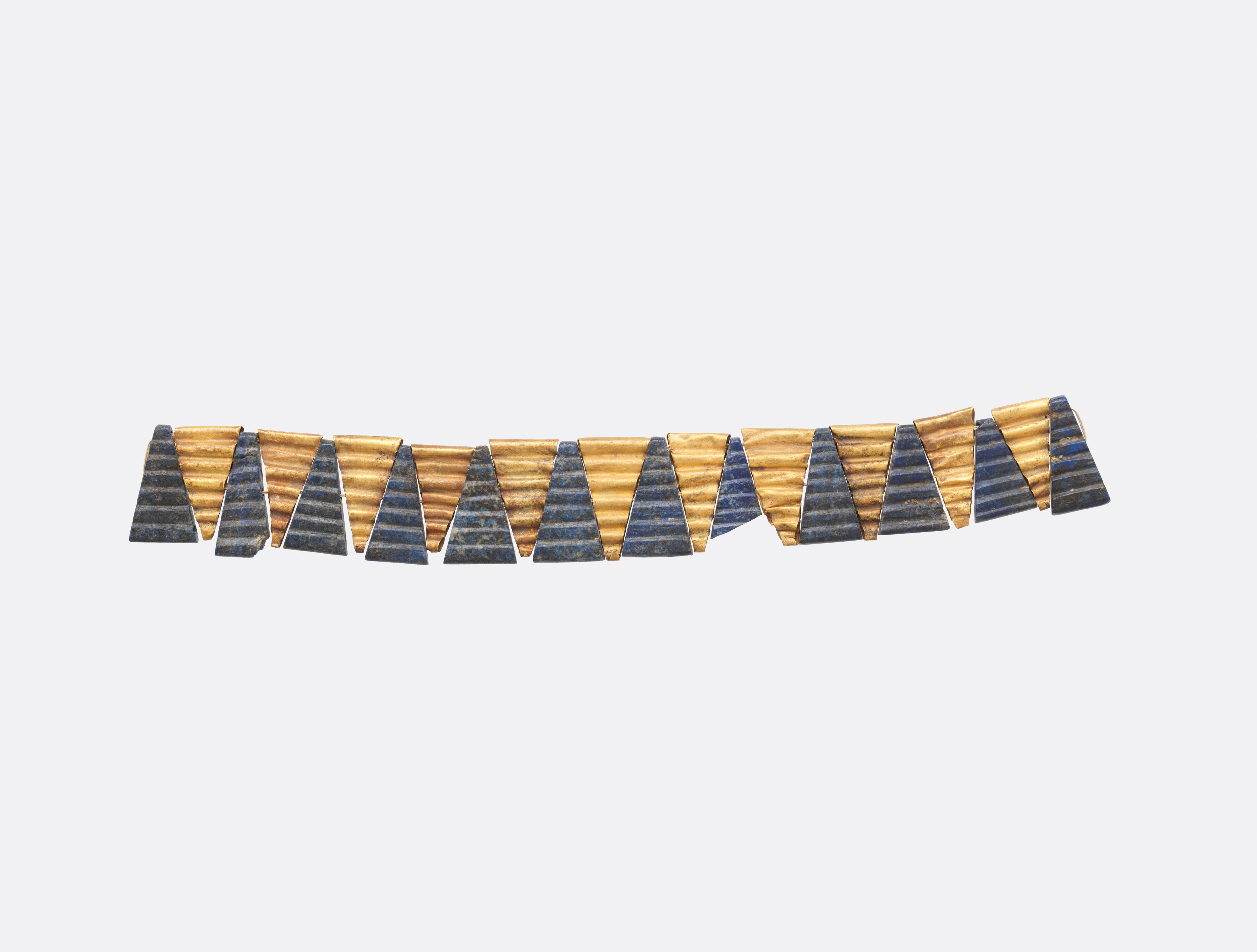
Strategic Heritage Analysis: The Sumerian Gold and Lapis Lazuli Necklace
This report presents a comprehensive heritage analysis of the Sumerian gold and lapis lazuli necklace, commissioned by Katherine Fashion Lab as a strategic standalone research document. The analysis examines the artifact’s symbolic power, its role in historical adornment, its spiritual meaning, and the implications for a 2026 high-end luxury strategy. The Sumerian civilization, flourishing in Mesopotamia from approximately 4500 to 1900 BCE, left an indelible mark on the history of jewelry, where materials were not merely decorative but encoded with profound cultural, religious, and political significance.
Symbolic Power: The Material Language of Authority and Divinity
The Sumerian necklace, crafted from gold and lapis lazuli, embodies a dual symbolism of terrestrial power and celestial connection. Gold, extracted from riverbeds and mines across the ancient Near East, was associated with the sun god Utu and the eternal, unchanging nature of divine authority. In Sumerian courtly life, gold was reserved exclusively for the ruling elite and temple priesthood, serving as a visible marker of hierarchical status. The necklace’s gold components—often formed into delicate leaves, rosettes, or cylinder seals—signified the wearer’s proximity to the gods and their role as an intermediary between heaven and earth.
Lapis lazuli, imported from the distant Badakhshan mines in modern-day Afghanistan, was more precious than gold in Sumerian society. Its deep, celestial blue, flecked with golden pyrite inclusions, was believed to mirror the night sky and the vault of heaven. The stone was sacred to Inanna, the goddess of love, war, and political power. Wearing lapis lazuli was an act of divine embodiment; the necklace did not merely represent status but actively channeled the protective and generative forces of the goddess. The combination of gold and lapis lazuli thus created a material statement of absolute sovereignty—a declaration that the wearer possessed both earthly wealth and heavenly favor.
Historical Adornment: Craftsmanship, Trade, and Social Identity
From a historical perspective, the Sumerian necklace represents a pinnacle of early metallurgical and lapidary craftsmanship. Artisans employed lost-wax casting, granulation, and filigree techniques to shape gold into intricate forms, while lapis lazuli was painstakingly ground and polished into uniform beads or carved into figurative amulets. The production of such jewelry required specialized knowledge, significant labor, and access to extensive trade networks that spanned from the Indus Valley to the Mediterranean. Consequently, the necklace was not merely an accessory but a tangible record of Sumer’s economic and diplomatic reach.
Adornment in Sumerian society was deeply gendered and hierarchical. Elite women, particularly priestesses and queens, wore multiple strands of lapis lazuli and gold beads as a sign of their ritual purity and political influence. The famous Royal Cemetery of Ur, excavated by Leonard Woolley in the 1920s, yielded spectacular examples of such necklaces, often found adorning the bodies of high-ranking women who were accompanied by servants and luxury goods into the afterlife. This funerary context underscores the necklace’s role as a marker of identity that transcended death—it was an eternal companion, ensuring the wearer’s status in the underworld as it had in the living world.
Spiritual Meaning: The Necklace as a Cosmic Talisman
The spiritual dimension of the Sumerian necklace cannot be overstated. In Mesopotamian cosmology, jewelry was a protective barrier against malevolent forces and a conduit for divine blessing. Lapis lazuli, in particular, was believed to ward off the evil eye and to facilitate communication with the gods. The necklace’s design often incorporated amuletic motifs, such as the eye-shaped bead or the crescent moon, which were thought to capture and redirect negative energy. When worn during temple rituals or royal ceremonies, the necklace became an active participant in the sacred drama—its weight and shimmer were part of the sensory experience of approaching the divine.
Additionally, the color blue of lapis lazuli held specific spiritual connotations. It was the color of the sky, the abode of Anu, the supreme god, and of the life-giving waters of the Tigris and Euphrates. Wearing blue stones was an act of sympathetic magic, aligning the wearer with cosmic order and fertility. The gold, meanwhile, represented the imperishable essence of the sun, ensuring renewal and immortality. Together, these materials created a spiritual armor that protected the wearer’s soul in life and guided it safely through the underworld after death.
2026 High-End Luxury Strategy: Translating Heritage into Modern Desire
For Katherine Fashion Lab, the Sumerian gold and lapis lazuli necklace offers a powerful template for a 2026 high-end luxury strategy that privileges authenticity, narrative, and spiritual resonance over ephemeral trends. The following strategic recommendations are grounded in the artifact’s heritage and tailored for a discerning, culturally literate clientele.
Material Sourcing and Artisanal Integrity
Luxury consumers in 2026 will increasingly demand provenance and ethical sourcing. Katherine Fashion Lab should source lapis lazuli directly from the traditional Afghan mines, establishing a transparent supply chain that supports local communities and preserves ancient extraction methods. Gold should be certified as fair-mined or recycled, with a narrative that highlights its historical continuity. The use of handcrafted techniques—such as granulation and bead stringing by master artisans—will differentiate the collection from mass-produced jewelry. Each piece should be accompanied by a digital certificate of authenticity that traces its materials and craftsmanship.
Narrative-Driven Design and Symbolic Reinterpretation
The collection should not merely replicate ancient forms but reinterpret their symbolic language for contemporary wear. For example, the amuletic motif of the eye can be abstracted into a minimalist pendant, while the lapis lazuli bead can be paired with rose-cut diamonds to evoke the starry sky. The necklace’s spiritual meaning should be communicated through immersive brand storytelling—short films, curator-led exhibitions, and limited-edition booklets that explain the Sumerian cosmology. This approach transforms the necklace from a commodity into a talisman, appealing to the modern desire for objects that carry meaning and intentionality.
Exclusivity and Ritualized Experience
High-end luxury in 2026 will be defined by scarcity and experiential depth. Katherine Fashion Lab should produce the Sumerian-inspired necklace in a strictly limited edition of 50 pieces, each numbered and accompanied by a private viewing at a partner museum or gallery. The purchase experience should be ritualized: clients receive a hand-written invitation, attend a private tasting of Sumerian-inspired cuisine, and are guided through the symbolism of their chosen piece by a dedicated heritage curator. This strategy elevates the necklace from a mere product to a cultural artifact, fostering deep emotional attachment and long-term brand loyalty.
Pricing and Positioning
Position the necklace at a price point exceeding $50,000, aligning with the rarity of materials and the depth of narrative. This positions Katherine Fashion Lab within the rarified segment of “heritage luxury,” competing not with fashion houses but with auction houses and private collectors. The necklace becomes an investment piece, a conversation starter, and a heirloom that bridges millennia. By 2026, the brand should also explore collaborations with contemporary artists or archaeologists to create capsule collections that reinterpret other Sumerian artifacts, building a coherent narrative around the cradle of civilization.
Conclusion
The Sumerian gold and lapis lazuli necklace is far more than an ancient ornament; it is a repository of symbolic power, historical identity, and spiritual meaning. For Katherine Fashion Lab, this heritage analysis provides a robust foundation for a 2026 luxury strategy that values material integrity, narrative depth, and ritualized experience. By honoring the past while innovating for the future, the brand can create jewelry that resonates with the most profound human desires—for connection, protection, and transcendence. This is not merely a commercial opportunity but a cultural responsibility, positioning Katherine Fashion Lab as a guardian and interpreter of one of humanity’s earliest and most sophisticated artistic traditions.