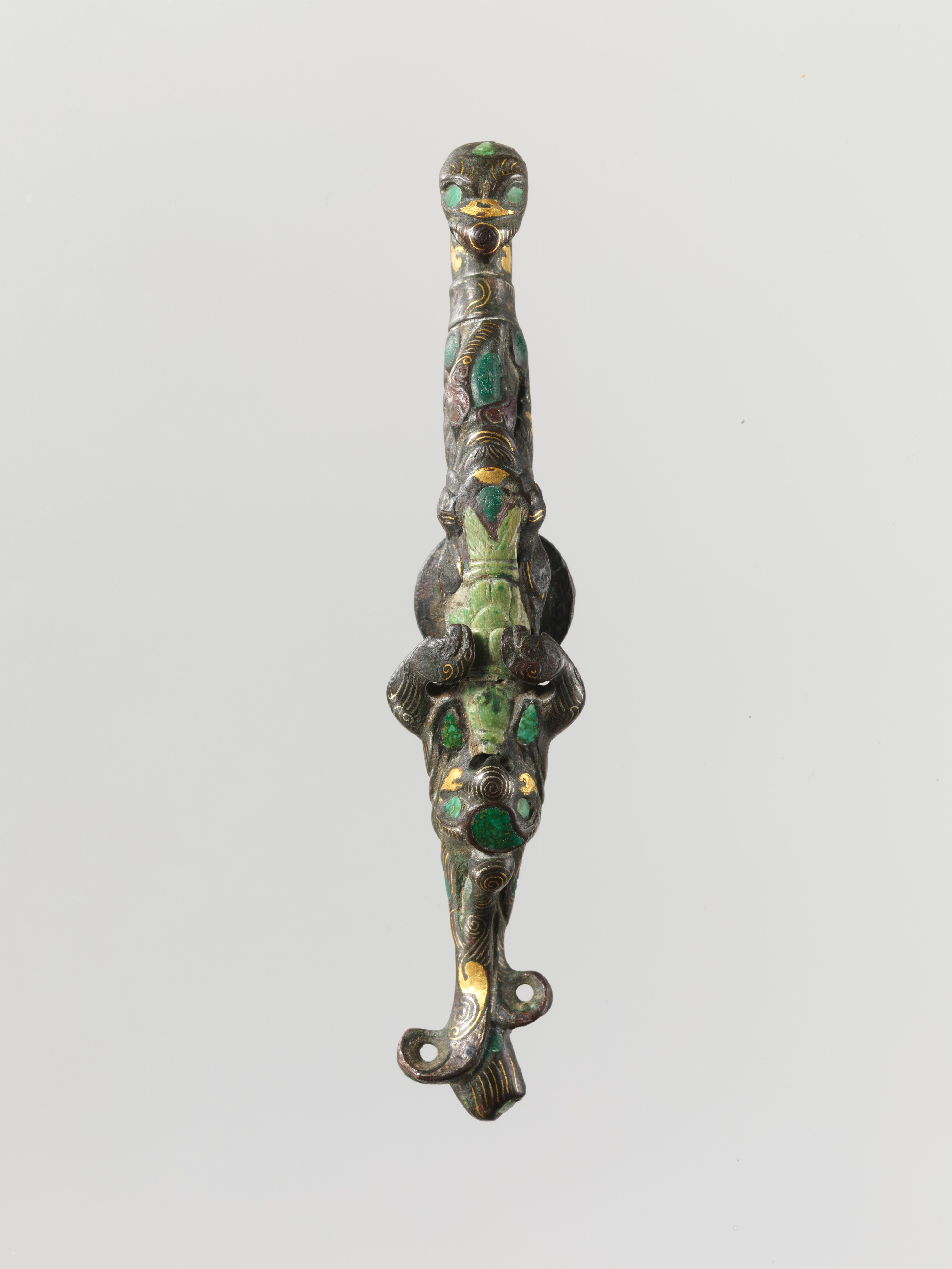
Heritage Analysis: The Chinese Belt Hook as a Strategic Luxury Artifact
Introduction: The Belt Hook as a Microcosm of Power and Prestige
The belt hook, or daigou, is a deceptively simple object that has served as a potent symbol of authority, status, and spiritual alignment in Chinese civilization for over two millennia. The specific artifact under analysis—a bronze belt hook inlaid with gold, silver, ivory, turquoise, and Paris green—represents a pinnacle of material and symbolic complexity. For Katherine Fashion Lab, this object is not merely an historical accessory; it is a strategic blueprint for 2026 high-end luxury design. This paper dissects the belt hook’s symbolic power, its role in historical adornment, its spiritual meanings, and its implications for a modern luxury strategy that prioritizes narrative depth, material mastery, and cultural resonance.
Symbolic Power: The Belt Hook as a Marker of Hierarchical Authority
In ancient China, the belt hook was far more than a functional fastener. It was a direct signifier of the wearer’s rank within the imperial and aristocratic hierarchies. The materials used in this piece—bronze, gold, silver, ivory, turquoise, and Paris green—each carry distinct symbolic weight. Bronze, the foundational metal, represents durability and ritual significance. Gold and silver denote wealth and celestial power, often reserved for the highest echelons of nobility. Ivory, sourced from elephants, symbolizes purity and rarity, while turquoise, a stone associated with heaven and earth, conveys protection and status. The inclusion of Paris green, a synthetic arsenic-based pigment developed in the 19th century, suggests a later, possibly Qing dynasty, adaptation that fused traditional motifs with imported chemical innovation, signifying a culture that absorbed and transformed foreign influences into expressions of power.
Strategically, the belt hook’s design—often featuring dragon, phoenix, or geometric motifs—reinforced the wearer’s connection to cosmic order. The dragon, a symbol of imperial authority, and the phoenix, representing grace and renewal, were not decorative choices but deliberate assertions of divine right. For Katherine Fashion Lab, this hierarchy of materials and symbols offers a template for 2026 luxury: the use of rare, ethically sourced materials combined with culturally specific iconography can elevate a product from commodity to talisman. The belt hook teaches that luxury is not about abundance but about intentional rarity and symbolic density.
Historical Adornment: The Belt Hook as an Integrated Garment System
Historically, the belt hook was an integral component of Chinese dress, particularly for men in official or ceremonial contexts. It secured the sash or belt that held robes together, and its visible placement at the waist made it a focal point for adornment. This was not a hidden accessory but a public declaration of identity. The belt hook’s size, material, and craftsmanship communicated the wearer’s social standing, profession, and even regional affiliation. For example, a jade belt hook was reserved for scholars and officials, while a bronze one inlaid with precious stones might indicate a military commander or a merchant prince.
The integration of the belt hook into the garment system highlights a key principle for modern luxury: accessories as anchors. In 2026, luxury consumers seek pieces that complete a narrative, not just an outfit. The belt hook’s role as a structural and symbolic anchor suggests that Katherine Fashion Lab should design accessories that are both functional and emblematic, serving as the linchpin of a collection’s story. The historical practice of commissioning bespoke belt hooks from master artisans further underscores the value of artisanal exclusivity—a strategy that resonates with today’s demand for craftsmanship over mass production.
Spiritual Meaning: The Belt Hook as a Conduit for Cosmic Energy
Beyond social status, the belt hook held profound spiritual significance. In Daoist and Confucian thought, the belt was associated with the dan tian, the body’s energy center located near the waist. The belt hook, therefore, was not just a clasp but a conduit for qi (life force) and a protective amulet. Turquoise, in particular, was believed to ward off evil spirits and bring good fortune. The inclusion of Paris green, a toxic pigment, might seem contradictory, but in its historical context, it was prized for its vibrant, unnatural hue, which was thought to mimic the color of jadeite and thus carry jade’s protective properties. This blending of natural and synthetic materials reflects a spiritual pragmatism—a willingness to adapt symbolism to available resources.
For a 2026 luxury strategy, the belt hook’s spiritual dimension offers a powerful differentiation. Modern consumers, particularly in high-end markets, are increasingly drawn to products that offer emotional and metaphysical value. Katherine Fashion Lab can leverage this by embedding spiritual narratives into its designs—for instance, by using gemstones with specific energetic properties or by incorporating motifs that symbolize protection, prosperity, or harmony. The belt hook’s legacy suggests that luxury is not merely about aesthetics but about energetic resonance—a quality that justifies premium pricing and fosters deep brand loyalty.
2026 High-End Luxury Strategy: Lessons from the Belt Hook
Translating the belt hook’s heritage into a 2026 luxury strategy requires a multi-faceted approach. First, material storytelling must be central. Each component of this belt hook—bronze, gold, silver, ivory, turquoise, and Paris green—tells a story of trade, technology, and taste. Katherine Fashion Lab should adopt a similar ethos, sourcing materials with documented provenance and cultural significance. For example, a modern belt hook could use recycled bronze, ethically sourced turquoise, and lab-grown gemstones, creating a narrative of sustainability without sacrificing luxury.
Second, symbolic design language must be intentional. The belt hook’s motifs were not random; they were chosen to convey specific messages. In 2026, Katherine Fashion Lab can develop a proprietary iconography—a visual vocabulary of power, protection, and prestige—that becomes instantly recognizable. This could include geometric patterns inspired by ancient Chinese cosmology or abstract forms that evoke dragon scales or phoenix feathers. The key is to create a coherent symbolic system that transcends seasonal trends.
Third, artisanal collaboration is essential. The belt hook was the product of master metalworkers, inlay specialists, and gem cutters. For 2026, Katherine Fashion Lab should partner with contemporary artisans who specialize in traditional Chinese techniques, such as filigree, cloisonné, or inlay work. This not only ensures unparalleled quality but also positions the brand as a custodian of cultural heritage—a powerful narrative in an era of cultural commodification.
Finally, exclusivity through customization mirrors the belt hook’s historical use as a bespoke item. Offering clients the opportunity to commission personalized belt hooks—selecting materials, motifs, and spiritual attributes—creates a deep emotional connection and a sense of ownership. This strategy aligns with the 2026 luxury trend toward hyper-personalization, where the product becomes an extension of the wearer’s identity.
Conclusion: The Belt Hook as a Strategic Archetype
The Chinese belt hook, in its material complexity and symbolic depth, is far more than an historical artifact. It is a strategic archetype for 2026 high-end luxury. By understanding its role as a marker of power, an integrated adornment, and a spiritual conduit, Katherine Fashion Lab can develop a product line that resonates with today’s discerning consumers. The belt hook teaches that true luxury is not about excess but about meaning—meaning embedded in material, design, and narrative. As the fashion industry moves toward a future of conscious consumption and cultural appreciation, the belt hook stands as a timeless reminder that the most valuable accessories are those that tell a story, protect a spirit, and proclaim a status that is both personal and profound.