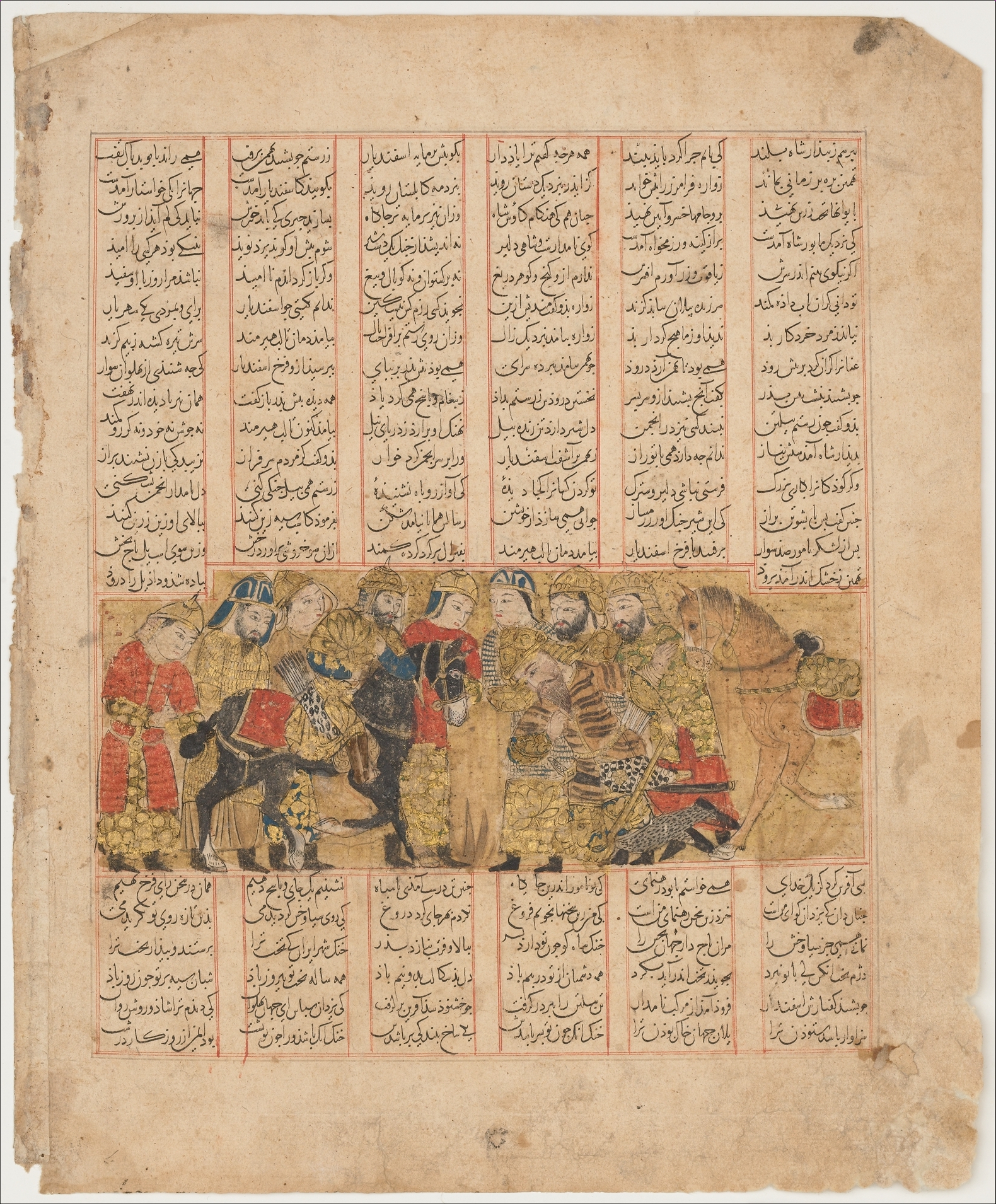
Heritage Analysis: “Rustam Pleads for Tus Before Kai Khusrau” – A Strategic Study for Katherine Fashion Lab
This heritage analysis examines the folio “Rustam Pleads for Tus Before Kai Khusrau” from the Shahnama (Book of Kings), a masterpiece of Persian manuscript illumination dated to the 14th century. Created with ink, opaque watercolor, and gold on paper, this work originates from the ancient civilization of Greater Iran, reflecting the confluence of Zoroastrian spirituality, imperial court culture, and sophisticated artistic traditions. For Katherine Fashion Lab, this folio offers unparalleled symbolic, historical, and spiritual resources that can be strategically deployed to inform a 2026 high-end luxury strategy rooted in narrative depth, cultural authority, and transcendent beauty.
Symbolic Power: Sovereignty, Intercession, and Moral Authority
The Iconography of Royal Pleading
The composition centers on Rustam, the legendary hero, kneeling before the young king Kai Khusrau. Rustam’s posture—one knee bent, head bowed, hands extended—is a masterclass in symbolic power. In ancient Persian court protocol, such a gesture signified submission to divine kingship while simultaneously asserting the pleader’s own heroic status. The folio captures a moment of moral tension: Rustam, the invincible warrior, must humble himself to save his rival Tus. This visual narrative encodes a hierarchy of virtues—loyalty, humility, and justice—that transcend mere political power.
For Katherine Fashion Lab, this symbolic dynamic offers a lexicon for luxury branding. The act of pleading, rendered with gold halos and intricate robes, transforms vulnerability into a form of elevated grace. In 2026, high-end consumers increasingly seek brands that embody ethical complexity and emotional intelligence. The folio suggests a design language where power is expressed through restraint, where opulence serves narrative rather than mere display. A luxury collection inspired by this scene could feature draped silhouettes that mimic Rustam’s supplication, using gold-thread embroidery to highlight moments of humility and intercession.
Cosmic Kingship and the Hero’s Dilemma
Kai Khusrau, seated on a throne elevated by celestial motifs, represents divine right rooted in Zoroastrian cosmology. His gaze is both stern and compassionate, embodying the farr (divine glory) that legitimizes rule. The folio’s gold-ground background is not mere decoration; it signifies the timeless realm of myth where earthly actions resonate with cosmic consequences. Rustam’s plea is thus a negotiation between mortal error and divine order—a theme that resonates deeply with contemporary luxury’s turn toward meaning-driven consumption.
Strategic application: A 2026 capsule collection could reference the farr through a signature “halo” motif in gold leaf or luminous silk, framing the wearer as both powerful and accountable. The color palette—deep lapis lazuli, vermillion, and burnished gold—can be translated into exclusive pigment-based fabrics, each hue carrying symbolic weight: blue for wisdom, red for sacrifice, gold for transcendence.
Historical Adornment: Textiles, Armor, and Regalia as Status Scripts
Robes of Authority and Identity
The folio meticulously renders the garments of Rustam and Kai Khusrau. Rustam wears a brocade tunic with geometric medallions, a leather belt, and a fur-lined cloak—emblems of his nomadic warrior heritage. Kai Khusrau is draped in a long, flowing robe of silk, patterned with arabesques and bordered with calligraphic inscriptions. These textiles are not arbitrary; they encode social rank, regional origin, and spiritual alignment. The use of gold thread in both figures’ attire signals their proximity to the divine, while the contrast between Rustam’s practical armor and the king’s ceremonial silk underscores the tension between action and contemplation.
For Katherine Fashion Lab, this offers a historical blueprint for textile storytelling. In 2026, luxury clients crave garments that tell a story of provenance and purpose. By studying the folio’s garment construction—layered tunics, wrapped sashes, and embroidered borders—the lab can develop a “Shahnama Silhouette” that reimagines historical cuts for modern wear. Key details include asymmetrical draping, high-waisted belts, and inscription-inspired embroidery that personalizes each piece with Persian poetry or protective symbols.
Armor and Adornment: The Hero as Relic
Rustam’s tiger-skin cloak and jewel-studded mace are more than weapons; they are relics of mythic lineage. Every element of his adornment—from the feathered headdress to the engraved greaves—references specific episodes in the Shahnama. This narrative adornment transforms the hero into a walking archive of cultural memory. Similarly, Kai Khusrau’s crown, with its tiered pearls and emeralds, is a microcosm of cosmic order: seven jewels for the seven planets, three tiers for the three realms (earth, sky, underworld).
Luxury strategy: A 2026 jewelry line could draw directly from this iconography, offering “episode-specific” pieces—a ring representing Rustam’s mace, a necklace echoing the king’s planetary crown. Each piece would come with a digital heritage certificate linking it to the folio’s story, appealing to the collector mentality of high-net-worth individuals. The use of recycled gold and ethically sourced gemstones would align with sustainability trends while respecting the original materials’ sanctity.
Spiritual Meaning: Zoroastrian Dualism and the Ethics of Luxury
The Cosmic Battle Within the Frame
Beneath the political drama, the folio encodes Zoroastrian spiritual principles: the eternal struggle between asha (truth) and druj (falsehood). Rustam’s plea is a test of moral rectitude—he must overcome personal pride for the greater good. Kai Khusrau’s judgment reflects the daena (inner conscience) that guides righteous kings. The gold ground, often interpreted as divine light, bathes the scene in a transcendent glow, suggesting that earthly decisions are witnessed by the celestial realm.
For modern luxury, this spiritual layer offers a counter-narrative to materialism. A 2026 strategy can position Katherine Fashion Lab as a curator of ethical opulence, where every garment or accessory is a tool for self-cultivation. The folio’s dualism inspires a design philosophy of contrast and balance: light versus shadow, structure versus fluidity, tradition versus innovation. Collections could be organized around themes like “Truth and Illusion,” using reversible fabrics or hidden embellishments that reveal deeper meanings upon closer inspection.
Ritual and Transcendence in Adornment
In ancient Persia, dressing for court was a ritual act that aligned the wearer with cosmic order. The folio’s figures are not merely clothed; they are enshrined in garments that prepare them for divine encounter. This spiritual dimension is crucial for 2026 luxury, where consumers seek transformative experiences rather than static products. Katherine Fashion Lab can develop a “Ritual Collection” that includes dressing ceremonies, scented fabrics, and meditative design cues—such as hidden pockets for prayer beads or gold-thread mantras sewn into hems.
The folio’s use of opaque watercolor—a medium that layers translucent pigments to create depth—can inspire a textile technique of layered organza and silk, evoking the spiritual journey from opacity to illumination. This aligns with the 2026 trend toward slow luxury and craftsmanship as meditation.
2026 High-End Luxury Strategy: Narrative Sovereignty and Cultural Capital
Positioning Katherine Fashion Lab as a Heritage Storyteller
In 2026, the luxury market will be defined by narrative sovereignty—brands that own authentic, deep-rooted stories will command premium pricing and loyalty. The “Rustam Pleads for Tus” folio provides a proprietary cultural asset that cannot be replicated. Katherine Fashion Lab should position itself as the custodian of Persian heritage, offering limited-edition pieces that are directly inspired by museum-grade artifacts. Each collection should include a curatorial essay and digital provenance linking designs to specific folio details.
Product Architecture: From Folio to Fashion
The following strategic product categories can be developed from this analysis:
1. Haute Couture Gowns: Draped silk with gold-thread calligraphy, echoing Kai Khusrau’s royal robe. Each gown features a “pleading sleeve” that cascades asymmetrically, referencing Rustam’s posture.
2. Armor-Inspired Outerwear: Structured jackets with embossed leather medallions and tiger-skin patterns, reinterpreted in sustainable vegan materials. Hidden pockets for talismanic objects.
3. Jewelry as Narrative Relics: Cuff bracelets engraved with scenes from the Shahnama, rings set with seven gemstones for cosmic alignment, and necklaces with detachable pendants representing the “crown of justice.”
4. Home Fragrance and Textiles: Scented candles with notes of frankincense, myrrh, and saffron, inspired by Zoroastrian fire temples. Silk scarves printed with the folio’s composition, framed by gold-leaf borders.
Marketing and Consumer Experience
The 2026 strategy must emphasize exclusivity through education. Katherine Fashion Lab can host private viewings of the original folio in partnership with museums, offering clients a heritage immersion before product launches. Digital campaigns should use augmented reality to overlay the folio’s symbols onto garments, allowing consumers to “unlock” hidden meanings. A <